Fact: schools operate on limited resources. It would simply be fantabulous if schools could offer every co-curricula activity (CCA) under the sun, from Aiki-do to Zookeeping, but how can a school apportion its annual budget to keep every activity functioning? Should it be fair and allocate an equivalent amount of cash to every CCA? That'll cater to lots of interests, of course, but a pie can only be sliced so thin before each slice becomes meaningless.
Every CCA has its demands: equipment, attire, and training, for example -- none of which comes cheap. And contrary to popular belief, even schools are not exempt from paying for such, despite our lofty purpose of Educating the Young. So yes, unfortunately schools are also subject to the laws of supply and demand when it comes to allocating resources.
It's simple economics. Supplies and resources get channeled to where demand is highest. How do we determine how much demand there is for a CCA? The question goes back to the students: how badly do you want it? Will you put yourselves on the line, train hard every day, learn the skills to improve yourselves one game at a time, and leave a legacy that will inspire your juniors to press on with your passion once you've advanced to a new division? These are the CCAs that deserve the support of the school which will gladly pay to keep such passion alive year after year. These are the types of CCAs that companies willingly sponsor because they embody the values that the sponsors wish to be associated with. Such CCAs never run out of resources.
What of the other students who may have the interest, but lack the will rise to the top of their game? Or those who just want to play "for fun" not for glory? To these students, honestly, what do they need the school's resources for? There's no point for the school to provide them with professional grade equipment and training if they're just looking forward to a private game of tiddlywinks after class. If they're not embarrassed, I would be.
If students really want to play for fun, they can buy their own cheap stuff, improvise their own play space, organize their own games and play till their hearts' content. That's fun. Nearly any activity can be had with the minimum of resources and a modicum of ingenuity without having to waste precious resources if fun is all you want out of it.
Some people think schools are like Santa Claus, happily distributing toys to all the good little boys and girls. Get real. School is limited, more like a toy box. It may contain great toys or crappy, broken toys, mostly a mix of both. And yet, it doesn't matter because whatever toy in whatever condition you pull out of the box, a real kid will still be able to have fun with it. Perhaps our kids have forgotten how to be kids?
Monday, March 03, 2008


Sunday, March 02, 2008
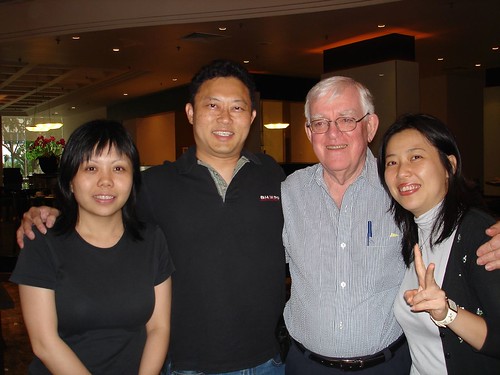 The Yorkies of S'pore met once again after a long break of, uh, a few years. Think our old Alma Mater must have got worried and sent down Prof Gerry (3rd from left) to see if any of us were still alive down here.
Fortunately, not only were we alive, but we were also hungry. Tempt us with a bit of food and we'll come running, no questions asked. We descended upon the White Rose Cafe, York Hotel (where else?) for quite a decent high tea.
Joyce had pre-arranged to meet me and Cat here, and we got to make some new friends from among our junior Alumni as well.
 There was no formal agenda apart from the eating and table-hopping. It was nice to talk to people again about how much the old campus has changed, how the weather is still as gorgeous as I remember (yes, -20 below has a certain charm to those who've survived through seasons of flaky skin and chapped lips), and how we would never have returned if we had found gainful employment there.
I could have been part of the brain drain, I admit, but then if I didn't go in the first place, I may not even have discovered I had a brain to drain. Um, I do, don't I?
Saturday, March 01, 2008
It's our society's own fault that people put off having kids till "later". Biologically, we are quite capable of reproducing in our teenage years, but society tells us that we aren't ready then. We're not (psychologically) mature enough, not financially secure enough, not socially stratified enough to bring a new life into the world, and we believe it. In fact, so many of us believe it so strongly that we still believe it well past our 40s when the peak our our hill looms just an Ollie away. We're not ready, we haven't got the money, we still have dreams we want to pursue that will presumably get us out of this social rut we're in before Baby ("Wah! Wah!", not "ooh, baby...!") ties us down irrevocably, once and for all.
It's society's rules that we have to get an education, get a job, get a mortgage, get insurance, pay taxes and do our part as a consumer of resources before we're considered responsible enough to bring forth offspring. If we strictly follow these rules, we'll never get to spawn at all as we'll never have enough personal security to know when we have met the prerequisites.
No wonder teens act up the way they do. They are physically mature but society keeps them immature with a brick wall comprising rules, norms and expectations that stands in their path. The collision is seldom pretty. Teens wonder why their parents/teachers/authority figures are so stupid; their parents et al, wonder what past sins they are being punished for. What a mess.
Which is why Juno is such a fortunate pregnant teen. Her friends and family take her shocking news with stoic resignation, then put their full support behind her decision to carry her baby to term. Instead of seeing the situation as the end of the world, they see more excitement in the potential for new life.
Despite the mistake she has made with her social timing, Juno is never alone in her predicament, nor made to feel guilty about keeping her baby even though she is still attending school. While she still gets stares from strangers and schoolmates who make fun of her, the people that matter to her continue to shower her with love and encouragement, making her burden just that little easier to bear.
Teenage pregnancy is no laughing matter, no matter the light treatment the movie gives it. Prevention is still better than cure, but if regardless of our best efforts as caregivers and it happens, it would be wonderful if the family just deals with the situation instead of making it worse through blame and recrimination.
Ultimately, it's Juno's courage, her commitment to do the right thing, her strength of character and her intelligence that salvages a bad situation and make it work for the greater good. Juno's a lovely character and a totally watchable movie if just a touch idealistic.
It's society's rules that we have to get an education, get a job, get a mortgage, get insurance, pay taxes and do our part as a consumer of resources before we're considered responsible enough to bring forth offspring. If we strictly follow these rules, we'll never get to spawn at all as we'll never have enough personal security to know when we have met the prerequisites.
No wonder teens act up the way they do. They are physically mature but society keeps them immature with a brick wall comprising rules, norms and expectations that stands in their path. The collision is seldom pretty. Teens wonder why their parents/teachers/authority figures are so stupid; their parents et al, wonder what past sins they are being punished for. What a mess.
Which is why Juno is such a fortunate pregnant teen. Her friends and family take her shocking news with stoic resignation, then put their full support behind her decision to carry her baby to term. Instead of seeing the situation as the end of the world, they see more excitement in the potential for new life.
Despite the mistake she has made with her social timing, Juno is never alone in her predicament, nor made to feel guilty about keeping her baby even though she is still attending school. While she still gets stares from strangers and schoolmates who make fun of her, the people that matter to her continue to shower her with love and encouragement, making her burden just that little easier to bear.
Teenage pregnancy is no laughing matter, no matter the light treatment the movie gives it. Prevention is still better than cure, but if regardless of our best efforts as caregivers and it happens, it would be wonderful if the family just deals with the situation instead of making it worse through blame and recrimination.
Ultimately, it's Juno's courage, her commitment to do the right thing, her strength of character and her intelligence that salvages a bad situation and make it work for the greater good. Juno's a lovely character and a totally watchable movie if just a touch idealistic.
It's Chinese Drama Night on campus again. Tonight's performance of the White Cloud Gang was for the first time a feature-length production rather than the usual double or triple bill.
The plot involves a cursed Chinese hairpin imbued with unholy power by a vengeful butterfly spirit bent on bringing down a dynastic kingdom over the emperor's indiscretions with her. The curse is so potent and so transcendant across time and space that disaster befalls the present-day family and friends of a teenaged girl who happens to find the ancient hairpin while on a camping trip.
It really is thanks to Amy that I've got the plot figured out this far. With the absence of in-house subtitles, Amy kept a running translation of dialogue and situation for me so I wouldn't feel too far behind.
A couple of observations: performers seemed very anxious to leave the stage -- before the scene has had time to build, it was over as there was no one left onstage to engage the situation. As a result, the occurrences and encounters offstage often appeared more interesting than what was happening onstage. Too bad all the characters tended to be so conflict averse. Lots of spicy details could have come out if the characters had interacted with one another more, but everyone was just too much in a hurry to leave in a huff instead.
Also, too many unnecessary scene changes in long blackouts. There were fewer and faster blackouts this year, but still... The kids who write these scripts tend to write as though they are producing TV drama in which a quick cut can warp time and space in an instant. This convention does not work for theatre with a 'live' audience, obviously.
Wonder what people are going to think of our Eunuch Admiral play in April? Chances are, the audience will be just as confused.
The plot involves a cursed Chinese hairpin imbued with unholy power by a vengeful butterfly spirit bent on bringing down a dynastic kingdom over the emperor's indiscretions with her. The curse is so potent and so transcendant across time and space that disaster befalls the present-day family and friends of a teenaged girl who happens to find the ancient hairpin while on a camping trip.
It really is thanks to Amy that I've got the plot figured out this far. With the absence of in-house subtitles, Amy kept a running translation of dialogue and situation for me so I wouldn't feel too far behind.
A couple of observations: performers seemed very anxious to leave the stage -- before the scene has had time to build, it was over as there was no one left onstage to engage the situation. As a result, the occurrences and encounters offstage often appeared more interesting than what was happening onstage. Too bad all the characters tended to be so conflict averse. Lots of spicy details could have come out if the characters had interacted with one another more, but everyone was just too much in a hurry to leave in a huff instead.
Also, too many unnecessary scene changes in long blackouts. There were fewer and faster blackouts this year, but still... The kids who write these scripts tend to write as though they are producing TV drama in which a quick cut can warp time and space in an instant. This convention does not work for theatre with a 'live' audience, obviously.
Wonder what people are going to think of our Eunuch Admiral play in April? Chances are, the audience will be just as confused.
Friday, February 29, 2008
 Baggy's leaving on a two year vacation, following her hubby's latest job posting. Her bags are packed and she's almost ready to go live the life of a Sydneysider taitai (lady of leisure).
Boss ladies, Cynth, Jo and Amy sponsored the Bon Voyage cake to conclude our department meeting (left).
Now that Baggy's gone, I believe I'm the last one left of the staff that
 Still, amongst friends, a small group of us -- who could spare the time -- took Baggy out for a farewell chix rice lunch. Even Vays dropped back in from maternity to join us.
The pix (left) was supposed to be the beginning of a longer series of farewell lunch pix, but I was thinking of my stomach first as usual, and carelessly left my cam in M2 while we ate. Duh.
Oh, well. Bye, bye, Baggy!
Wednesday, February 27, 2008
Got family in England riding out the big quake. The following is a mass email from our Mancurian colony, basically telling family here that everyone's still ok, not to worry:
"I thought you would like to know that it lasted for awhile, was 5.2 on the Richter scale and it felt like there was an elephant under the bed. I thought the cats were having a fight on the bed and almost shouted at them until Dan said it was probably an earthquake. The house then spent the next half an hour settling down, with much creaking and groaning of pipes. The in-laws, who were pretty much near the epicentre of the quake slept through the thing... I ask you? Poppy is convinced that the trampoline has walked off the patio onto the surrounding gravel...hmmm. Ok. end of excitement. Now I need some sleep."
Good idea.
Meantime, despite the number of nasty shocks Indonesia's had in the last few weeks and predictions of the "big one" yet to come, CalTech quake expert, Prof K Sieh, assures us that 'tectonically, Singapore's possibly one of the safest places on Earth.'
Good to know.
"I thought you would like to know that it lasted for awhile, was 5.2 on the Richter scale and it felt like there was an elephant under the bed. I thought the cats were having a fight on the bed and almost shouted at them until Dan said it was probably an earthquake. The house then spent the next half an hour settling down, with much creaking and groaning of pipes. The in-laws, who were pretty much near the epicentre of the quake slept through the thing... I ask you? Poppy is convinced that the trampoline has walked off the patio onto the surrounding gravel...hmmm. Ok. end of excitement. Now I need some sleep."
Good idea.
Meantime, despite the number of nasty shocks Indonesia's had in the last few weeks and predictions of the "big one" yet to come, CalTech quake expert, Prof K Sieh, assures us that 'tectonically, Singapore's possibly one of the safest places on Earth.'
Good to know.
Monday, February 25, 2008
Matters of the heart are clear-cut and simple for the S'pore male, if what we read in the Sunday Times is true. How does a S'pore guy know when a S'pore gal likes him? He gets the privilege of paying for her meals, opening her doors, and carrying her handbags and shopping bags. If he's really lucky, he even gets to see where she lives when he deposits her at her front door after being entertaining, charming and generous with her during their romantic date.
It's also equally clear that when S'pore gal goes out of her way to make S'pore guy feel special, to cater to what the guy really wants without him having to work too hard for it, and even allow him to entertain the illusion that he might actually be interesting, witty and desirable, the warning bells of our more aware males clang with the intensity of a paranoiac Peter Parker's spider sense. If it's too good to be true, it probably is. Beware the "honey trap", set by the real girlfriend, baited by a fraud.
Whether the guy passes the "honey trap" test or not, the result is pretty much the same. The relationship has come to an end. If the sting is successful, she gains sufficient evidence to prove that the split was not her idea. If unsuccessful, it's still a clear signal to him that she doesn't want him to carry her stuff, open her doors and drop her off at home any more. Think of it as the ultimate going-away pressie: after he has spent so much on the dating, it's only fair that she spends an equivalent amount on the break-up.
It's unsurprising then that good ol' boy, Edison Chen, wants to quit showbiz in HK. It'll be so much more lucrative conductingdating motivational workshops for the hapless S'pore male. :P
It's also equally clear that when S'pore gal goes out of her way to make S'pore guy feel special, to cater to what the guy really wants without him having to work too hard for it, and even allow him to entertain the illusion that he might actually be interesting, witty and desirable, the warning bells of our more aware males clang with the intensity of a paranoiac Peter Parker's spider sense. If it's too good to be true, it probably is. Beware the "honey trap", set by the real girlfriend, baited by a fraud.
Whether the guy passes the "honey trap" test or not, the result is pretty much the same. The relationship has come to an end. If the sting is successful, she gains sufficient evidence to prove that the split was not her idea. If unsuccessful, it's still a clear signal to him that she doesn't want him to carry her stuff, open her doors and drop her off at home any more. Think of it as the ultimate going-away pressie: after he has spent so much on the dating, it's only fair that she spends an equivalent amount on the break-up.
It's unsurprising then that good ol' boy, Edison Chen, wants to quit showbiz in HK. It'll be so much more lucrative conducting
Sunday, February 24, 2008
Propaganda doesn't look like propaganda if you present it as a hilarious satire. In the DS Dollies' History of S'pore, few sacred cows survive intact by the end of the show. Every S'porean's pet peeves get some air time -- en bloc woes, personal taxation, parking enforcement, neighbourly relations, even the issue of ministers' salaries, all dressed in an amazing variety of colourful costumes, set to catchy beats and slick dance numbers, and slain upon the altar of uproarious, raunchy comedy.
The DS Dollies themselves are wonderfully energetic and versatile with their characters. With quick-change costumes and accents, they play a roughly chronogical series of vignettes involving a multitude of our favourite historical working-class stereotypes (and the occasional world leader). From pirates of the high seas, to the women entrepreneurs of the leisure and entertainment industry, to the samsui women, to the colour-blind kampong aunties, we get the sense that our current concerns are nothing new. Like we do today, our predecessors too could have faced rising costs, unsympathetic public officials, unequal income distribution between the leadership in comparison with everyone else.
As the sacred cows fall one by one, oddly enough we discover that it isn't unpatriotic to air our worries in public, or to laugh and poke fun at ourselves and our foibles. By the end of the show, we audience members are singing along with the Dollies' renditions of national songs, many of us waving our national flags (they handed each of us one during the interval) in time with the music. Despite our grouses about life in S'pore, we are still proud to be S'poreans.
But most of all, we're proud that even growing up in "straitlaced" S'pore, there's still enough homegrown talent to create the music, dance and comedy that make the DS Dollies franchise such a success.
The DS Dollies themselves are wonderfully energetic and versatile with their characters. With quick-change costumes and accents, they play a roughly chronogical series of vignettes involving a multitude of our favourite historical working-class stereotypes (and the occasional world leader). From pirates of the high seas, to the women entrepreneurs of the leisure and entertainment industry, to the samsui women, to the colour-blind kampong aunties, we get the sense that our current concerns are nothing new. Like we do today, our predecessors too could have faced rising costs, unsympathetic public officials, unequal income distribution between the leadership in comparison with everyone else.
As the sacred cows fall one by one, oddly enough we discover that it isn't unpatriotic to air our worries in public, or to laugh and poke fun at ourselves and our foibles. By the end of the show, we audience members are singing along with the Dollies' renditions of national songs, many of us waving our national flags (they handed each of us one during the interval) in time with the music. Despite our grouses about life in S'pore, we are still proud to be S'poreans.
But most of all, we're proud that even growing up in "straitlaced" S'pore, there's still enough homegrown talent to create the music, dance and comedy that make the DS Dollies franchise such a success.
Saturday, February 23, 2008
Went to Kum Kum's wake a day later than my fellows had planned. June was busy and I did not wish to meet my long-lost school chums unaccompanied.
After all these years, apart from the moustache he sports, he didn't look all that different from the guy who sat behind me in our last two years of secondary school. Our inquiry revealed that he'd been battling liver cancer for a year already and had finally succumbed.
Guess he wasn't particularly inspired by our nickname for him, so for his official fighter jock callsign he answered to 'Mongol'.
So, to the 'Mongol' whose dreams of flying became reality in life, now the sky's no limit.
After all these years, apart from the moustache he sports, he didn't look all that different from the guy who sat behind me in our last two years of secondary school. Our inquiry revealed that he'd been battling liver cancer for a year already and had finally succumbed.
Guess he wasn't particularly inspired by our nickname for him, so for his official fighter jock callsign he answered to 'Mongol'.
So, to the 'Mongol' whose dreams of flying became reality in life, now the sky's no limit.
Took 12 J2s to the big general knowledge quiz at the national uni. There was a record-breaking number of teams participating this year with more institutions fielding more teams. The teams sat through the preliminary round in which each member had to complete a pencil-and-paper multiple-choice quiz comprising 50 questions. The top three teams with the highest team totals went on to entertain everyone else in the final round held in the afternoon.
The finals was vastly more entertaining than the preliminaries. The three teams representing AC, JJ and R, had to answer time-limited questions in three separate rounds. The first was a multiple-choice with no penalty for wrong answers. The second was a true-false with penalties for wrong answers. The third and last round was a Jeopardy-like game with opportunities to double points for correct answers, be penalized for wrong answers, and to shunt questions to a rival team hoping they don't answer correctly and threrby lose points accordingly.
Arch-rivals, AC and R kept 'sabo-ing' each other, leaving JJ virtually unscathed through the final round. In their all or nothing game, AC emerged victorious while R came off worst. JJ happily accepted second place, though not to take anything away from their performance as they answered their questions correctly when it counted.
Wonder if we could run a similar contest on campus among the CTs? It could make for a fun and educational Assembly session.
The finals was vastly more entertaining than the preliminaries. The three teams representing AC, JJ and R, had to answer time-limited questions in three separate rounds. The first was a multiple-choice with no penalty for wrong answers. The second was a true-false with penalties for wrong answers. The third and last round was a Jeopardy-like game with opportunities to double points for correct answers, be penalized for wrong answers, and to shunt questions to a rival team hoping they don't answer correctly and threrby lose points accordingly.
Arch-rivals, AC and R kept 'sabo-ing' each other, leaving JJ virtually unscathed through the final round. In their all or nothing game, AC emerged victorious while R came off worst. JJ happily accepted second place, though not to take anything away from their performance as they answered their questions correctly when it counted.
Wonder if we could run a similar contest on campus among the CTs? It could make for a fun and educational Assembly session.
Friday, February 22, 2008
Bowling alleys. How hard can it be to find one to train in during the late afternoon/early evening hours? Yishun SAFRA fully booked for school tournament. CSC fully booked for school training. Star Bowl closed for a complete overhaul, reopening in July or thereabouts. My last resort was Marine Bowl, ECP, which had some vacant lanes at last.
Marine Bowl boasts the most basic of electronic scoring systems. The pin sweeper is wobbly and the setter occasionally loses a pin on the second roll. The lanes are narrower and shorter than any I've ever bowled in. But because the pins are packed a little more tightly together, it's a great place to rack up some easy strikes.
Bowling here can be quite an ego boost as the pins go down quite easily as long as the ball stays roughly on course down centre. Check out the scores of my three game series: 148, 212, 159. Now, that's a forgiving lane!
Marine Bowl boasts the most basic of electronic scoring systems. The pin sweeper is wobbly and the setter occasionally loses a pin on the second roll. The lanes are narrower and shorter than any I've ever bowled in. But because the pins are packed a little more tightly together, it's a great place to rack up some easy strikes.
Bowling here can be quite an ego boost as the pins go down quite easily as long as the ball stays roughly on course down centre. Check out the scores of my three game series: 148, 212, 159. Now, that's a forgiving lane!
Thursday, February 21, 2008
Just got word of the demise of an old school chum of mine. From his obituary, it seems he was an air force pilot of both fighters and unmanned aerial reconnaissance craft. No idea what happened to him, so I'll probably find out... if I decide to attend the wake tomorrow.
I'll just immortalize this story of him here: When we were classmates in lower secondary school, there was a cartoon on TV called Kum Kum. We nicknamed my friend after this character because they shared a similar name. One day, he got in trouble with our lit teacher who hauled him up in front of the class and gave him an earful. Thinking the tirade was over, my friend turned to walk back to his seat. But, no, our teacher wasn't finished. She stretched out a hand at him and called him back, "Come come!" I doubt she ever knew the reason why the class dissolved into hilarity at that.
I'll just immortalize this story of him here: When we were classmates in lower secondary school, there was a cartoon on TV called Kum Kum. We nicknamed my friend after this character because they shared a similar name. One day, he got in trouble with our lit teacher who hauled him up in front of the class and gave him an earful. Thinking the tirade was over, my friend turned to walk back to his seat. But, no, our teacher wasn't finished. She stretched out a hand at him and called him back, "Come come!" I doubt she ever knew the reason why the class dissolved into hilarity at that.
Wednesday, February 20, 2008
The dog and bunny detectives never fail to amuse me. Sam and Max are into Season 2 Episode 3. This time the case involves returning the undead -- zombies; an emo goth vampire; and his Frankenstein monster -- back from whence they came.
For all the cartoon violence that has been a trademark of the Sam & Max franchise, this episode actually deals with death, though in its own loopy cornball fashion. Let's just say the undead in this universe aren't so bad once you get to know them.
As usual, as with any other point-and-click adventure game, there is a mix of easy puzzles and obscure head-scratchers, though for the latter, the solutions are usually quite 'duh' once you figure out that the game leaves ample clues to indicate what you should do next. The challenge is in seeing the connections, which usually fall into place only after lots of random clicking on-screen.
The one great moment in the game for me is in the exchange between the monster and Max. The monster tells his woeful tale of being the only one of his kind... alone, so dreadfully alone; "no one to confide in, no one to love," to which Max astutely replies, "No one to smack you and tell you to get over yourself already!" If Max wasn't the psychotically violent half of the "freelance police", he'd make a wonderful psychotherapist.
For all the cartoon violence that has been a trademark of the Sam & Max franchise, this episode actually deals with death, though in its own loopy cornball fashion. Let's just say the undead in this universe aren't so bad once you get to know them.
As usual, as with any other point-and-click adventure game, there is a mix of easy puzzles and obscure head-scratchers, though for the latter, the solutions are usually quite 'duh' once you figure out that the game leaves ample clues to indicate what you should do next. The challenge is in seeing the connections, which usually fall into place only after lots of random clicking on-screen.
The one great moment in the game for me is in the exchange between the monster and Max. The monster tells his woeful tale of being the only one of his kind... alone, so dreadfully alone; "no one to confide in, no one to love," to which Max astutely replies, "No one to smack you and tell you to get over yourself already!" If Max wasn't the psychotically violent half of the "freelance police", he'd make a wonderful psychotherapist.
Tuesday, February 19, 2008
Finally gathered enough people together to throw Mel a seriously belated birthday lunch. We made up a table for 12 (including Linc who made a special guest appearance), occupying the entire bank of tables along the side wall.
The prices at Friends have increased quite a bit. What helped is that with HP's membership privilege, we got a 1-for-1 deal for every Executive Set Lunch we ordered. For those less mathematically inclined, if we had ordered 12 sets, we would have only paid for 6.
For $29 something +++ per Exec Set, we got a soup du jour (the fates arranged that today's soup combined two of Mel's fave things: soup and broccoli); a choice of lasagna, hamburger steak or sea bass; dessert which turned out to be carrot cake; and a choice of hot beverage.
The prices at Friends have increased quite a bit. What helped is that with HP's membership privilege, we got a 1-for-1 deal for every Executive Set Lunch we ordered. For those less mathematically inclined, if we had ordered 12 sets, we would have only paid for 6.
For $29 something +++ per Exec Set, we got a soup du jour (the fates arranged that today's soup combined two of Mel's fave things: soup and broccoli); a choice of lasagna, hamburger steak or sea bass; dessert which turned out to be carrot cake; and a choice of hot beverage.
Sunday, February 17, 2008
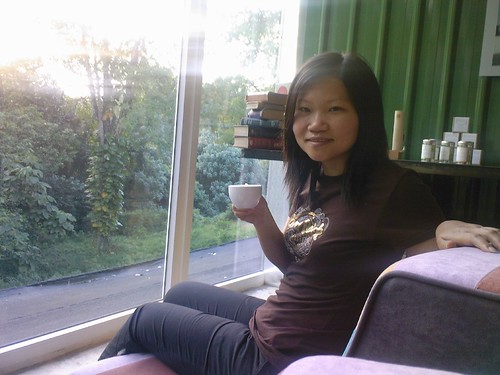 To avoid the V-Day crowds, we held back till today to use the Spa Esprit@House vouchers I gave June for Christmas. She could have used them for one glorious afternoon of personal pampering, but she chose to buy a single treatment for each of us instead.
Spa Esprit@House is one of the big tenants of Dempsey House, occupying one whole floor of differently themed massage rooms and relaxing corners for tea and light reading. The set-up is modern and professional, and the rooms give a calming sense of privacy as they overlook the secondary forest area of Dempsey Hill.
We both opted for the 'Hot Stone' massage which fully focused on the back, neck, shoulders and limbs... whatever was accessible without having to flip us over on the table. Having slept badly the night before, I was grateful for the extra attention I got for the crick in my neck I'd been nursing all day. While the massage didn't make the pain go away entirely, at least it got soothed down some.
The massage was mostly the application of rolling pressure to the muscles. With the application of some wood-scented essential oil, ginger and black pepper, after a while I felt like pastry being prepared as piecrust. There was an odd disconnect between mind and body -- about halfway through the treatment I couldn't tell if I was awake or not. Mind in beta, body in alpha, a pleasantly weird sensation.
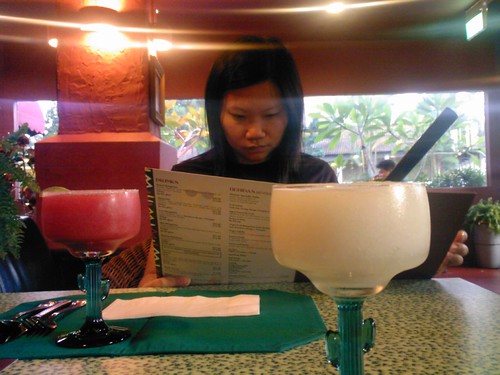 After a relaxing rub-down, it was dinner at Margatita's. I had no idea what I was in for when I ordered the lamb shank. I got two huge, meaty bones of stewed lamb with tortillas on the side. June ordered the mixed fajitas, chix and beef served on a sizzling hot plate. There was so much in just these two dishes, we couldn't get everything down. Way too full for the Ben & Jerry's we had planned on.
Next time, we'll split one main course and top up with a couple of starters and dessert. Or work out a solid week beforehand.
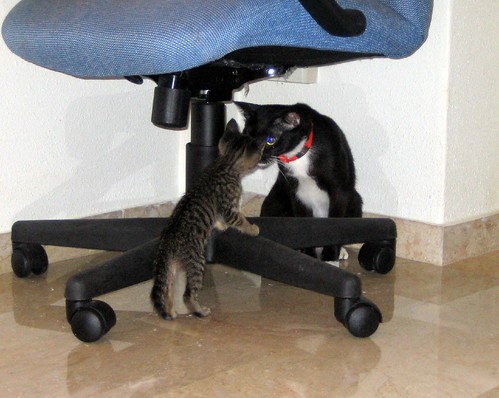
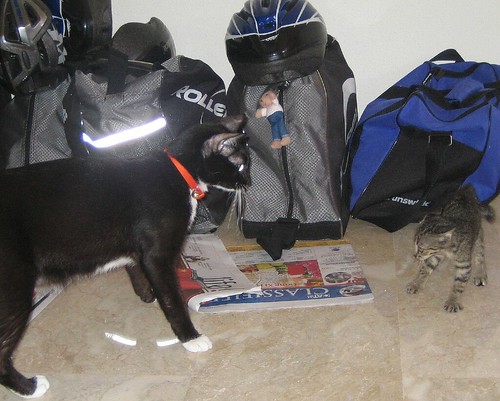
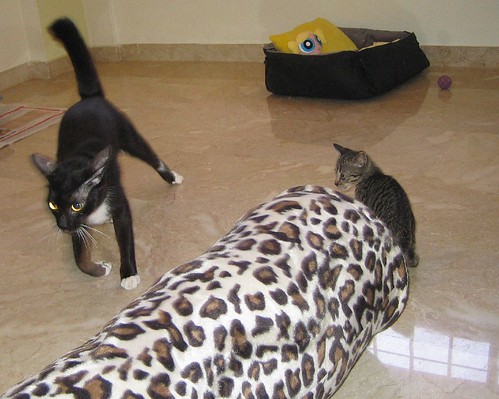
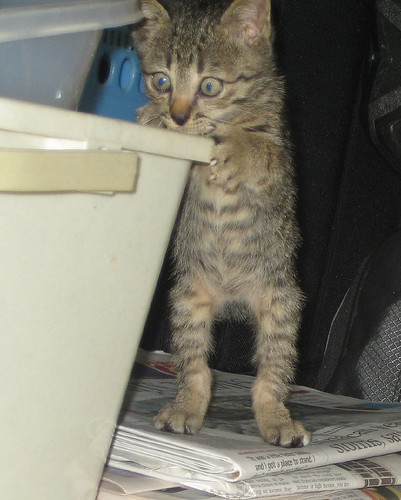
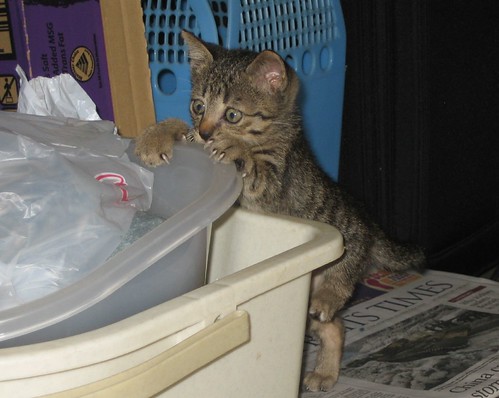
Off topic: Anyone looking for more kitten pix? Got a couple of new shots over on Flickr.
Pegging pay to performance is a contentious issue for the education industry. Facing a shortage of teaching professionals, the US has begun debating this idea to as means to attract and retain good staff. Attracting talent is not so much a problem. Wave enough money around and potential workers will line up around the block to submit an application. It's sort of like chumming the waters to bring the fish to a boat. But without appropriate tackle, hooking and landing the big fish is going to be a much more difficult proposition.
We need a better analogy to understand how the human resource of our industry works. How about a well kept aquarium instead, with a diversity of niches where different kinds of organisms can be at home in, be well fed, happy and can expect to live a decently long life? One of the mistakes the industry makes is to take a one-size-fits-all approach to their aquariums, not bothering with regular maintenance, and very quickly the fish choke and go belly-up in the murk. In such environments, only the scavengers will survive by eating the crap and scum that the tank is rich with.
While education boards in the US are still debating with their unions, as of last week we have already transferred our lot to a performance-rewarded aquarium -- more like Sea-World than a living-room fishbowl, to extend the analogy. All public teaching staff individually had to choose to either keep their pay package at status quo or to adopt the new performance-based pay package our industry has decided to implement from this year on. Even if we opted out of the new system for now, on our next promotion our pay will go according to the new scheme. The assumption is that if a teacher is worthy of promotion, he or she is already performing well (and probably intends to continue performing well) and might as well be rewarded accordingly.
Now that most of us have opted for performance pay, the next question is how to measure 'performance' so that we get the pay we deserve? I think that our baseline concern is not in how much the high-fliers are going to get, but it's more about how poorly our lower performers are going to be treated.
If this new system is going to work, the one thing our policy makers have to absolutely assure us on, and our middle-management has to absolutely carry out is to ensure that while our rewards may be performance-based, our survival is not. Our schools are not jungles in which predators prowl and prey have to keep looking over their shoulders at every snap of a twig. If this is the mental picture our HR has about our new pay structure, there may be a catastrophic brain-drain which we may never recover from.
The new pay system has got to be sold as if our industry was a massive Sea-World theme park. Every organism is well taken care of and given clean tanks, suitable habitats to live in, and have their daily dietary requirements met. The environment is predator-free so each organism can happily focus on the Maslow-ian higher-order things in life, like teaching kids.
Having few worries about their basic needs, there will be a much larger pool of staff interested in doing a little bit more for better rewards. Every Sea-World needs its dolphin/orca/sea-lion shows to bring in the crowds, so these performers get additional training, more varieties of stimulation, recognition and applause. They get their names in lights and their faces on posters. They are the reason why people come to Sea-World in the first place.
But without the smaller fish-tanks for the people to admire, there would be nothing to do between the shows (performers need their rest time too) to keep the people interested. So whether they 'perform' or not, every individual organism has a role to play in the industry. Their efforts, big or small, keep their visitors happy and coming year after year, ensuring enough revenue to pay for regular maintenance, upkeep and rewards for themselves. Of course taxpayers pay for the service our industry provides, but we do want happy taxpayers who feel their taxes are well spent, don't we?
In our industry, a lot of what we do tends to be unquantifiable because we deal a lot with human unpredictability, so we really do need to view 'performance' as a value-added incentive, not a threat to our survival. Convince us of this in our daily work and in our work environment. Don't make teachers territorial and competitive with each other but value everyone and what each of us has to offer. Give more to those who do more, but don't take away from those who do comparatively less (for one reason or another). If that's how our industry shapes up, I think we'll have a winner on our hands.
We need a better analogy to understand how the human resource of our industry works. How about a well kept aquarium instead, with a diversity of niches where different kinds of organisms can be at home in, be well fed, happy and can expect to live a decently long life? One of the mistakes the industry makes is to take a one-size-fits-all approach to their aquariums, not bothering with regular maintenance, and very quickly the fish choke and go belly-up in the murk. In such environments, only the scavengers will survive by eating the crap and scum that the tank is rich with.
While education boards in the US are still debating with their unions, as of last week we have already transferred our lot to a performance-rewarded aquarium -- more like Sea-World than a living-room fishbowl, to extend the analogy. All public teaching staff individually had to choose to either keep their pay package at status quo or to adopt the new performance-based pay package our industry has decided to implement from this year on. Even if we opted out of the new system for now, on our next promotion our pay will go according to the new scheme. The assumption is that if a teacher is worthy of promotion, he or she is already performing well (and probably intends to continue performing well) and might as well be rewarded accordingly.
Now that most of us have opted for performance pay, the next question is how to measure 'performance' so that we get the pay we deserve? I think that our baseline concern is not in how much the high-fliers are going to get, but it's more about how poorly our lower performers are going to be treated.
If this new system is going to work, the one thing our policy makers have to absolutely assure us on, and our middle-management has to absolutely carry out is to ensure that while our rewards may be performance-based, our survival is not. Our schools are not jungles in which predators prowl and prey have to keep looking over their shoulders at every snap of a twig. If this is the mental picture our HR has about our new pay structure, there may be a catastrophic brain-drain which we may never recover from.
The new pay system has got to be sold as if our industry was a massive Sea-World theme park. Every organism is well taken care of and given clean tanks, suitable habitats to live in, and have their daily dietary requirements met. The environment is predator-free so each organism can happily focus on the Maslow-ian higher-order things in life, like teaching kids.
Having few worries about their basic needs, there will be a much larger pool of staff interested in doing a little bit more for better rewards. Every Sea-World needs its dolphin/orca/sea-lion shows to bring in the crowds, so these performers get additional training, more varieties of stimulation, recognition and applause. They get their names in lights and their faces on posters. They are the reason why people come to Sea-World in the first place.
But without the smaller fish-tanks for the people to admire, there would be nothing to do between the shows (performers need their rest time too) to keep the people interested. So whether they 'perform' or not, every individual organism has a role to play in the industry. Their efforts, big or small, keep their visitors happy and coming year after year, ensuring enough revenue to pay for regular maintenance, upkeep and rewards for themselves. Of course taxpayers pay for the service our industry provides, but we do want happy taxpayers who feel their taxes are well spent, don't we?
In our industry, a lot of what we do tends to be unquantifiable because we deal a lot with human unpredictability, so we really do need to view 'performance' as a value-added incentive, not a threat to our survival. Convince us of this in our daily work and in our work environment. Don't make teachers territorial and competitive with each other but value everyone and what each of us has to offer. Give more to those who do more, but don't take away from those who do comparatively less (for one reason or another). If that's how our industry shapes up, I think we'll have a winner on our hands.
Friday, February 15, 2008
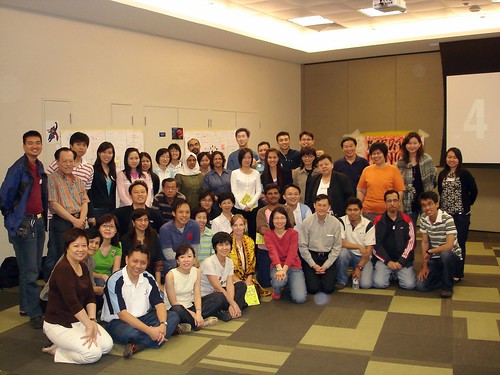 Can teaching creativity be possible? Isn't creativity an in-born trait we either have or don't have? Or can creativity be nurtured through a social environment that encourages its members to play, be silly and be free to ask the really stupid questions?
That was what this bunch of us signed up for today; the chance to shuck off the weight and wisdom of our years and be noisy, mischievous, shameless little kids once again.
This time, for being the monkey who disrupts class with his antics, instead of death-threats and letters to our parents we got rewarded with chocolate! And guess who amassed the largest haul of cocoa-based goodness? Ahem.
But this full-day workshop was about having purpose-oriented fun. We participants -- representing organizations involving different fields of education, transport and maintenance -- were there to experience how to solve our industrial problems, or explore potential opportunities using innovative thinking tools fueled by freedom, fun and play.
In between laughing, egging on and cheering our fellow participants to perform eyeball-rolling acts of ego suicide (like playing modified games of catching and pole dancing), we were gently being led to put together a business concept for some unlikely product or service that arose from our games.
A few competitive brainstorming sessions led us to ask 'what if...?' questions somewhat akin to Lewis Carroll's "why is a raven like a writing desk?" conundrum. But since we were thinking within the contexts of our particular industries, our questions came out something like "What if our office set-up was like the S'pore Flyer?" or "How can we use a bus to assist in ship repair?" or my group's "What if education was fast food?"
If we're stuck for ideas, the theory goes that by putting different things together in weird combinations and thinking through the random associations and connotations these combos embody, we can find a seed of a powerful new innovation that may solve an immediate headache, or become the next big thing to take the world by storm... who's to say?
While this method sounds suspiciously like the monkeys with typewriters theory, because there's some actual thought going on, the odds for success are marginally better. The oddities our various groups ended up pitching were things like creating a carnival atmosphere in the admin office; training office staff with a magician's showmanship to add entertainment value to the basic service provided; an ERP system to track and fine latecomers; a personal counselling service to help troubled workers be more confident and effective in their workplace; and a transforming bus that assists with ship repair (which we voted Idea of the Day). Obviously, Feasibility is another lesson for another time.
Today, we learned to not fear the stupid question, but rather how to ask the stupid question, no matter how stupid. A better tomorrow depends less on the clever answers people work out, and more on the stupid questions people ask. That's human history in a nutshell.
The car stays home today. I'm taking public transport into town; yep, cutting class to attend a course at the National Library. No way am I shelling out for ERP and whole day parking downtown. Gonna join the rest of humanity jostling our way through the bus and subway system enroute to and from work. Should be setting off in the next few minutes. It'll be like old times again.
Tuesday, February 12, 2008
For once, Drama Night has a proper performing venue. This despite having convinced ourselves that the only available venue was back in LT4. But because it became possible to share the stage with a concurrent production, this year we get to tread the boards of SRT. Yes!
Went with Mel and Steph to recce the site. We looked at the stage, backstage, changing rooms, and we're pretty sure the kids will give extra oomph to match the glam factor of performing in a professional theatre. No doubt we have to share the morning show's set and lights, but we're adaptable.
Now the thing is whether we can produce a show worthy of the space. Steph's piece should be well in hand, given her experience in directing, but I'm still kind'a antsy about mine. Today's rehearsal at least showed some of my ideas are feasible, and that I do have a core set of actors to build the show on. We're off to a slow start, but at least we're starting to move.
Went with Mel and Steph to recce the site. We looked at the stage, backstage, changing rooms, and we're pretty sure the kids will give extra oomph to match the glam factor of performing in a professional theatre. No doubt we have to share the morning show's set and lights, but we're adaptable.
Now the thing is whether we can produce a show worthy of the space. Steph's piece should be well in hand, given her experience in directing, but I'm still kind'a antsy about mine. Today's rehearsal at least showed some of my ideas are feasible, and that I do have a core set of actors to build the show on. We're off to a slow start, but at least we're starting to move.
Monday, February 11, 2008
The South Koreans see that proficiency in English is essential for staying competitive in this world. We've known that all along, making English one of our official languages. South Korea wants to start teaching English classes in English -- a bit late in the game, since we have already implemented this revolutionary innovation since granddad's time. And yet so many of the essays and assignments I've received for marking only just approach the quality of perhaps the harder working students in ESL class. Grammar, syntax, paragraph construction, vocabulary, convey some basic sense of the subject in question, but because of frequent poor expression it all sounds like I'm being reached out to by some rudimentary intelligence rather than the erudite seekers of answers that the students are supposed to be.
Making English an "official language" may actually have the drawback of allowing our people to settle into complacency about it. It's an official language, therefore whatever vernacular we use must therefore be good enough, collect or not? When it comes to spoken English, we have the attitude that when in S'pore speak as the S'poreans do. As long as can unnerstan', can awreddy, w'at!
It's also a pride thing. S'poreans speak Singlish. It's our identity, our heritage and our proudest export to the rest of the Commonwealth. C'mon, lah! We not kentang or banana; wanna be so Ang Mor for what? Speak "proper" English in school and be labeled a Western wannabe, a freakshow, an object of ridicule and contempt. This probably happens in most neighbourhoods and families as well, so there's little encouragement to learn more than what passes for basic comprehension.
It's little surprise then that our students find difficulty expressing themselves in public. The brand of English they use is obviously inappropriate for formal discourse, and naturally, it's easy to develop an inferiority complex coming face-to-face with others who have a stronger command of the language. This lack of confidence is more pronounced in the colleges ranked below our mythical "top 5" JCs. They are "top 5" because their students use a higher level of English that allows them to access, digest and discuss higher level reading material. Those kids thrive on, and are stimulated by stuff that would put their lesser peers to sleep. They get to be the future brains, bureaucrats and insensitive policy-makers, while the majority of their cohort get by with their daily grind and complain how unfair life is.
I daresay the English teachers we have on campus are among the world's best. We have an oyster for every student who passes through our classes, but few of them actually reach out and take what is rightfully theirs. The rest rather slog away at more concrete subjects like the sciences and math, but they forget what language medium they receive such instruction in. That's like sweating it out making bricks, but without the cement of English to bind all the brick fragments together, they'll never be able to build a house. And they wonder why their lives are so hard.
"The private English education market is estimated to be worth about US$15.8 billion (S$22 billion) a year, fuelled by families who spend an average of 700,000 won a month on their children, according to the Samsung Economic Research Institute." That's a lot of moolah to be shared by those of us who can teach English. Perhaps we should put some thought into getting a piece of that action and be paid by people who can appreciate what we have to offer.
Making English an "official language" may actually have the drawback of allowing our people to settle into complacency about it. It's an official language, therefore whatever vernacular we use must therefore be good enough, collect or not? When it comes to spoken English, we have the attitude that when in S'pore speak as the S'poreans do. As long as can unnerstan', can awreddy, w'at!
It's also a pride thing. S'poreans speak Singlish. It's our identity, our heritage and our proudest export to the rest of the Commonwealth. C'mon, lah! We not kentang or banana; wanna be so Ang Mor for what? Speak "proper" English in school and be labeled a Western wannabe, a freakshow, an object of ridicule and contempt. This probably happens in most neighbourhoods and families as well, so there's little encouragement to learn more than what passes for basic comprehension.
It's little surprise then that our students find difficulty expressing themselves in public. The brand of English they use is obviously inappropriate for formal discourse, and naturally, it's easy to develop an inferiority complex coming face-to-face with others who have a stronger command of the language. This lack of confidence is more pronounced in the colleges ranked below our mythical "top 5" JCs. They are "top 5" because their students use a higher level of English that allows them to access, digest and discuss higher level reading material. Those kids thrive on, and are stimulated by stuff that would put their lesser peers to sleep. They get to be the future brains, bureaucrats and insensitive policy-makers, while the majority of their cohort get by with their daily grind and complain how unfair life is.
I daresay the English teachers we have on campus are among the world's best. We have an oyster for every student who passes through our classes, but few of them actually reach out and take what is rightfully theirs. The rest rather slog away at more concrete subjects like the sciences and math, but they forget what language medium they receive such instruction in. That's like sweating it out making bricks, but without the cement of English to bind all the brick fragments together, they'll never be able to build a house. And they wonder why their lives are so hard.
"The private English education market is estimated to be worth about US$15.8 billion (S$22 billion) a year, fuelled by families who spend an average of 700,000 won a month on their children, according to the Samsung Economic Research Institute." That's a lot of moolah to be shared by those of us who can teach English. Perhaps we should put some thought into getting a piece of that action and be paid by people who can appreciate what we have to offer.
Saturday, February 09, 2008
Women are such incredible motivators for men to do great things. Or if not, then to just get off their lazy butts and do constructive things with their lives. It's sort of biologically hardwired in us guys that women have to be impressed, and so we scramble to make ourselves more outstanding, to prove we can provide, to otherwise jump up and down, wave out arms and yell, "Pick me! Pick me!"
But over time, guys discovered the online world, and they have started overwriting their biological programming with Internet code. It's something of a revolution. They're tired of women pushing them around, making them jump through hoops, and saddling them with irrational domestic responsibilities at the prime of their lives. No longer are guys content to be willing victims, sacrificing themselves to the altar of the preying mantis / black widow sisterhood. Guys have finally found a way to turn their backs on hormonal tyranny and return to what nature intended them to be: slacking, unwashed neanderthals, as they "huddle together and have fun" for the rest of their parents' lives. The Internet: the saviour of MANkind, fancy that!
Boys. Heh, what do they know? All it takes is one woman to be firm enough, who will reach out, grab and drag the unwary guy home by the ear to reactivate the biological imperative again. For me, I believe that when June decided to take me home, reality split in two. In one reality, June never appeared in my life and I'm still the 'home boy' that I was more than a decade ago. But in this reality, I have a great wife, a home of my own, an interesting job, a decent income AND I still have the Internet to regress to when I feel like it.
Women are great motivators. Men are easy prey.
But over time, guys discovered the online world, and they have started overwriting their biological programming with Internet code. It's something of a revolution. They're tired of women pushing them around, making them jump through hoops, and saddling them with irrational domestic responsibilities at the prime of their lives. No longer are guys content to be willing victims, sacrificing themselves to the altar of the preying mantis / black widow sisterhood. Guys have finally found a way to turn their backs on hormonal tyranny and return to what nature intended them to be: slacking, unwashed neanderthals, as they "huddle together and have fun" for the rest of their parents' lives. The Internet: the saviour of MANkind, fancy that!
Boys. Heh, what do they know? All it takes is one woman to be firm enough, who will reach out, grab and drag the unwary guy home by the ear to reactivate the biological imperative again. For me, I believe that when June decided to take me home, reality split in two. In one reality, June never appeared in my life and I'm still the 'home boy' that I was more than a decade ago. But in this reality, I have a great wife, a home of my own, an interesting job, a decent income AND I still have the Internet to regress to when I feel like it.
Women are great motivators. Men are easy prey.

Thursday, February 07, 2008


For the second year running, we had our clan reunion dinner at Ban Leong Wah Hoe, Casuarina. The food portions were as generous as always: from our three tables, we collected several containers worth of leftovers to take away.
The clan reconvened at Aunt L's to carry out our traditional Chinese familial duties. This year, the game was Bingo, with Aunt L particularly anxious to put her brand-new lottery ball tumbler to good use. Won a little, lost more; but it was for a good cause. The family that plays together, stays together...though not necessarily in the same house.
Happy year of the rat!
The clan reconvened at Aunt L's to carry out our traditional Chinese familial duties. This year, the game was Bingo, with Aunt L particularly anxious to put her brand-new lottery ball tumbler to good use. Won a little, lost more; but it was for a good cause. The family that plays together, stays together...though not necessarily in the same house.
Happy year of the rat!
Tuesday, February 05, 2008
Our little newcomer is making Q-tip a little uneasy. June's officially calling him Maui, and while he's adjusting to his new environment, we're devoting a lot of time and attention to him to make him feel safe and welcome.
Q-tip's a little jealous of this new addition competing for our time, so she's temporarily abandoned her usual reserve and reticence to hang out longer with us in the living room. Or else she's frequently hovering within our peripheral vision just to make sure we remember that we still have a dog in the house.
It'll be a delicate balancing game of dealing with Q-tip's insecurities and Maui's demands for attention, but I believe June and I are pretty fair with our pets. One more shouldn't disrupt our routine too much. I know we'll adapt and manage.
Q-tip's a little jealous of this new addition competing for our time, so she's temporarily abandoned her usual reserve and reticence to hang out longer with us in the living room. Or else she's frequently hovering within our peripheral vision just to make sure we remember that we still have a dog in the house.
It'll be a delicate balancing game of dealing with Q-tip's insecurities and Maui's demands for attention, but I believe June and I are pretty fair with our pets. One more shouldn't disrupt our routine too much. I know we'll adapt and manage.
Monday, February 04, 2008
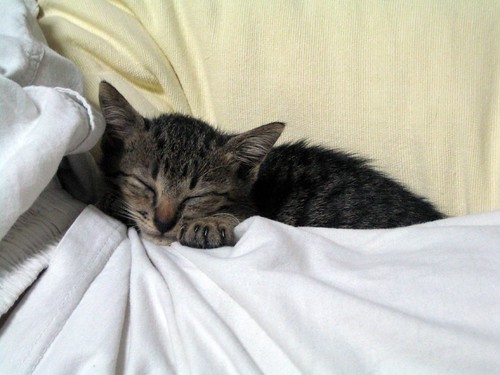
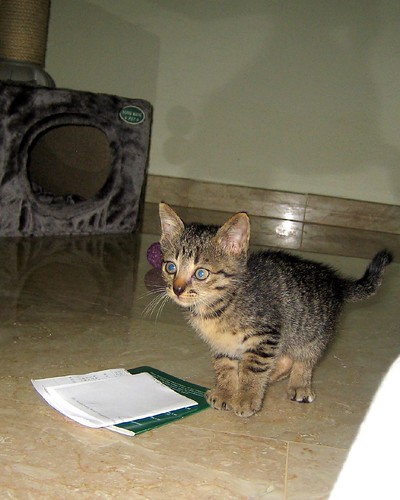 "If you save someone's life, you become responsible for that life." I can't verify this quote anywhere, but I'll take it to be true anyway. Hence, I have a new member in my family: this four-week old kitten, as yet unnamed.
It happened when we took Mimi to the vet for her shot and a follow-up exam of her recent allergy attack. I found this little guy sitting atop the car in front of mine in the parking lot. No way he could have got up there by himself, and I can't bear to think what would have happened to him if later the car drove off with him still on top.
I couldn't put him back on the street either 'cos the cars were passing by so close to the slip of a sidewalk, the only place I could have put him on. So it looks like he's gonna be my third cat despite the resistance I've put up over the years not to have more than two.
He's tiny now, and so fragile, though Kasey gave him a clean bill of health. But his paws tell me he's got great growth potential. We got him some milk, a personal sandbox to suit his size, and recycled a sleeping basket for his comfort. He hates being left alone right now, so I let him fall asleep on my stomach before transferring him to his basket.
He's the smallest ball of fur we've ever picked up. He's just awakened again so now he's sharing my office chair as I'm typing. I can't help it. I want him to know that as long as I'm around, I'll protect him and keep him safe, come what may.
Hmm... hope he'll be ok when June and I go to work tomorrow.
Saturday, February 02, 2008
The militants responsible for blowing up the pet market in Baghdad have finally made a statement about how far removed they are from the rest of normal human society. The weapon: bomb vests strapped on mentally disabled women (though I don't know how the militants mentally disabled the women... probably through endless repetition of boring militant rhetoric). The detonator: a cell phone. The target: pets -- kitties, doggies, monkeys (actually, these shouldn't be kept as pets), birds, and the kids who throng the market every week looking for an animal they can shower their budding affection on. And the regular joes, shmoes, and janes taking their families out on a weekend jaunt, the usual IED fodder.
Don't know what's up with them militants. It's fine if they blow themselves up 'cos there'll be less of them in the world, but they aren't even doing that now. They're detonating bombs by remote control showing that cynical as they are about life, they do feel that there is at least one life worth saving: their own.
If we look through their eyes, this is what we'll probably see: Women have attractive qualities so they make good bait to draw as many as possible into the kill zone. The mentally disabled are of no use to anyone and are probably carrying the curse of the Almighty anyway, so no loss there, and no backchat either. The cell phone to them is not a device for getting to know people but to communicate their miscreant tendencies instead. The poor shlubs who got blown up , well, the more the merrier, and the stronger the statement that nobody matters in this petty vendetta of theirs. And the animals? People seem to care more for the four-legged beasties that serve neither as labour nor food than for the militants themselves and their pitiful cause, so they deserve to get blown up too.
That's it, then. There's no one left that they would want to share this world with. So why don't we just offer them a nice asteroid for them to inhabit and leave the rest of us alone? A couple of hundred smelly bearded guys squatting on an arid rock floating through the cosmos. After all, if and when they achieve their desired objective, that's still going to be the net result.
Don't know what's up with them militants. It's fine if they blow themselves up 'cos there'll be less of them in the world, but they aren't even doing that now. They're detonating bombs by remote control showing that cynical as they are about life, they do feel that there is at least one life worth saving: their own.
If we look through their eyes, this is what we'll probably see: Women have attractive qualities so they make good bait to draw as many as possible into the kill zone. The mentally disabled are of no use to anyone and are probably carrying the curse of the Almighty anyway, so no loss there, and no backchat either. The cell phone to them is not a device for getting to know people but to communicate their miscreant tendencies instead. The poor shlubs who got blown up , well, the more the merrier, and the stronger the statement that nobody matters in this petty vendetta of theirs. And the animals? People seem to care more for the four-legged beasties that serve neither as labour nor food than for the militants themselves and their pitiful cause, so they deserve to get blown up too.
That's it, then. There's no one left that they would want to share this world with. So why don't we just offer them a nice asteroid for them to inhabit and leave the rest of us alone? A couple of hundred smelly bearded guys squatting on an arid rock floating through the cosmos. After all, if and when they achieve their desired objective, that's still going to be the net result.
Friday, February 01, 2008
It was kinda' fun to self-diagnose my own inner-demons, though the game initially was to source interesting reading material for KI from Psychology Today. I like the articles 'cos they are easy to read, without all the technical gobbledegook that professional shrinks use to euphemise "I haven't the foggiest idea what's wrong with you. Solve your own problems. That'll be $150 for this afternoon's session, thank you!"
The topics make for highly compelling reading: advice on confidence-building, an in-depth look at introversion as a personality trait, how to get over a break-up, taking apart "champions of lost causes" to see what makes them tick (tick, tick, tick, boom!). I could picture myself lounging on a comfy couch as the Doctor probed the deepest, darkest recesses of the cesspit I call my mind with the most impertinent of questions.
Fortunately, my indulgence in an afternoon's worth of pop psychology didn't cost me a cent. I grabbed the couple of issues lying around in the college's library stacks for a free consultation.
The topics make for highly compelling reading: advice on confidence-building, an in-depth look at introversion as a personality trait, how to get over a break-up, taking apart "champions of lost causes" to see what makes them tick (tick, tick, tick, boom!). I could picture myself lounging on a comfy couch as the Doctor probed the deepest, darkest recesses of the cesspit I call my mind with the most impertinent of questions.
Fortunately, my indulgence in an afternoon's worth of pop psychology didn't cost me a cent. I grabbed the couple of issues lying around in the college's library stacks for a free consultation.
Thursday, January 31, 2008
For a moment this afternoon, I really wanted to shut down my brain. It was textual overload after a whole day of processing text from a variety of sources: admin forms, news, lecture notes, play script, meeting notes, routine schedules, email.
It was the compulsion that was scary, like being addicted to the stuff: ploughing through one thing, then putting it away and instantly, instinctively, reaching for another. Even when I was trying to rest, I'd naturally gravitate to the library looking for something new to read, or trawl the 'net for news and trivia. My whole world today comprised nothing but text, and nothing but text could fill my world. Seems as if I was trying to occupy my mind though there was nothing there but noise, yet too afraid of the resulting silence if I stopped. Weird.
Let's not do that again. ok?
It was the compulsion that was scary, like being addicted to the stuff: ploughing through one thing, then putting it away and instantly, instinctively, reaching for another. Even when I was trying to rest, I'd naturally gravitate to the library looking for something new to read, or trawl the 'net for news and trivia. My whole world today comprised nothing but text, and nothing but text could fill my world. Seems as if I was trying to occupy my mind though there was nothing there but noise, yet too afraid of the resulting silence if I stopped. Weird.
Let's not do that again. ok?
Wednesday, January 30, 2008
Teachers are great students, contrary to popular belief. The Civil Defence people came over to teach us staff how to save lives in an emergency, but I also got to see how fantastic lessons are conducted as well.
We ran three modules in one afternoon: fire fighting, CPR and first-aid. They could have been dreadfully dull as they involved us learning procedures for dealing with various types of emergencies, but we had a ball of a time instead.
Some things the trainers did right:
(1) Invoked self-interest -- we saved our lives and those of our friends too
(2) Liberally used self-deprecating humour -- they didn't take themselves or their content too seriously
(3) Delivered only core ideas -- just enough theory for background understanding but not to confuse or bore us
(4) Lots of stories -- we could vividly visualize the situations we had to respond to
(5a) A variety of media -- text and visual...
(5b) A variety of practical activities -- contextual and tactile
(6) Highly participatory, spontaneous presenter-audience interaction -- non-threatening environment giving free-rein to questions and responses from both parties
But most of the enjoyment from this afternoon's session was due to (6). We staff may have been bored and tired, but we were fully participating in the lessons anyway. We asked as many questions as the trainers asked us, we answered questions voluntarily even if we didn't know if our answers were right (we didn't take it personally if we were wrong,sorry B-lo), we threw observations, comments and questions as they occurred to us even if it meant interrupting the presentation. We took every opportunity to engage, sometimes even make the trainer eat his words (like making him confess that Chapter 1 in the Training Manual had some outdated information).
We had a great time, 'cos we wanted to learn, and more importantly, we wanted to play and have fun with the trainers and their programme. That, I think, is already half the battle in creating a lively, constructive learning environment -- the learners themselves having a good reason (whatever it is) for attending class.
Ha! Everything I learned about teaching, I learned from a firefighter.
We ran three modules in one afternoon: fire fighting, CPR and first-aid. They could have been dreadfully dull as they involved us learning procedures for dealing with various types of emergencies, but we had a ball of a time instead.
Some things the trainers did right:
(1) Invoked self-interest -- we saved our lives and those of our friends too
(2) Liberally used self-deprecating humour -- they didn't take themselves or their content too seriously
(3) Delivered only core ideas -- just enough theory for background understanding but not to confuse or bore us
(4) Lots of stories -- we could vividly visualize the situations we had to respond to
(5a) A variety of media -- text and visual...
(5b) A variety of practical activities -- contextual and tactile
(6) Highly participatory, spontaneous presenter-audience interaction -- non-threatening environment giving free-rein to questions and responses from both parties
But most of the enjoyment from this afternoon's session was due to (6). We staff may have been bored and tired, but we were fully participating in the lessons anyway. We asked as many questions as the trainers asked us, we answered questions voluntarily even if we didn't know if our answers were right (we didn't take it personally if we were wrong,
We had a great time, 'cos we wanted to learn, and more importantly, we wanted to play and have fun with the trainers and their programme. That, I think, is already half the battle in creating a lively, constructive learning environment -- the learners themselves having a good reason (whatever it is) for attending class.
Ha! Everything I learned about teaching, I learned from a firefighter.
Sunday, January 27, 2008
Kids are left to roam the streets unsupervised during the afternoon hours and dogs have to live in pet hotels costing a monthly bomb of a bill. Sumiko continues acting wistful, pining away for a family with kids of her own to assuage her boring single life. When we connect the dots in today's ST, we're looking at a picture of a people who are lonely even in the midst of company. Is that what life in S'pore is like these days?
While I have little affinity for kids, it does perturb me that of the kids surveyed there were so many left to fend for themselves while the adults were out at work. That they were gormless enough to receive a stranger's advances suggests that they are quite lonely for an adult's attention, especially if the adult treats them as equals and not talk down to them. Kids like being helpful, particularly if it seems to them as if they posess some knowledge the adult does not, like how to get to the MRT station for example. And with all the questions the reporter asked, the kids are quite happy to spill the beans on their personal lives. Who else is there to talk to? Who else has shown them such interest in a while?
On the other end of the spectrum, some people are spending a lot of money making sure their dogs are well taken care of. They can't help it. Our society isn't open enough to tolerate the idea of peaceful mutual coexistence between the species. So by legislation or public censure, we separate companions from each other, and make them pay a hefty penalty if they wish to continue the relationship. I shudder to think what happens to those who can't afford to make such payment, and I'm reasonably sure there are lots more who fall into the latter category than the first.
Even the free-wheeling single, living an independent life, accountable to no one, unencumbered by family responsibilities goes all misty-eyed longing to exchange all that for domestic bliss and its attendant shackles and chains and the promise of a lifetime of hard labour that follows. At least she won't have so much time on her hands that she's "bored out of her mind" over the weekend.
Isn't that the problem? We only want a family on the weekend to keep us occupied and busy. Family isn't so important on weekdays because we already have our hands full with our occupations and businesses. It's fine to let the kids roam the playgrounds on weekdays, we'll make it up to them on the weekends when we pack them off to tuition and ballet class and check on their homework when they come home at night. Oh, by the way, remember to drop in on Fido at the pet hotel on Monday, Wednesday and Friday. We have to hug him and let him know we love him, or he'll have separation anxiety, you know?
Geez. Even I think there's something wrong there.
While I have little affinity for kids, it does perturb me that of the kids surveyed there were so many left to fend for themselves while the adults were out at work. That they were gormless enough to receive a stranger's advances suggests that they are quite lonely for an adult's attention, especially if the adult treats them as equals and not talk down to them. Kids like being helpful, particularly if it seems to them as if they posess some knowledge the adult does not, like how to get to the MRT station for example. And with all the questions the reporter asked, the kids are quite happy to spill the beans on their personal lives. Who else is there to talk to? Who else has shown them such interest in a while?
On the other end of the spectrum, some people are spending a lot of money making sure their dogs are well taken care of. They can't help it. Our society isn't open enough to tolerate the idea of peaceful mutual coexistence between the species. So by legislation or public censure, we separate companions from each other, and make them pay a hefty penalty if they wish to continue the relationship. I shudder to think what happens to those who can't afford to make such payment, and I'm reasonably sure there are lots more who fall into the latter category than the first.
Even the free-wheeling single, living an independent life, accountable to no one, unencumbered by family responsibilities goes all misty-eyed longing to exchange all that for domestic bliss and its attendant shackles and chains and the promise of a lifetime of hard labour that follows. At least she won't have so much time on her hands that she's "bored out of her mind" over the weekend.
Isn't that the problem? We only want a family on the weekend to keep us occupied and busy. Family isn't so important on weekdays because we already have our hands full with our occupations and businesses. It's fine to let the kids roam the playgrounds on weekdays, we'll make it up to them on the weekends when we pack them off to tuition and ballet class and check on their homework when they come home at night. Oh, by the way, remember to drop in on Fido at the pet hotel on Monday, Wednesday and Friday. We have to hug him and let him know we love him, or he'll have separation anxiety, you know?
Geez. Even I think there's something wrong there.
Saturday, January 26, 2008
Am I a "creative"? Is that how people see me? An eccentric with the occasional wild, wacky idea that could potentially turn the world on its head, but fizzles out when I actually try to implement it? Is that why people handle me with kid gloves like as if I was a leaky crate of nitro that could explode at the slightest jolt?
Maybe it's the image I have been projecting for myself, so I'm not really doing myself any favours there. If I was a crate of nitro, I'd still much rather make a detonation that will help people build a railway or something useful rather than leak away neglected and forgotten in some secure bunker kept safe for some future contingency that will never happen.
If people want the best out of what I have to offer, they have to engage me, and not just assume that I know what I'm doing. Kellaway's FT article on managing creatives makes a lot of practical sense, assuming I am some kind of "creative". Sure, I get weird ideas sometimes. I may get idealistic, and do things my own way. I shake things up, buck trends... but only within my own limited sphere of influence, which realistically amounts to nothing at all.
While I'm grateful that people generally leave me to my own devices, I get precious little feedback and even less guidance as I trailblaze my path to parts unknown. So although my bumper sticker may read "Don't follow me, I don't know where I'm going!", it'd be great to have a co-pilot or even a backseat driver to help me evaluate what I did before, and discuss what it is I'm about to do next.
I don't need multiple leather sofas backstage like Streisand, though a little praise would be nice. But I also need a boot up the butt from time to time as motivation to improve or work harder on turning concepts into reality. And being able to see things from beyond my own warped perspective will be a major plus.
No one creates in vacuum.
Maybe it's the image I have been projecting for myself, so I'm not really doing myself any favours there. If I was a crate of nitro, I'd still much rather make a detonation that will help people build a railway or something useful rather than leak away neglected and forgotten in some secure bunker kept safe for some future contingency that will never happen.
If people want the best out of what I have to offer, they have to engage me, and not just assume that I know what I'm doing. Kellaway's FT article on managing creatives makes a lot of practical sense, assuming I am some kind of "creative". Sure, I get weird ideas sometimes. I may get idealistic, and do things my own way. I shake things up, buck trends... but only within my own limited sphere of influence, which realistically amounts to nothing at all.
While I'm grateful that people generally leave me to my own devices, I get precious little feedback and even less guidance as I trailblaze my path to parts unknown. So although my bumper sticker may read "Don't follow me, I don't know where I'm going!", it'd be great to have a co-pilot or even a backseat driver to help me evaluate what I did before, and discuss what it is I'm about to do next.
I don't need multiple leather sofas backstage like Streisand, though a little praise would be nice. But I also need a boot up the butt from time to time as motivation to improve or work harder on turning concepts into reality. And being able to see things from beyond my own warped perspective will be a major plus.
No one creates in vacuum.
Friday, January 25, 2008
Killerzyph interviewed me for an article in the next NYconnex, something about featuring various staff members to show we have lives beyond hectoring students all day. Trade secret: Actually, we just return to our closets in a hidden underground facility in the campus basement where we get deactivated, then brought out again to walk among the living when the sun rises the next morning. Heh, if only.
We talked about mime and busking, which I don't do anymore, and about my goals for drama now that I've moved back to the only place where I really know what I'm doing. Except this year I've been so out of touch, I am freaking out at the edges wondering how to bring a Eunuch Admiral back to life again by Drama Night.
I owe a lot to my training in mime, and not just for my appreciation in the aesthetics of the theatre. Being primarily a kinesthetic learner, I discovered through mime a movement-based language that I could use to understand abstract concepts better. The movement doesn't have to be physical, it can take place in my imagination, though occasionally my hands or fingers may twitch, echoing the thought I'm processing at the time.
It's hard to explain how a "movement-based language" works. However, I assure you that there there is no white-face painted street performer that's producing the movement in my imagination. The movement sort of exists on its own. There. Now I sound like a raving lunatic.
The point I was hoping to get at in killerzyph's interview was that all of us need to train in some form of discipline and get real good at it. I'm talking about non-academic disciplines that involve making things (like an art, craft or music) or doing things (like a sport or dance or theatre). The discipline has to be non-academic in nature because it is physical, tangible and direct, and therefore easier and clearer to obtain good results in. We get praise, applause and appreciation for our masterpiece, encouragement if the product is so-so, or by audience critique or defeat we know we sucked and therefore need to work harder at it.
Training in a non-academic discipline gives us the confidence to take on academic disciplines which, being more abstract, operate at a higher level. Academics are text-language based, so there is a step of having to learn the language first, even before apprehending the concepts themselves. People deficient in the language of instruction are screwed. Unlike non-academic disciplines, there is nothing in an academic discipline for monkey to see, and therefore monkey cannot do if the student and the instructor do not speak the same language. Gibberish text input results in gibberish text output. Garbage in, garbage out. And that's just the first level of difficulty.
If and when we do master the language of an academic discipline, we realize that the results of academic study are often judged arbitrarily, often subjectively. As academic concepts are text-based in construction, a lot depends on the interpretation of the text, and there are often too many variables to pin down. Academics themselves seldom agree with each other, in fact, they thrive in their fields by proving one another wrong. Success in the academic world is either a paper qualification (how satisfying), or a paper published challenging others to attack the ideas presented therein. That takes a pretty hardy, highly confident individual to live like that.
Success in the academic field is easier to strive for if we know we are already doing well in our non-academic pursuits. Well, at least this approach has worked for me so far. I am a degree-holding pedant by profession, but by trade, I am a mime. Most people find this combination to be the most irritating by far.
We talked about mime and busking, which I don't do anymore, and about my goals for drama now that I've moved back to the only place where I really know what I'm doing. Except this year I've been so out of touch, I am freaking out at the edges wondering how to bring a Eunuch Admiral back to life again by Drama Night.
I owe a lot to my training in mime, and not just for my appreciation in the aesthetics of the theatre. Being primarily a kinesthetic learner, I discovered through mime a movement-based language that I could use to understand abstract concepts better. The movement doesn't have to be physical, it can take place in my imagination, though occasionally my hands or fingers may twitch, echoing the thought I'm processing at the time.
It's hard to explain how a "movement-based language" works. However, I assure you that there there is no white-face painted street performer that's producing the movement in my imagination. The movement sort of exists on its own. There. Now I sound like a raving lunatic.
The point I was hoping to get at in killerzyph's interview was that all of us need to train in some form of discipline and get real good at it. I'm talking about non-academic disciplines that involve making things (like an art, craft or music) or doing things (like a sport or dance or theatre). The discipline has to be non-academic in nature because it is physical, tangible and direct, and therefore easier and clearer to obtain good results in. We get praise, applause and appreciation for our masterpiece, encouragement if the product is so-so, or by audience critique or defeat we know we sucked and therefore need to work harder at it.
Training in a non-academic discipline gives us the confidence to take on academic disciplines which, being more abstract, operate at a higher level. Academics are text-language based, so there is a step of having to learn the language first, even before apprehending the concepts themselves. People deficient in the language of instruction are screwed. Unlike non-academic disciplines, there is nothing in an academic discipline for monkey to see, and therefore monkey cannot do if the student and the instructor do not speak the same language. Gibberish text input results in gibberish text output. Garbage in, garbage out. And that's just the first level of difficulty.
If and when we do master the language of an academic discipline, we realize that the results of academic study are often judged arbitrarily, often subjectively. As academic concepts are text-based in construction, a lot depends on the interpretation of the text, and there are often too many variables to pin down. Academics themselves seldom agree with each other, in fact, they thrive in their fields by proving one another wrong. Success in the academic world is either a paper qualification (how satisfying), or a paper published challenging others to attack the ideas presented therein. That takes a pretty hardy, highly confident individual to live like that.
Success in the academic field is easier to strive for if we know we are already doing well in our non-academic pursuits. Well, at least this approach has worked for me so far. I am a degree-holding pedant by profession, but by trade, I am a mime. Most people find this combination to be the most irritating by far.
Thursday, January 24, 2008
To be honest, it's getting harder to sustain a daily, even a regular flow of entries to quidestveritas. The nonsense I've been spewing these last few weeks only shows that I've lost a sense of purpose for this exercise. I'm losing touch with my audience, what with all these random posts about whatever I can force myself to commit to text. It makes for quite painful re-reading, actually.
Perhaps all I've been aiming for recently is to just reassure myself that life is more exciting than it really is? Or by commenting on policy that I'm smarter than I really am? Or to persuade myself that I have an audience because I'm writing, and not that I'm writing because I have an audience?
Quidestveritas needs a fresh purpose, perhaps even a new identity. One of its original purposes was to be an exercise for me to practice what I teach: writing. For the moment then, I'm going back to my roots. No more writing for any particular audience in mind, it's just going to be a jotter book of grammar and vocabulary practice, perhaps some composition or loosely structured argumentation, or whatever else strikes my fancy. In other words, I'm still going to be spewing nonsense, only that I want to stop feeling guilty about it. I reserve the right to slack off anytime I want, and not let my addiction for "addressing the world" get the better of me if I don't feel like it. So there.
When my new batch of GP kids arrive in a few weeks' time, maybe I can go back to writing for them again. But in the meantime, if anyone wants to stick with me through my dry spell, they're most welcome.
Perhaps all I've been aiming for recently is to just reassure myself that life is more exciting than it really is? Or by commenting on policy that I'm smarter than I really am? Or to persuade myself that I have an audience because I'm writing, and not that I'm writing because I have an audience?
Quidestveritas needs a fresh purpose, perhaps even a new identity. One of its original purposes was to be an exercise for me to practice what I teach: writing. For the moment then, I'm going back to my roots. No more writing for any particular audience in mind, it's just going to be a jotter book of grammar and vocabulary practice, perhaps some composition or loosely structured argumentation, or whatever else strikes my fancy. In other words, I'm still going to be spewing nonsense, only that I want to stop feeling guilty about it. I reserve the right to slack off anytime I want, and not let my addiction for "addressing the world" get the better of me if I don't feel like it. So there.
When my new batch of GP kids arrive in a few weeks' time, maybe I can go back to writing for them again. But in the meantime, if anyone wants to stick with me through my dry spell, they're most welcome.
Wednesday, January 23, 2008
We're reaching the end of a major JC tradition. This year is the last time 'O' level kids will get to sample JC life for one term before they commit themselves to (or opt out of) the remaining year-and-a-half of hard labour. No longer will there be in subsequent years this opportunity to try before they buy; to focus primarily on making new friends and work on the side and with less dire consequences to bear for taking it easy.
From next year, as soon as they step through the front gate, they're our to keep, for better or for worse. In a way, that helps planning our programme easier. A single intake of students is less disruptive, so whatever systems we put in place the first time won't have to be redone three months later when our 'real' students report for duty a whole term later.
We will need to plan for only one Orientation week, undergo only one time-tabling allocation exercise, and start our co-curricula activities (CCA) immediately without an additional recruitment drive to replace members lost in the second posting period. That cuts down a lot of annual pain by half at least.
So how have we been treating our final batch of transients? In a move contrary to my personal preference, we're running "seminars" instead of the [relatively] small tutorials that we're used to. Seminars, as far as dNYel interprets it, means that we get a huge group of students per venue supervised by two or three tutors at once. We manage the numbers by setting them a group-based project which they collaborate on while us tutors provide the scaffolding as necessary.
Seminars are such an impersonal way to interact with the students. So many kids, how are we going to remember all their names before they graduate? How can we tell from the sea of faces who needs help with what? As tutors, we can only flit from group to group, bearing in mind that there are lots of other groups that could use a little of our attention as well.
Guess what? I'm enjoying this teaching format a lot -- more than I ever expected to. With less tutor time per student, we can't afford to hold anybody's hand (figuratively speaking, of course) for long. The kids have got to depend on their groupmates and on the general seminar discussions a lot more than before, and as they grab the microphone to share their solutions to the assigned problems, their difficulties and reflections on the tasks, they seem more like adults at a learning conference than just a bunch of difficult kids being spoon-fed stuff they don't like to eat. To me, that's progress.
Well, hope our JC1s will be happy with their 'O' level results when they collect them tomorrow. Hope they come back...
From next year, as soon as they step through the front gate, they're our to keep, for better or for worse. In a way, that helps planning our programme easier. A single intake of students is less disruptive, so whatever systems we put in place the first time won't have to be redone three months later when our 'real' students report for duty a whole term later.
We will need to plan for only one Orientation week, undergo only one time-tabling allocation exercise, and start our co-curricula activities (CCA) immediately without an additional recruitment drive to replace members lost in the second posting period. That cuts down a lot of annual pain by half at least.
So how have we been treating our final batch of transients? In a move contrary to my personal preference, we're running "seminars" instead of the [relatively] small tutorials that we're used to. Seminars, as far as dNYel interprets it, means that we get a huge group of students per venue supervised by two or three tutors at once. We manage the numbers by setting them a group-based project which they collaborate on while us tutors provide the scaffolding as necessary.
Seminars are such an impersonal way to interact with the students. So many kids, how are we going to remember all their names before they graduate? How can we tell from the sea of faces who needs help with what? As tutors, we can only flit from group to group, bearing in mind that there are lots of other groups that could use a little of our attention as well.
Guess what? I'm enjoying this teaching format a lot -- more than I ever expected to. With less tutor time per student, we can't afford to hold anybody's hand (figuratively speaking, of course) for long. The kids have got to depend on their groupmates and on the general seminar discussions a lot more than before, and as they grab the microphone to share their solutions to the assigned problems, their difficulties and reflections on the tasks, they seem more like adults at a learning conference than just a bunch of difficult kids being spoon-fed stuff they don't like to eat. To me, that's progress.
Well, hope our JC1s will be happy with their 'O' level results when they collect them tomorrow. Hope they come back...
Monday, January 21, 2008
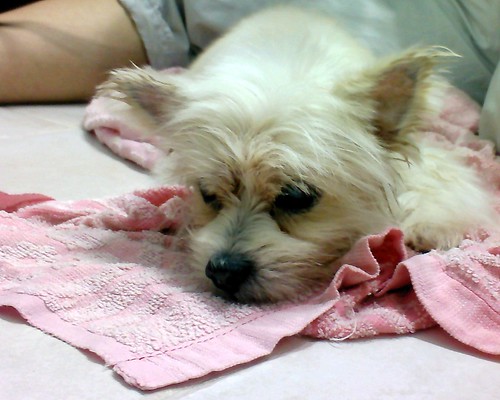 Mimi went to see Doc Kasey today. She has developed an allergy to some unknown substance and is scratching herself silly. The Wongs will have to slowly track down the allergen, but in the meantime, her medicated shampoo, a course of antibiotics and antihistamines will have to suffice.
Here (pix left) Mimi is getting a blow-dry after a nice shower with her new shampoo. And Q-tip got her annual booster too, while we were at the vet's.
Sunday, January 20, 2008
The Wongs marked their annual ancestral commemorative lunch today. They loaded the dining table with a variety of deep-fried finger foods, and the specialty of the occasion: Shanghainese meat balls with cabbage in gravy. There is a bowl of rice and a glass of beer in front of each place around the table. The places are not for us, but for the departed Wong ancestors. The Wongs individually offer joss at the head of the table, kowtow thrice and pray for continued blessing and protection over the family.
June and I don't participate in the ritual, since our religion doesn't count so much on ancestral support. We're there because it's an event of family significance, so even if we don't pray to the same deity, our togetherness keeps the family bond as strong as ever.
What's good about ceremonies like this is the sense of history and continuity in the family line. It's nice, I guess, knowing that people will still remember us, call us by name and recall how we impacted the lives of those closest to us long after we've gone.
Not so many of us are in that position these days, though. So those of us who don't have much hope in having adoring descendants are going to have to make the most of life while we're still here. Rock on!
June and I don't participate in the ritual, since our religion doesn't count so much on ancestral support. We're there because it's an event of family significance, so even if we don't pray to the same deity, our togetherness keeps the family bond as strong as ever.
What's good about ceremonies like this is the sense of history and continuity in the family line. It's nice, I guess, knowing that people will still remember us, call us by name and recall how we impacted the lives of those closest to us long after we've gone.
Not so many of us are in that position these days, though. So those of us who don't have much hope in having adoring descendants are going to have to make the most of life while we're still here. Rock on!
Saturday, January 19, 2008
Our industry is still getting criticism for someone's poor choice of words in advising some kids about their academic options. Now it's about the tone adopted in conveying the message as being demoralizing, discouraging and disparaging, instead of being encouraging and uplifting. The kids should have been inspired to work harder to achieve their 'O's, they say, not crushed underfoot at the beginning of the year, fresh after their success at the 'N's.
It's a dilemma, really. In our profession, we know that the next level is a tremendous leap from the previous. To paint a rose-tinted picture of what lies ahead for our kids can be misleading, especially if the kids, in their post-challenge euphoric state, choose to hear only the good stuff. To point out frankly the risks, dangers and pitfalls of the road ahead can, as seems to be the case, make the way forward insurmountable. And to try to balance between the two sort of waters down the message, and an unskilled orator will just appear to be babbling contradictory nonsense of the kind I spout all the time.
But, honestly, when taking up a new challenge, we don't usually expect to breeze through it easily. Taking up a new challenge is an informed decision on our part, not simply a matter of process. It takes a struggle and a fight to overcome our latest challenge, and though it would be nice, our previous success seldom adequately prepares us for the task at hand. It's best to know what we're in for rather than just jumping in blindly thinking it'll be no problem. After all, being forewarned is being forearmed.
We learn on the job while we're doing it, not while we're resting on our laurels. And on the job, whatever the job, the reality is that people won't always say what we want to hear. So if we're going to become so easily "shattered" at the first obstacle, say a vocal Supervisor who may be more draconian than inspirational, that's not a very strong indication of our commitment to the cause, is it?
As for the kids affected, I'd say they showed some gumption -- enough to cause a ruckus amidst kopitiam talk about how the education system is going to the pits -- but I'd respect them more if they'd just had enough gumption to determine to prove their advice wrong. Instead of hitting the books, they hit the streets, making a Roman spectacle of their situation. I'm sure that'll help their 'O' level ambitions no end.
The key questions everyone's missing are these:
Are they still enrolled to take the 'O's? If they still are, then their wishes are being respected.
Have they been advised of their options and the consequences of their choice? Evidently. Pretty much the whole newspaper-reading population of S'pore also knows now.
Are they prepared to bear the consequences of their decision? Ah, that's up to them, isn't it?
It's a dilemma, really. In our profession, we know that the next level is a tremendous leap from the previous. To paint a rose-tinted picture of what lies ahead for our kids can be misleading, especially if the kids, in their post-challenge euphoric state, choose to hear only the good stuff. To point out frankly the risks, dangers and pitfalls of the road ahead can, as seems to be the case, make the way forward insurmountable. And to try to balance between the two sort of waters down the message, and an unskilled orator will just appear to be babbling contradictory nonsense of the kind I spout all the time.
But, honestly, when taking up a new challenge, we don't usually expect to breeze through it easily. Taking up a new challenge is an informed decision on our part, not simply a matter of process. It takes a struggle and a fight to overcome our latest challenge, and though it would be nice, our previous success seldom adequately prepares us for the task at hand. It's best to know what we're in for rather than just jumping in blindly thinking it'll be no problem. After all, being forewarned is being forearmed.
We learn on the job while we're doing it, not while we're resting on our laurels. And on the job, whatever the job, the reality is that people won't always say what we want to hear. So if we're going to become so easily "shattered" at the first obstacle, say a vocal Supervisor who may be more draconian than inspirational, that's not a very strong indication of our commitment to the cause, is it?
As for the kids affected, I'd say they showed some gumption -- enough to cause a ruckus amidst kopitiam talk about how the education system is going to the pits -- but I'd respect them more if they'd just had enough gumption to determine to prove their advice wrong. Instead of hitting the books, they hit the streets, making a Roman spectacle of their situation. I'm sure that'll help their 'O' level ambitions no end.
The key questions everyone's missing are these:
Are they still enrolled to take the 'O's? If they still are, then their wishes are being respected.
Have they been advised of their options and the consequences of their choice? Evidently. Pretty much the whole newspaper-reading population of S'pore also knows now.
Are they prepared to bear the consequences of their decision? Ah, that's up to them, isn't it?
Wednesday, January 16, 2008
Our industry has tried to open many more routes to "success" today than was available to me when I took my 'O' Levels. Our people, however, are still locked into the view that the traditional Cambridge route is the only acceptable one.
Our ITEs still have a horrible rep among our parents and concerned constituents. This despite the makeovers these vocational institutions have undergone in recent years. As I've observed before, their campuses have facilities comparable to our current JCs. Their curricula are just as rigorous, even if the content focus is more practically tuned. If ITE students don't study they flunk out, just as students in other institutions do. Trust me, I know about this first hand -- and that was before the makeovers.
The P who "advised" her Sec 5 cohort to apply directly to ITE instead may have been insensitive in her delivery, but the real damage to the kids' morale has been done by all the people who wrote in to the press to complain how wrong she was to give such advice. As unwilling as the P seemed to give her kids a chance at the 'O's, the public is just as unwilling to give the ITE path a chance to succeed as a viable alternative route to education. Thus, instead of having more doors opened to them, all the more the kids will feel that they've been hung out to dry in a society that gives no respect to ITE grads.
We have to wonder what exactly the people who have had their gripes published in the news really want. They tear down the scholars who did well in school for not understanding the plight of their less able compatriots, but they are also tearing down the systems that at least try to do something for the underachievers as well. Perhaps mediocrity really does crave company.
Check out the comments of people who have an axe to grind here. Don't know how long the link will last, so get it while it's hot!
Edit:
Looks like the argument has balanced itself a little since I last looked... a little.
Our ITEs still have a horrible rep among our parents and concerned constituents. This despite the makeovers these vocational institutions have undergone in recent years. As I've observed before, their campuses have facilities comparable to our current JCs. Their curricula are just as rigorous, even if the content focus is more practically tuned. If ITE students don't study they flunk out, just as students in other institutions do. Trust me, I know about this first hand -- and that was before the makeovers.
The P who "advised" her Sec 5 cohort to apply directly to ITE instead may have been insensitive in her delivery, but the real damage to the kids' morale has been done by all the people who wrote in to the press to complain how wrong she was to give such advice. As unwilling as the P seemed to give her kids a chance at the 'O's, the public is just as unwilling to give the ITE path a chance to succeed as a viable alternative route to education. Thus, instead of having more doors opened to them, all the more the kids will feel that they've been hung out to dry in a society that gives no respect to ITE grads.
We have to wonder what exactly the people who have had their gripes published in the news really want. They tear down the scholars who did well in school for not understanding the plight of their less able compatriots, but they are also tearing down the systems that at least try to do something for the underachievers as well. Perhaps mediocrity really does crave company.
Check out the comments of people who have an axe to grind here. Don't know how long the link will last, so get it while it's hot!
Edit:
Looks like the argument has balanced itself a little since I last looked... a little.
Tuesday, January 15, 2008
My seniors are overwhelmingly interested in my next level of career development. I've been getting advice, encouragement, portfolio samplers and additional materials from them in the last few weeks, ever since I inquired about what's next.
Lazy slob that I am, I'm not really inclined to much thought beyond my next meal. But knowing that people believe in me and are supporting me in this, the prospect has become a lot more exciting. In gaming, we call this process "levelling up"; in reality, forward movement actually does mean something more than just a bunch of pixel enhancements on an LCD screen.
Let's get something clear. It isn't about mo' clout or mo' money, though they're nice too. What gets my juices flowing is that I can define on my own terms what area of specialization I want to develop in. By so doing, I could find myself right on the cutting edge of the industry where all the exciting things are happening, where few people understand precisely what is going on and what it all means.
Here's my problem: the above paragraph is probably gibberish to anyone living outside my brain. I know what I want, but I haven't yet found the words to describe it to anyone else. Well, that doesn't mean I won't try. Here goes:
This afternoon, I was sourcing materials for use in class. I was looking for video clips about future technology to inspire the kids in their small group research project. Many of the clips I looked at posed questions about the adequacy of our current education system in meeting the needs of the 21st century. Other clips showed off the capabilities of current developments in technology and projected their applications in the years ahead.
I realized that what the future promised was already what I was doing, only faster, more streamlined, seamless, portable and invisible. Gathering a wealth of information today is already quite easy. Search engines are fast and getting more reliable, streaming video is comparatively lo-res but already quite watchable. Information is still manipulated through mediated interface i/o systems (i.e., physical keyboard-mouse-monitor combinations), but we have solid platforms for social and collaborative networking.
The capabilities of intelligence wizardry we have already. A 'net search yields material we ask for, plus other possibly related material as well. A video clip contains expert opinions and projections from named interviewees. If we pause the video and search the names onscreen, we easily find information about them; their credentials; other works they have done; the organization they work for and its field of business/research... ad infinitum, almost. Depending on how curious we are, our minds can wander as far as our fingers are able to type and click.
The learning potential of our existing everyday technology is aready quite awesome, if we know how to use it properly. The future promises learning that will be a lot more intuitive, perhaps even unconscious, in the way that the individual mind and our collective human consciousness will be able to intertwine and interact with each other.
I think I know what I want now. My niche will not be for any particular subject. I want to teach people to use the technology of the day to teach themselves according to their own needs and interests. Perhaps I might have to phrase that in more academic terms if I want to be taken seriously.
Other than that, there's the mundane stuff of having to put together a portfolio spanning the last three years (current year inclusive) of stuff I've been doing as a JC tutor. Now, that will deserve an entry or more on its own.
Somewhere in here is the closest thing I'll ever get to a new year's resolution. Wish me fair winds and good fortune!
Lazy slob that I am, I'm not really inclined to much thought beyond my next meal. But knowing that people believe in me and are supporting me in this, the prospect has become a lot more exciting. In gaming, we call this process "levelling up"; in reality, forward movement actually does mean something more than just a bunch of pixel enhancements on an LCD screen.
Let's get something clear. It isn't about mo' clout or mo' money, though they're nice too. What gets my juices flowing is that I can define on my own terms what area of specialization I want to develop in. By so doing, I could find myself right on the cutting edge of the industry where all the exciting things are happening, where few people understand precisely what is going on and what it all means.
Here's my problem: the above paragraph is probably gibberish to anyone living outside my brain. I know what I want, but I haven't yet found the words to describe it to anyone else. Well, that doesn't mean I won't try. Here goes:
This afternoon, I was sourcing materials for use in class. I was looking for video clips about future technology to inspire the kids in their small group research project. Many of the clips I looked at posed questions about the adequacy of our current education system in meeting the needs of the 21st century. Other clips showed off the capabilities of current developments in technology and projected their applications in the years ahead.
I realized that what the future promised was already what I was doing, only faster, more streamlined, seamless, portable and invisible. Gathering a wealth of information today is already quite easy. Search engines are fast and getting more reliable, streaming video is comparatively lo-res but already quite watchable. Information is still manipulated through mediated interface i/o systems (i.e., physical keyboard-mouse-monitor combinations), but we have solid platforms for social and collaborative networking.
The capabilities of intelligence wizardry we have already. A 'net search yields material we ask for, plus other possibly related material as well. A video clip contains expert opinions and projections from named interviewees. If we pause the video and search the names onscreen, we easily find information about them; their credentials; other works they have done; the organization they work for and its field of business/research... ad infinitum, almost. Depending on how curious we are, our minds can wander as far as our fingers are able to type and click.
The learning potential of our existing everyday technology is aready quite awesome, if we know how to use it properly. The future promises learning that will be a lot more intuitive, perhaps even unconscious, in the way that the individual mind and our collective human consciousness will be able to intertwine and interact with each other.
I think I know what I want now. My niche will not be for any particular subject. I want to teach people to use the technology of the day to teach themselves according to their own needs and interests. Perhaps I might have to phrase that in more academic terms if I want to be taken seriously.
Other than that, there's the mundane stuff of having to put together a portfolio spanning the last three years (current year inclusive) of stuff I've been doing as a JC tutor. Now, that will deserve an entry or more on its own.
Somewhere in here is the closest thing I'll ever get to a new year's resolution. Wish me fair winds and good fortune!
Monday, January 14, 2008
Just read about Oscar Peterson's passing (which happened in mid-December). He was Chancellor of York U when I graduated in 1991. At my convocation ceremony, I discovered to my horror that underneath my gown I was the most inappropriately dressed of my fellow grads. Everyone else was in a suit and tie, proper shoes; or in a dress gown if female. I was in a t-shirt and jeans, sneakers, and for the occasion, a light jacket. Apparently, I didn't get the memo.
As I stepped up on stage to receive my scroll, the Chancellor, seated on his throne or whatever they call that big chair reserved for the big kahuna, made eye-contact with me. His eyebrows shot up. Immediately, he rose and strode briskly over, intercepting me at the point where I had the scroll placed in my clammy, nervous hands. He gave me a firm handshake and with a broad smile on his face, returned to his seat like as if I had made his day. More likely, I won him a bet.
I think that incident had a lot to do with my educational philosophy as it stands today. Thanks, Oscar. We made contact for just a second or two, but I'll miss you.
The music in heaven has just got better! Yahoo! video clip here.
As I stepped up on stage to receive my scroll, the Chancellor, seated on his throne or whatever they call that big chair reserved for the big kahuna, made eye-contact with me. His eyebrows shot up. Immediately, he rose and strode briskly over, intercepting me at the point where I had the scroll placed in my clammy, nervous hands. He gave me a firm handshake and with a broad smile on his face, returned to his seat like as if I had made his day. More likely, I won him a bet.
I think that incident had a lot to do with my educational philosophy as it stands today. Thanks, Oscar. We made contact for just a second or two, but I'll miss you.
The music in heaven has just got better! Yahoo! video clip here.
Sunday, January 13, 2008
That we aren't neighbourly to our neighbours kinda' hits home in today's ST article. Our front door is locked tight, though it would seriously improve the air flow in our flat if it were kept open. When I come home, I try to make it a point not to share the lift with anyone, and all the more so when I go out. Neighbour makes for the lift, I make for the stairs; anything to avoid making contact with anyone I should at least be familiar with. (Note that I'm speaking for myself 'cos I don't think June is as pathologically paranoid as me).
"A man's home is his castle". It's where we feel safest, freest to indulge in our own excesses without having to keep up appearances for the sake of harmonious living with the rest of humanity. Outside the home, it's all propriety, sobriety, and hard work pretending that I know what's going on and what I'm doing at all times. The social fraud shows through the cracks sometimes, although generally, we're quite good at the cover up game. But at home, I can be the lazy slob that I am, watchin' too much TV, gaming, surfin' and attempting the other 6 deadly sins. Honestly, who's to say I can't?
Being neighbourly literally opens the door to much unwelcome intrusion. The social masks come on again and while I'm grinning and making small talk, my eyeballs are anchored in place, doing their darndnest not to roll, and the little voice in the back of my mind is going, "C'mon! Heroes is starting already!"
It's easier to be friendly with people outside. It's quite legitimate to get rid of them by saying I have to go home. What excuse is there to toss out the neighbour since we're both technically at "home" already? And usually, there isn't just one neighbour, their kids are part of the package too. I don't want to be a meanie, so I avoid situations that may potentially force my hand.
That's not to say I won't help out in the neighbourhood if there is a real need. If there's an emergency or something, then of course making contact is the necessary and humane thing to do. But other than that, I'll be in my room.
So if I died in my own house, would anyone know? Would anyone care? Perhaps not among the neighbours, but hopefully, my friends outside will call the cops before the smell gets too bad.
"A man's home is his castle". It's where we feel safest, freest to indulge in our own excesses without having to keep up appearances for the sake of harmonious living with the rest of humanity. Outside the home, it's all propriety, sobriety, and hard work pretending that I know what's going on and what I'm doing at all times. The social fraud shows through the cracks sometimes, although generally, we're quite good at the cover up game. But at home, I can be the lazy slob that I am, watchin' too much TV, gaming, surfin' and attempting the other 6 deadly sins. Honestly, who's to say I can't?
Being neighbourly literally opens the door to much unwelcome intrusion. The social masks come on again and while I'm grinning and making small talk, my eyeballs are anchored in place, doing their darndnest not to roll, and the little voice in the back of my mind is going, "C'mon! Heroes is starting already!"
It's easier to be friendly with people outside. It's quite legitimate to get rid of them by saying I have to go home. What excuse is there to toss out the neighbour since we're both technically at "home" already? And usually, there isn't just one neighbour, their kids are part of the package too. I don't want to be a meanie, so I avoid situations that may potentially force my hand.
That's not to say I won't help out in the neighbourhood if there is a real need. If there's an emergency or something, then of course making contact is the necessary and humane thing to do. But other than that, I'll be in my room.
So if I died in my own house, would anyone know? Would anyone care? Perhaps not among the neighbours, but hopefully, my friends outside will call the cops before the smell gets too bad.
Saturday, January 12, 2008
Human kindness is not kindness at all, especially concerning our dealings with the wild animals in our midst. Now that the fine for feeding the wild monkeys at Upper Seletar Reservoir has skyrocketed, the monkeys -- spoilt by years of living off human handouts -- have pretty much forgotten how to forage for themselves in the forest and are instead moving to the edge of human habitation in search of food.
We were at Casuarina Road today where we saw families of monkeys dangling on tree branches hanging over the public parking lot. There were monkeys on the street and clambering over the parked cars as well. They've never come this close to our space before, but hunger is making them stupid, making them lose their natural caution of us.
I can imagine what will happen next. People are going to complain to the authorities. Their homes will be invaded by desperate monkeys. Their cars will be scratched and shat upon by monkeys who know not the value of COE-enhanced automobile luxury in Singapore. Several will get killed by passing traffic, and when the authorities arrive, well, let's just say there'll be a significant reduction in the primate population in our protected rainforest.
What's happening to these monkeys is our fault. Our acts of kindness and charity sometimes do the greatest harm to others. But it's probably happened many times before as human civilizations encountered one another. Apart from bringing warfare and disease, we've also killed each other with a similar brand of misguided goodwill.
It's hard, but sometimes, the greater kindness is to say, "No. Go away!"
We were at Casuarina Road today where we saw families of monkeys dangling on tree branches hanging over the public parking lot. There were monkeys on the street and clambering over the parked cars as well. They've never come this close to our space before, but hunger is making them stupid, making them lose their natural caution of us.
I can imagine what will happen next. People are going to complain to the authorities. Their homes will be invaded by desperate monkeys. Their cars will be scratched and shat upon by monkeys who know not the value of COE-enhanced automobile luxury in Singapore. Several will get killed by passing traffic, and when the authorities arrive, well, let's just say there'll be a significant reduction in the primate population in our protected rainforest.
What's happening to these monkeys is our fault. Our acts of kindness and charity sometimes do the greatest harm to others. But it's probably happened many times before as human civilizations encountered one another. Apart from bringing warfare and disease, we've also killed each other with a similar brand of misguided goodwill.
It's hard, but sometimes, the greater kindness is to say, "No. Go away!"
Friday, January 11, 2008
"Survival" is the name of the horror movie genre these days. There is no triumph, no hero. Only people who make smart and/or lucky choices and live to see another day. It is this way too with AvP2. A Predator ship carrying Alien facehuggers has a nasty Alien-induced accident and crashes on Earth. This is the Earth of today, a semi-large town, populated with ordinary people with ordinary concerns. We haven't a chance against the specialized hunting skills of the escaped Aliens and the one horrid "Predalien" that emerges from the wreckage.
A single Predator arrives to take care of the mess. Between June and me, we can't decide if the Predator is of the Hero class, or the Janitor class. Whichever, the lone Predator is quite capable of taking on the Alien infestation and taking out any human being careless enough to get in the line of fire.
And all the townfolk can do is to run, scream, cry and die senselessly and unpredictably. With everyone equal in misery, no one deserves their deaths, helpless in the disaster that befalls them. I'm pretty sure the Predalien crossed an unwritten line that horror movie monsters have not crossed before: don't mess with newborns and expectant mothers. The atrocity it commits in the maternity ward is the stuff of nightmares.
No one's a hero. There is no avoiding an Acheh tsunami, a Katrina hurricane, a Malibu wildfire. There are only survivors and casualties. In these days, we're beginning to recognize how helpless we are against nature's wrath. Yup, it's time to give nature back the respect she deserves.
A single Predator arrives to take care of the mess. Between June and me, we can't decide if the Predator is of the Hero class, or the Janitor class. Whichever, the lone Predator is quite capable of taking on the Alien infestation and taking out any human being careless enough to get in the line of fire.
And all the townfolk can do is to run, scream, cry and die senselessly and unpredictably. With everyone equal in misery, no one deserves their deaths, helpless in the disaster that befalls them. I'm pretty sure the Predalien crossed an unwritten line that horror movie monsters have not crossed before: don't mess with newborns and expectant mothers. The atrocity it commits in the maternity ward is the stuff of nightmares.
No one's a hero. There is no avoiding an Acheh tsunami, a Katrina hurricane, a Malibu wildfire. There are only survivors and casualties. In these days, we're beginning to recognize how helpless we are against nature's wrath. Yup, it's time to give nature back the respect she deserves.
Thursday, January 10, 2008
 When dealing with turkey leftovers from the recently passed festive season, M-i-L does it with style. Her solution: breaded turkey cutlets served with french fries and side salad.
I lie. The turkey in the pix is freshly thawed, not actual Christmas leftovers. Still, if anyone does have a problem with turkey leftovers, this is one way to make disposal more pleasant.
On my side of the family, the story's quite the opposite. We got Mom a nice, 4kg turkey to roast on new year's eve. June dropped out to entertain Madoka. Then their designated driver for the evening got sick, so I had to provide transport. 31 Jan 2007 was a Monday, not a Sunday, which is our usual day to drop in and have dinner with my folks; so my sis and her brood forgot to show up that evening. Same thing probably happened to my bro too. Poor Mom & Dad waited till 2000 hrs and no-one showed up for dinner. So, according to Dad, they switched off the lights and had a quiet, romantic candlelight dinner for two.
Yep. There's still a lot of turkey left in the fridge. Turkey porridge for the next few weeks... mmm...
Tuesday, January 08, 2008
I'm going to miss the journo/debate kids now that I've moved back to drama again. While I'm happy that NYconneX has continued to publish over the last two years I've been on board, I still feel that I haven't got it running at the level I was hoping it would be at by this time.
Truth be told, I had no idea what I was doing when I first took charge of it. Thankfully, Amy's initial guidance and advice helped me catch some direction, though what we are still producing today -- two years later -- still tends to be more self-indulgent ramblings than actual Journalism. I'm quite proud that it's got this far, that is, all the parts are working, but it hasn't taken on a life of its own yet. That's why it's hard to pass it on to new management. I feel I haven't done enough to let it go.
Debate, on the other hand, was an unqualified disaster. That's no reflection on the wonderful, enthusiastic, and courageous trio who stuck with me through the year. Let's just say I've been nursing the team through a stint in the ICU and have just managed to keep it breathing, but not much more. Hopefully, new management will find a way to revive the team. I'm sorry, guys, but when it comes to debating, I just don't have a green thumb for it.
CCA recruitment starts tomorrow, so good hunting, my ex-charges. Hope you get another crop of good people this year that'll bring some new life to the club!
Meantime, with drama, I'm taking on yet another role I've never done before -- not at this scale, at least. I may well have just signed up to direct a famous local play penned by a famous local playwright. As yet, I have no cast, no crew. I do have a couple of sketchy ideas, and a grand total of three months to put it all together into a performance... if we're lucky, on the SRT stage. No pressure.
Kindly keep an open reservation for my favourite padded cell. I may be visiting it wearing my favourite long-sleeved jacket real soon.
Truth be told, I had no idea what I was doing when I first took charge of it. Thankfully, Amy's initial guidance and advice helped me catch some direction, though what we are still producing today -- two years later -- still tends to be more self-indulgent ramblings than actual Journalism. I'm quite proud that it's got this far, that is, all the parts are working, but it hasn't taken on a life of its own yet. That's why it's hard to pass it on to new management. I feel I haven't done enough to let it go.
Debate, on the other hand, was an unqualified disaster. That's no reflection on the wonderful, enthusiastic, and courageous trio who stuck with me through the year. Let's just say I've been nursing the team through a stint in the ICU and have just managed to keep it breathing, but not much more. Hopefully, new management will find a way to revive the team. I'm sorry, guys, but when it comes to debating, I just don't have a green thumb for it.
CCA recruitment starts tomorrow, so good hunting, my ex-charges. Hope you get another crop of good people this year that'll bring some new life to the club!
Meantime, with drama, I'm taking on yet another role I've never done before -- not at this scale, at least. I may well have just signed up to direct a famous local play penned by a famous local playwright. As yet, I have no cast, no crew. I do have a couple of sketchy ideas, and a grand total of three months to put it all together into a performance... if we're lucky, on the SRT stage. No pressure.
Kindly keep an open reservation for my favourite padded cell. I may be visiting it wearing my favourite long-sleeved jacket real soon.
Saturday, January 05, 2008
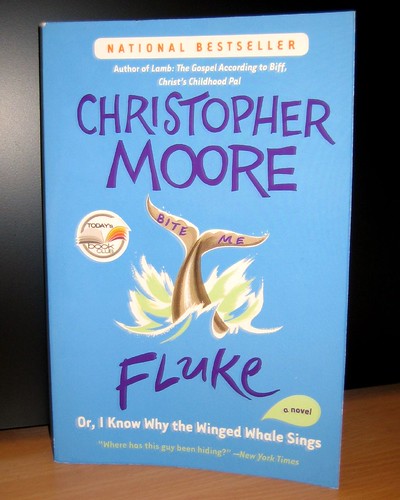 'Fluke' could have been a bleeding-heart appeal to "save the whales" but author, Christopher Moore, avoids all the maudlin and instead spins a tale of great imagination and wit, conjecturing the purpose and meaning behind whalesong, and offering an unusual perspective on why hunting the great whales to extinction isn't exactly a good idea.
Fortunately, the novel isn't about the whales themselves, but rather focuses on the lives of a struggling whale research team which comes so close to deciphering whalesong that someone or something begins sabotaging its operations in order to preserve the secret.
What's fun is the question of who is in on, and what motives lie behind the conspiracy. Is it a rival researcher, or a business or military interest? Hmm...
I like the idea that although trust is an issue between the team members, suspicion fails to drive them apart. Instead, they continue to trust each other to do their jobs as part of the team despite their personal flaws and mysterious backgrounds. This team truly believes in (I'm inferring this) not jumping the gun; nobody's perfect; innocent until proven without a shadow of a doubt guilty; and everybody has something to contribute to the effort.
Each of the main and a couple of the minor characters grow and develop. Either by discovery, learning or revelation, they eventually experience a transformation that gives their initial passion a purpose and a new perspective and direction in life. Yes, I know this is supposed to happen in a good narrative, but it's good to see the team also getting stronger as a result.
Despite the weirdness about mid-way through, 'Fluke' is a compelling, easy read. Moore liberally peppers his narrative with situational and dialogue humour. There is also some exploration on the issue of dealing with sexual attraction in a professional relationship, though the situation between the older male lead researcher and his perky, cute, smart-as-a-whip assistant who has every guy on the island drooling after her is too conveniently and unconvincingly resolved. Few of us are ever gonna get that lucky.
So, let's see... this past hols, I've managed to read Gaiman's "Interworld", Maguire's "Son of a Witch", Moore's "Fluke", and Gaiman's "Marvel 1602" (a graphic novel). I'm getting slow.
Oh, yeah. Anyway, "save the whales!"
Thursday, January 03, 2008
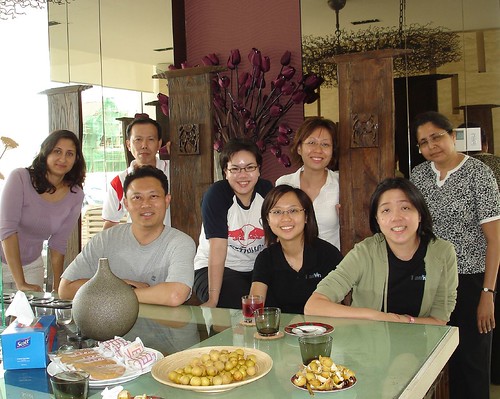 Visited Sentosa twice in three days! This time it was to accompany our new J1s while they ran around the island on their orientation activities.
EmL kindly let us have the run of her house in Sentosa Cove, so we set up an impromptu base of operations in the most luxurious of surroundings most of us have ever seen in our pathetic little poverty-stricken lives.
There was nothing but exclamations of 'wow!' from the entourage as we went room-to-room on our grand tour. From the living room that seems to float on a koi pond, to the open-concept glass bathrooms, the backyard boat-dock, the swimming pool surrounding the house, the roof-top bbq facility, to the comfy, comfy things that people sit on (including the massage chair that nearly ate Baggy), to the four continental cars in the driveway, we're like, how on earth does anyone ever live in so much wealth and yet still be the down-to-earth, normal, all-round ok person we all know her to be?
'k. Enough gushing.
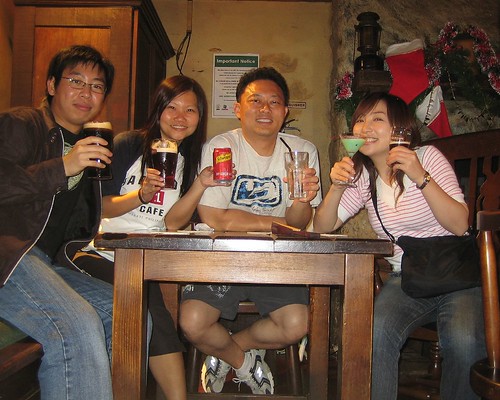 Madoka's arrival threw our lives into utter disarray. June went home to stay with her mom, we neglected our pets, destroyed our diets and drank into the night, foregoing sleep for entertainment.
And despite all the bitchin' and whinin' I've been doing, I had a really great time! We showed her as much as we could of S'pore in the short time she had, and in so doing did some amazing things that we normally wouldn't have done if we didn't have a legitimate excuse.
Hopping the barrier along the river to get a better view of the new year fireworks was one. Having our feet nibbled on by fish at Fish Therapy, Underwater World was another. Jostling with the crowds at Mustafa's while laughing at tacky souvenirs was an eye opener -- whoever would buy a plastic merlion that lights up and sings 'Rasa Sayang' at the flick of a switch?
But full credit to Cammy, without whom this trip might have been a horrible disaster: an embarrassment for us and a total bore-fest for her. With all his non-stop prattle (which would have driven me stark-raving nuts very quickly if I had been his sole audience), he kept Madoka entertained, flirted with and cared for throughout her stay. Between June and myself, we didn't have much to talk to her about. Language was no barrier, but we just couldn't find a common wavelength with each other. I felt so 'uncle' beside her, particularly as I found myself carrying mineral water in an unglam Watson's plastic bag on one day, and a large umbrella to ward off potential rain on another.
If anything, I was behaving like an indulgent otosan with his favourite musume. Now, that was an interesting brush with my paternal side. But Cammy, same age, same interests, his eagerness to learn language from her, and his all-out eyeball-rolling attempts to be amusing at all cost saved the day for us. So glad we brought him on board.
Well, hope Madoka has had a holiday to remember with fondness. And things are settling back to normal at home. Phew! :)
Wednesday, January 02, 2008
Too many late nights and early mornings. My brain is suffering sleep deprivation... can't... conentrate... Meanwhile, Madoka's pix (yet to be captioned) are here.
Tuesday, January 01, 2008
Sunday, December 30, 2007
Madoka arrived in the midst of the worst rainstorm I've ever driven through. Visibility was severely down through my windshield while my wipers and lights were operating at max. And we were late. Her plane had already landed ahead of schedule even as we were getting ready to drive off to meet her at the airport. Fortunately, the torrent didn't last and we were able to take her around and introduce her to S'pore's most favourite pastime pretty much as soon as she arrived:
 Yup, our eating culture. This is at Jumbo Seafood Restaurant, ECP, where we -- me & June, with June's colleagues including Cammy (at right) whom we assigned to escort Madoka on the grounds that he needed to train his conversational Japanese since he is looking for a posting in Japan soon -- demolished three chili crabs (it's been a crabby month for me!), cereal prawns, scallops in yam, and the house not-on-the-menu specialty: some tofu/nametake dish.
 We took her downtown after dinner to Suntec City to have a look at the big fountain. We needed to buy time to let the crabs, et al, digest a bit so we could attack dessert!
 (R-L) June, Madoka, Jamie, Jamie's hubby, Cammy and yours truly look seriously well-fed after cheesecake, chocolate milk, a brownie and ice-cream. NYDC rox!
Oh, and a small reprieve for us. We're putting Madoka up at M-i-L's instead of our place. She'll certainly be more comfortable in a proper guest room than the meagre lodging we can afford her at our place. Hope she can get along with Mimi ok. We'll see how they pass the night...
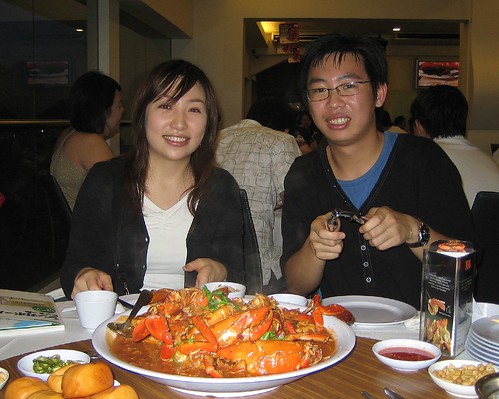 Yup, our eating culture. This is at Jumbo Seafood Restaurant, ECP, where we -- me & June, with June's colleagues including Cammy (at right) whom we assigned to escort Madoka on the grounds that he needed to train his conversational Japanese since he is looking for a posting in Japan soon -- demolished three chili crabs (it's been a crabby month for me!), cereal prawns, scallops in yam, and the house not-on-the-menu specialty: some tofu/nametake dish.
 We took her downtown after dinner to Suntec City to have a look at the big fountain. We needed to buy time to let the crabs, et al, digest a bit so we could attack dessert!
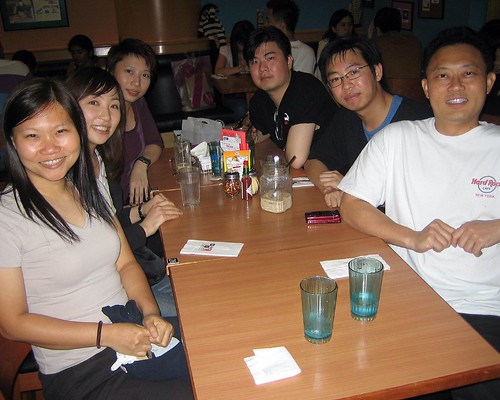 (R-L) June, Madoka, Jamie, Jamie's hubby, Cammy and yours truly look seriously well-fed after cheesecake, chocolate milk, a brownie and ice-cream. NYDC rox!
Oh, and a small reprieve for us. We're putting Madoka up at M-i-L's instead of our place. She'll certainly be more comfortable in a proper guest room than the meagre lodging we can afford her at our place. Hope she can get along with Mimi ok. We'll see how they pass the night...
Subscribe to:
Posts (Atom)