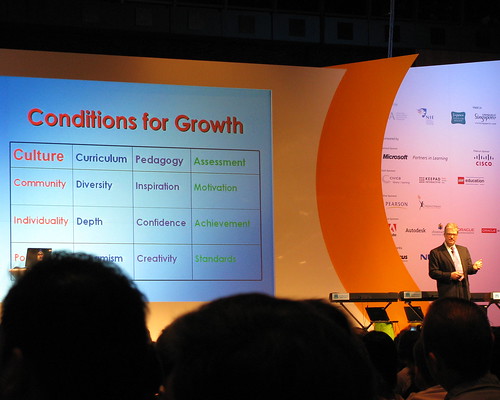
Can't help gushing, but what a rush Day 1 has been. Apart from watching our new Boss unveil our industry's latest IT Masterplan, we also had two illustrious keynote speakers, Sir Ken Robinson, of the ouch-inducing "schools kill creativity" TED address; and Mitch Resnick of the Lifelong Kindergarten, among other things he's doing for MIT.
Inviting these two critics of education systems that have seen little change since the Industrial Revolution tells those of us at implementation level to prepare for a new revolution in education. With the technology that's available to us now, there exists the potential for a tremendous explosion of new ideas and new means of expressing them, but we have to let go of the purely economic, purely functional, assembly line approach to education in order for it to happen. We're moving into an era of teaching and managing creativity, and it's happening right here, right now.
While it might be a tool to achieve "results", we can no longer use fear to drive our kids like we used to. They've got to be happy to come to school and learn whatever it is they are learning. If we say they can only be happy when they receive their Certificates, it's too late because by then they have become "set for life", literally. Learning in this way is only a means to an end, but paradoxically it also puts an end to their means. I'm just saying.
Personally, I've never been so turned on by events like this one; but today I'm accumulated half a small notebook of scribbled thoughts and ideas. I need some quiet to reflect and figure out possible implementation strategies and I'd love for some sensible person to help harness my wild imagination and make it real and workable. Dunno who yet, so I'll just leave it open and see what (or who) Providence turns up.
Anyway, for my personal reference, the following links are John Connell's informal transcripts of some of the key proceedings from yesterday and today:
iCTLT '08: Education 2.0
iCTLT '08: Sir Ken's Keynote
Notes from a Singapore JC, and other matters of domestic life including marriage, pets and middle-class entertainment.
Tuesday, August 05, 2008
Monday, August 04, 2008
International Conference on Teaching and Learning with Technology: Day 0
The Seminar title was promising enough, "Web 2.0: The Power of Learning in a Networked World". But it looks like even Web 1.0 has yet to kick off in this region. Here's an analogy straight from this afternoon's experience: When I walked into the conference this afternoon, there were already some people seated, waiting for the event to begin. We were all individually scattered, keeping as much physical distance from each other as possible.
In a "networked world", the idea is that we'd walk into an environment that we'd find information about each other very quickly, establish common grounds with each other and begin trashing out ideas and opinions almost the instant we met each other. That wasn't happening. Instead, we sat apart, kept doing our own things trying not to attract attention to ourselves until a familiar face walked through the door, and only then to cluster into a node of discussion. Turned out that me, Kev and Wan became the noisiest node (imagine that!) simply because three of us came from the same institution, whereas everyone else came either alone or in a pair at the most.
Because physically we weren't networking as a whole, it was obvious that no one was networking online either. With the exception of yours truly and his little blog, I suppose. And even then, I'm not much of a networker, either. So instead of me learning from more experienced Web 2.0 users, it became more of a session where our speaker, J Connell, tried to convince the rest of his audience to at least get started with a personal blog, and see what happens from there.
Connell also showed us some other useful tools as well, such as RSS aggregators and other means of sharing information amongst a smaller, personally defined audience rather than jumping straight into the wild and wooly world wide web itself. So at least out of this afternoon, I got a clue about some new toys I could start playing with.
Don't know what the situation will be over the next couple of days at the Conference, but I gather so far that I am one of the pioneers in the transformation education is about to undergo now that human knowledge is shifting to occupy an increasingly electronic space. I still have a lot to learn about this promising medium, but because we already have the infrastructure, we might as well figure out how to use it to its best advantage.
To me, that best advantage is to let each learner create his (or her) own "learning environment", sourcing their own materials, experiences, and mentors for whatever it is they want to learn. From the diversity of experiences, a class -- whether physical or online -- becomes a home node for a group of learners who teach and learn from each other. That of course means that the teacher can no longer be the "source" (and we'd be deluding ourselves if we think we still are in this day and age), but an orchestrator of the learning that goes on in the class. That'll be a major task for us, in keeping flexible enough to work all that cacophony into some kind of music that everyone can make sense of.
With the web, there is no more need for content, just relevance and coherence, tempered with strong values. We're rewriting the entire book of pedagogy, and for me, it's cool to be starting on page one.
In a "networked world", the idea is that we'd walk into an environment that we'd find information about each other very quickly, establish common grounds with each other and begin trashing out ideas and opinions almost the instant we met each other. That wasn't happening. Instead, we sat apart, kept doing our own things trying not to attract attention to ourselves until a familiar face walked through the door, and only then to cluster into a node of discussion. Turned out that me, Kev and Wan became the noisiest node (imagine that!) simply because three of us came from the same institution, whereas everyone else came either alone or in a pair at the most.
Because physically we weren't networking as a whole, it was obvious that no one was networking online either. With the exception of yours truly and his little blog, I suppose. And even then, I'm not much of a networker, either. So instead of me learning from more experienced Web 2.0 users, it became more of a session where our speaker, J Connell, tried to convince the rest of his audience to at least get started with a personal blog, and see what happens from there.
Connell also showed us some other useful tools as well, such as RSS aggregators and other means of sharing information amongst a smaller, personally defined audience rather than jumping straight into the wild and wooly world wide web itself. So at least out of this afternoon, I got a clue about some new toys I could start playing with.
Don't know what the situation will be over the next couple of days at the Conference, but I gather so far that I am one of the pioneers in the transformation education is about to undergo now that human knowledge is shifting to occupy an increasingly electronic space. I still have a lot to learn about this promising medium, but because we already have the infrastructure, we might as well figure out how to use it to its best advantage.
To me, that best advantage is to let each learner create his (or her) own "learning environment", sourcing their own materials, experiences, and mentors for whatever it is they want to learn. From the diversity of experiences, a class -- whether physical or online -- becomes a home node for a group of learners who teach and learn from each other. That of course means that the teacher can no longer be the "source" (and we'd be deluding ourselves if we think we still are in this day and age), but an orchestrator of the learning that goes on in the class. That'll be a major task for us, in keeping flexible enough to work all that cacophony into some kind of music that everyone can make sense of.
With the web, there is no more need for content, just relevance and coherence, tempered with strong values. We're rewriting the entire book of pedagogy, and for me, it's cool to be starting on page one.
Sunday, August 03, 2008
Q-tip attends the Singapore Dog Walk 2008
Saturday, August 02, 2008
The Move progresses past another checkpoint
First appointment completed without a hitch. All HDB wanted to check was our eligibility to buy and their's to sell. So after a quick round of document verification and signature collecting, the relevant authority has approved the transaction... and we are another step closer to our big move north.
Big ticket expenses for today: paid off our agency for successfully brokering this deal, then made our downpayment for laminate flooring by Vohringer. We need the flooring to lay over the existing granite tile, which in itself is very nice but of a colour we are unable to work with 'cos it's just wrong -- too dark and too red for our taste.
Now attempting to balance between watching TV and putting a dent in my pile of essays. So far the TV's winning...
Big ticket expenses for today: paid off our agency for successfully brokering this deal, then made our downpayment for laminate flooring by Vohringer. We need the flooring to lay over the existing granite tile, which in itself is very nice but of a colour we are unable to work with 'cos it's just wrong -- too dark and too red for our taste.
Now attempting to balance between watching TV and putting a dent in my pile of essays. So far the TV's winning...
Friday, August 01, 2008
"Life was simpler when we had less money..."
In preparation for our first appointment at the HDB, I was running around like a mad thing trying to transfer the funds I cashed out of my CPF investments back into my Ordinary Account to be able to have a sufficient balance for the downpayment of our new digs. Nearly freaked out when the nice, young banker boy who attended to me warned that it would take three to four working days to clear the transaction. That's a wee bit too late, considering I needed the money like, let me see... tomorrow!
But no, I don't, actually. After some panicked clarifications, I realised that it was only during our second appointment (at which we collect our keys) that we need to make any significant payments, and not the first. So everything should be all in readiness when I require it, after all. Got myself all worked up for nothing. :p
Now working on collecting all the documents I need to bring tomorrow. Hope I've got everything...
But no, I don't, actually. After some panicked clarifications, I realised that it was only during our second appointment (at which we collect our keys) that we need to make any significant payments, and not the first. So everything should be all in readiness when I require it, after all. Got myself all worked up for nothing. :p
Now working on collecting all the documents I need to bring tomorrow. Hope I've got everything...
Thursday, July 31, 2008
2 wakes in a week
Must be my week for attending wakes. Last Friday, it was for Aggie's mom; today for Cammy's granny. Both deceased had lived till quite a ripe old age, both enjoyed being well taken care of until the end. That, above everything else, is the most anyone can realistically ask for in this lifetime.
Sorry I couldn't join the guys for dinner but happy birthday, anyway, to Sha and Josh!
Wednesday, July 30, 2008
Tuesday, July 29, 2008
Where do all the babies go?
There's a dearth of babies in S'pore, isn't there? That's the reason for the latest frenzy of mooting fresh incentives for married couples to bravely face the full consequences of their private activities without taking the necessary safety precautions.
Yet one institution seems to be doing its math and coming up with a different answer from our local census bureau. NY kindergarten will be opening its doors to 500+ pre-schoolers from next year. 700 others are on the waiting list.
Parents are willing to fork out close to $1K per three-month term to give their precious a headstart in Chinese language education. That'll nicely pay for all the lovely facilities Junior will be enjoying on campus, like the gym and the kitchen (aerobics instructors, master chefs and fire-safety officials don't come cheap).
The rock-climbing facility isn't for the students. It's for the teachers. Looking after 500+ screaming kids and the parents of 700 other kids still on the waiting list, that's the wall they'll be driven up before each day is over.
Um, what's a "singlethon"? Is that like the festival in which they catch singles, tie them to a stake and mercilessly goad them with biological clocks until they cough up a million bucks in donations? If there's money to be made, it's sure worth exploring...
Yet one institution seems to be doing its math and coming up with a different answer from our local census bureau. NY kindergarten will be opening its doors to 500+ pre-schoolers from next year. 700 others are on the waiting list.
Parents are willing to fork out close to $1K per three-month term to give their precious a headstart in Chinese language education. That'll nicely pay for all the lovely facilities Junior will be enjoying on campus, like the gym and the kitchen (aerobics instructors, master chefs and fire-safety officials don't come cheap).
The rock-climbing facility isn't for the students. It's for the teachers. Looking after 500+ screaming kids and the parents of 700 other kids still on the waiting list, that's the wall they'll be driven up before each day is over.
Um, what's a "singlethon"? Is that like the festival in which they catch singles, tie them to a stake and mercilessly goad them with biological clocks until they cough up a million bucks in donations? If there's money to be made, it's sure worth exploring...
Monday, July 28, 2008
*crickets chirping in the background
Staffroom looks quite empty today, at least my section of it. People have gone on course or are sick at home. It's quiet, but perhaps a little too quiet.
Could this be a preview of things to come?
Sunday, July 27, 2008
How blue is my S'porean II?
Perhaps it's my personal bias. I have a sense of pride when I encounter more than the usual ethnic demographic of people who are making a living here. To know that tiny us have made such an impact on the far-flung corners of the world, and that people there choose to relocate all the way here to share in what we have to offer. I'm proud that we have made this place more than the rock that it is, so much so that we CAN share it with others.
Immigration is a sore point though, for indigenous peoples. Lax Immigration policies practically wiped out native American culture, today's Europeans are antsy about their non-euro enclaves. The Bumis are worried about their Indian and Chinese neighbours.
As for us, we can't exactly say we are indigenous to this island. The majority of us ARE ourselves immigrants who have chosen this place as our home, much in the same way as new immigrants are choosing this place as home. No one's replacing anyone, it's just a continuation of the process that kick-started us into life in the first place.
We immigrant stock are nomadic in nature. We pick a place, we try to settle down and make a living; like it, we stay, don't like, we move on. We identify opportunities, we take opportunities, we make the best use of our opportunities. What more education do we need than that? That's us, our S'porean identity. We freeze, we die, plain and simple.
As for NS: in an actual conflict, we only fight for those we love and care for. We are not protecting anyone other than ourselves, so who cares about FTs who don't serve NS? In a fight, who's going to give them a gun? But in any case, I hope that in the spirit of true neighbourliness, we can still extend our protection to them anyway because they may yet be a generation short of becoming us.
And in any case, with so many different countries our FTs come from, which country could declare war on us and not declare war on their own people? The more people from more countries we can attract to live here and like it, the safer we are. FTs form a natural line of national defence, whether they actively serve NS or not.
Our success cannot be measured in economic terms but rather in the amount of people we can keep on attracting as partners, friends and eventually neighbours... possibly family? The smooth intermingling of our collective blood, sweat and tears is the fuel that makes us the powerhouse of our region. Our unique blend confounds our competing neighbouring nations -- they can never emulate our high-octane formula and that gives us our sole edge in this deadly game of political survival. Let's keep the fuel lines open, and not clog it up with bigotry and our sense of "born S'porean" entitlement as if that gave us some special privilege over everyone else here.
It's still a jungle where we live. It's good to keep sharp and stay wary of predators. We could get rid of all the predators (say via tightening up Immigration laws, etc.), but animals that live without fear of predation usually live on the farm where they are penned and fed till fat, then slaughtered to feed others. Dunno about you, I'll take my chances in the jungle any day.
Hey, RX, I've always enjoyed reading your GP essays. Glad to see NS hasn't dulled your edge. It's great to hear from you again!
Immigration is a sore point though, for indigenous peoples. Lax Immigration policies practically wiped out native American culture, today's Europeans are antsy about their non-euro enclaves. The Bumis are worried about their Indian and Chinese neighbours.
As for us, we can't exactly say we are indigenous to this island. The majority of us ARE ourselves immigrants who have chosen this place as our home, much in the same way as new immigrants are choosing this place as home. No one's replacing anyone, it's just a continuation of the process that kick-started us into life in the first place.
We immigrant stock are nomadic in nature. We pick a place, we try to settle down and make a living; like it, we stay, don't like, we move on. We identify opportunities, we take opportunities, we make the best use of our opportunities. What more education do we need than that? That's us, our S'porean identity. We freeze, we die, plain and simple.
As for NS: in an actual conflict, we only fight for those we love and care for. We are not protecting anyone other than ourselves, so who cares about FTs who don't serve NS? In a fight, who's going to give them a gun? But in any case, I hope that in the spirit of true neighbourliness, we can still extend our protection to them anyway because they may yet be a generation short of becoming us.
And in any case, with so many different countries our FTs come from, which country could declare war on us and not declare war on their own people? The more people from more countries we can attract to live here and like it, the safer we are. FTs form a natural line of national defence, whether they actively serve NS or not.
Our success cannot be measured in economic terms but rather in the amount of people we can keep on attracting as partners, friends and eventually neighbours... possibly family? The smooth intermingling of our collective blood, sweat and tears is the fuel that makes us the powerhouse of our region. Our unique blend confounds our competing neighbouring nations -- they can never emulate our high-octane formula and that gives us our sole edge in this deadly game of political survival. Let's keep the fuel lines open, and not clog it up with bigotry and our sense of "born S'porean" entitlement as if that gave us some special privilege over everyone else here.
It's still a jungle where we live. It's good to keep sharp and stay wary of predators. We could get rid of all the predators (say via tightening up Immigration laws, etc.), but animals that live without fear of predation usually live on the farm where they are penned and fed till fat, then slaughtered to feed others. Dunno about you, I'll take my chances in the jungle any day.
Hey, RX, I've always enjoyed reading your GP essays. Glad to see NS hasn't dulled your edge. It's great to hear from you again!
Saturday, July 26, 2008
Going once, twice... sold!
Oh-tee-pee signed this morning. Barring any unforseen complications, our house is going to a nice FT family. The agreed price is reasonable for our location and considering the market as it is, we are very happy. Made a much smaller loss than expected, 4-figures instead of the five we were anticipating when we began this mad adventure of ours.
Then this news hits the morning papers: "Yishun to get exciting new facilities in facelift". FT family looks like they've got a good deal too. How's that for win-win?
Friday, July 25, 2008
How blue is my S'porean?
We don't even have 50 years of history as a nation, but we already seem to have developed a sharply defined distinction between whom we consider to be true-blue S'poreans and who are "foreign talents" (FTs). We've got people quibbling over losing jobs to FTs, rights to purchase public housing, attend public schools, and now the right to represent the nation in sports.
A true S'porean is someone who was born in the S'pore, and has... um... well, apart from the guys having to serve NS, there isn't really much else. Just how many people in the world can qualify by this drinking-straw narrow definition to be S'porean, then? A couple of million, maybe, out of six billion? We have no history, no land mass, and no critical mass to even make up a decent self-replenishing population, and we still have the temerity to demand an exclusive membership in this little country-club of ours. Right.
When are people going to realize that erecting fences around ourselves is more likely going to keep us in, all nicely penned up suffocating in our own dung, rather than keep other people out? No one would come here willingly anyway, unless we gave them a reason. We ourselves were once cast-offs hailing from other lands, though now having made good, we have excised from our memories the bad old days. This nation grew on the backs of lost souls seeking a better life. When the Brits put out the call that anyone with adventure in their hearts and nothing else in their pockets and stomachs could try their luck here or bust, we were the first to line up at Immigration. Nothing has changed since then, except that we're now starting to get uppity, looking down our noses at our newly-arrived FTs and exclaiming, "there goes the neighbourhood!"
It makes no sense to deny FTs housing and education. How else are they going to assimilate into our community and become S'porean? If they can live door to door with us, struggle through public education with us, they will BE us. Otherwise we segregate them, put their kids in private schools and make them live in separate housing, and then they'll either feel discriminated against, or possibly even superior to us. Neither reaction is going to engender any strong affinity for us and make them want to put their roots down should the choice ever come up for them.
And if they can help us set new standards in sporting and other achievement willingly under our colours, then they represent the best and brightest our nation has to offer. Hiding them under a bushel is simply a pure waste of available talent.
Like it or not, we are an immigrant nation. Our open door through which people freely come and go is an integral part of our success. Close it and we kill the goose that lays our golden eggs.
A true S'porean is someone who was born in the S'pore, and has... um... well, apart from the guys having to serve NS, there isn't really much else. Just how many people in the world can qualify by this drinking-straw narrow definition to be S'porean, then? A couple of million, maybe, out of six billion? We have no history, no land mass, and no critical mass to even make up a decent self-replenishing population, and we still have the temerity to demand an exclusive membership in this little country-club of ours. Right.
When are people going to realize that erecting fences around ourselves is more likely going to keep us in, all nicely penned up suffocating in our own dung, rather than keep other people out? No one would come here willingly anyway, unless we gave them a reason. We ourselves were once cast-offs hailing from other lands, though now having made good, we have excised from our memories the bad old days. This nation grew on the backs of lost souls seeking a better life. When the Brits put out the call that anyone with adventure in their hearts and nothing else in their pockets and stomachs could try their luck here or bust, we were the first to line up at Immigration. Nothing has changed since then, except that we're now starting to get uppity, looking down our noses at our newly-arrived FTs and exclaiming, "there goes the neighbourhood!"
It makes no sense to deny FTs housing and education. How else are they going to assimilate into our community and become S'porean? If they can live door to door with us, struggle through public education with us, they will BE us. Otherwise we segregate them, put their kids in private schools and make them live in separate housing, and then they'll either feel discriminated against, or possibly even superior to us. Neither reaction is going to engender any strong affinity for us and make them want to put their roots down should the choice ever come up for them.
And if they can help us set new standards in sporting and other achievement willingly under our colours, then they represent the best and brightest our nation has to offer. Hiding them under a bushel is simply a pure waste of available talent.
Like it or not, we are an immigrant nation. Our open door through which people freely come and go is an integral part of our success. Close it and we kill the goose that lays our golden eggs.
Thursday, July 24, 2008
"I don't know!"
Kids are looking lost and panicky over their second common test paper. Essay exams drive them nuts because their instant response is to assume they know nothing about the topics the questions cover. But that's exactly the point of essay exams, particularly for GP. There is no other reason to take GP than to train in crafting out a rational answer to any question to which our initial response is, "how the ^%#$ should I know??"
GP is humbling that way. Every essay begins with zero knowledge. Unlike the other academic subjects the kids are taking in the JC, it is the question that is more important than the answer. A GP essay is little more than the breaking apart of the question and examining or exploring the intricacies of each little component and then reassembling it all back within the context provided by the question. This is excellent preparation for the Uni at which every question in any subject they will encounter will be structured more or less like this.
It helps to have lots of background knowledge of the subject. The more knowledge we have the more facets we can appreciate of the question, but having comprehensive knowledge is not mandatory. There's only so many bits we can play with in the 800 word limit.
The less the knowledge, the higher the fudge factor. It's best to keep the knowledge up, of course, but it's sufficient to strike a balance between the two. That's the real skill, and that's how most questions get answered in the real world, anyway.
The best questions are those that answer themselves. A good GP student will be able to identify such questions and let it take the lead in coming to an answer.
The higher up the education ladder we climb, the less we know, we realize. But that's great! "I haven't a clue" is the best way to begin answering a question. In fact, it's the only way.
GP is humbling that way. Every essay begins with zero knowledge. Unlike the other academic subjects the kids are taking in the JC, it is the question that is more important than the answer. A GP essay is little more than the breaking apart of the question and examining or exploring the intricacies of each little component and then reassembling it all back within the context provided by the question. This is excellent preparation for the Uni at which every question in any subject they will encounter will be structured more or less like this.
It helps to have lots of background knowledge of the subject. The more knowledge we have the more facets we can appreciate of the question, but having comprehensive knowledge is not mandatory. There's only so many bits we can play with in the 800 word limit.
The less the knowledge, the higher the fudge factor. It's best to keep the knowledge up, of course, but it's sufficient to strike a balance between the two. That's the real skill, and that's how most questions get answered in the real world, anyway.
The best questions are those that answer themselves. A good GP student will be able to identify such questions and let it take the lead in coming to an answer.
The higher up the education ladder we climb, the less we know, we realize. But that's great! "I haven't a clue" is the best way to begin answering a question. In fact, it's the only way.
Wednesday, July 23, 2008
Let the bidding begin!
We finally got an offer for this old house. Just as we were starting to develop an inferiority complex, we received at least an indication that someone was looking at us with more than just a passing interest. There were a couple of other interested parties who raised an eyebrow at us earlier, but took to their heels the instant they noticed some inexplicable feng shui problem they could not reconcile. We've never had a problem living here, but beliefs are beliefs, so whatever.
The offer is no great shakes, nowhere near the king's ransom we were hoping for. But it's a start. We know now how the market values our piece of humble real estate in actual dollars and cents and we're prepared to be realistic ourselves.
And now we wait while they mull over our counter-offer. Make us happy, please.
The offer is no great shakes, nowhere near the king's ransom we were hoping for. But it's a start. We know now how the market values our piece of humble real estate in actual dollars and cents and we're prepared to be realistic ourselves.
And now we wait while they mull over our counter-offer. Make us happy, please.
Tuesday, July 22, 2008
From the horse's mouth
Spent the last couple of days taking lessons on critical thinking from John B, the man, himself. His technique is simple: layer in a little theory, throw us a bone to maul together in small groups, review the carnage, peppering it with bits of additional techniques, cautions, and other interesting little nuggets as the situation warrants. His lessons are easy-going, free-flowing chat sessions that really made us feel like we were actually learning something... not foreign or alien from ourselves but something we had in ourselves already but hadn't properly awakened yet.
Every discussion was a test, but we weren't testing each other. Rather, we were putting ideas to the test as we took them apart and looked at whether they worked or not, how they worked if they did and where they failed when they didn't. Nothing was personal. I messed up my evaluations a few times, but hey, no pressure; it's all just part of the learning curve, anyway. I never once felt I'd got things so wrong that I was too intimidated to say whatever came to mind the next time something did come to mind.
Good food (yesterday, Ragazzi; today, Colbar) and pleasant company for lunch added additional motivation to a couple of days well spent.
Every discussion was a test, but we weren't testing each other. Rather, we were putting ideas to the test as we took them apart and looked at whether they worked or not, how they worked if they did and where they failed when they didn't. Nothing was personal. I messed up my evaluations a few times, but hey, no pressure; it's all just part of the learning curve, anyway. I never once felt I'd got things so wrong that I was too intimidated to say whatever came to mind the next time something did come to mind.
Good food (yesterday, Ragazzi; today, Colbar) and pleasant company for lunch added additional motivation to a couple of days well spent.
Saturday, July 19, 2008
Drama seniors say bye-bye!
NYeDC Seniors’ Farewell Party 08
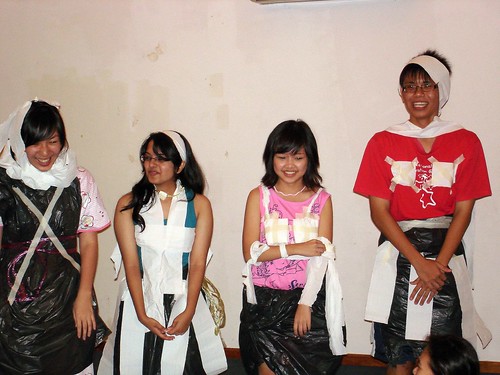
Never any tears in an NYeDC farewell, we had a silly time at our little soiree making speeches, giving gifts, and enjoying lots of laughter at what is probably the last time the 07 batch will be having any fun at all, at least till their finals are over.
The seniors were seriously out to cause a riot, taking so much trouble to dress especially for the occasion. They were hilarious in their rented costumes. The juniors impressed with their meticulous programme, the attention to detail in improvising a dining hall from a classroom, and for once the food was really good -- catered (which we were happy to pay for) rather than self-burned on a bbq grill, which has been a standard practice for the club as far back as I've known it.
The juniors devised a nutty game to keep us entertained: a cross between bingo and a lucky dip. Up for grabs was an iPod and only those who bingo-ed were eligible to dip for it. The risk was that there were equal odds of lucky and unlucky prizes. But for the 'pod we all put our faces and reputations on the line. Interestingly enough, all the prized were "donated" by the juniors; all stuff they didn't want anymore and "freecycled" for a laugh.
As no one had won the 'pod by the third bingo round, we decided to just put our names in a pot and just draw for it. It was sweet of the seniors who wrote Mel's name on their own ballots, rigging the draw so she'd win it in the end. The 'pod wasn't in working condition anyway, but it was the thought that counted. Heh.
I'm sad to lose the crazy do-anything-for-a-laugh seniors. Their creativity, spirit and energy is so crucial to projecting an impressive on-stage presence. But their successors, the 08 batch, have also been amazing in their self-motivation, organization and planning abilities. With these assets and their desire to improve on their stagecraft, I think the run-up to next year's Drama Night might just be very interesting.
Friday, July 18, 2008
The Dark Joke
It's the Joker we want to see in Batman movies. In "The Dark Knight", Heath Ledger's interpretation is as chilling as we might ever get. Ledger's Joker is no criminal; more like a violent, wanton, sadistic anarchist. He has no agenda beyond playing the role of the bringer of Chaos, and delights in being the spoiler of well-made plans. His aim is to bring an end to social order. Every system is an equal opportunity target, even organized crime. His theory is to eliminate those at the top and the people down the line will eventually turn on and destroy themselves.
The odd thing about this Joker is that he has no "origin" backstory. Just as his face hides behind that grotesque mask, his identity is a complete mystery. It's like he has no beginning and consequently, no end either. He could be anyone, and no one. He is thus the ideal metaphor for the unknown a paranoid nation fears, freaked out by terrorists hiding in every flitting shadow.
The Joker's machinations are sadistic experiments in how far he can push the people he places in mortal moral dilemmas to cross the line. And in Gotham City, so reliant on the Bat as their protector and guardian, and so sold on Harvey Dent's grand vision to turn its crime-ridden streets completely around, the Joker wants to know if the Gothamites have it in them to save themselves when they have no confidence left in their fragile social structures and systems once he's trashed them.
The Bat, rock-solid, honourable, courageous, in possession of a social conscience, and displaying a fighting style so efficient it's almost perfunctory, is every bit the warrior-hero we expect him to be. He too is an anarchist of a different sort. He upholds justice but is not constrained by the legal system. The anonymity behind the mask and a fat bank balance helps. But as the mask hides his face, his is not the face the public can trust.
The Bat, he's the devil we know. The Joker, he's the one we don't. Maniac, unpredictable, menacing, and with serously bad hair, he's the one who hooks us with horrid fascination in this movie. The Joker pulls the strings and the Bat has to play along. With his deft manipulations, Harvey Dent transforms from hero to monster. "The Dark Knight" is a vehicle for the Joker, the raison d'etre that brings his supporting cast to life. The Bat and Dent lose so much to the Joker's insanity. What did it cost Heath Ledger to bring this incarnation of the Joker to life?
The odd thing about this Joker is that he has no "origin" backstory. Just as his face hides behind that grotesque mask, his identity is a complete mystery. It's like he has no beginning and consequently, no end either. He could be anyone, and no one. He is thus the ideal metaphor for the unknown a paranoid nation fears, freaked out by terrorists hiding in every flitting shadow.
The Joker's machinations are sadistic experiments in how far he can push the people he places in mortal moral dilemmas to cross the line. And in Gotham City, so reliant on the Bat as their protector and guardian, and so sold on Harvey Dent's grand vision to turn its crime-ridden streets completely around, the Joker wants to know if the Gothamites have it in them to save themselves when they have no confidence left in their fragile social structures and systems once he's trashed them.
The Bat, rock-solid, honourable, courageous, in possession of a social conscience, and displaying a fighting style so efficient it's almost perfunctory, is every bit the warrior-hero we expect him to be. He too is an anarchist of a different sort. He upholds justice but is not constrained by the legal system. The anonymity behind the mask and a fat bank balance helps. But as the mask hides his face, his is not the face the public can trust.
The Bat, he's the devil we know. The Joker, he's the one we don't. Maniac, unpredictable, menacing, and with serously bad hair, he's the one who hooks us with horrid fascination in this movie. The Joker pulls the strings and the Bat has to play along. With his deft manipulations, Harvey Dent transforms from hero to monster. "The Dark Knight" is a vehicle for the Joker, the raison d'etre that brings his supporting cast to life. The Bat and Dent lose so much to the Joker's insanity. What did it cost Heath Ledger to bring this incarnation of the Joker to life?
Thursday, July 17, 2008
Yearbook photo and LC invig
Wayne's the kind of friend who will lend you the shirt off his back. Literally. I needed a proper shirt to wear for the staff photo shoot today 'cos the one I was wearing would have looked absolutely hideous with a tie. Trust me to forget the College yearbook shoot ends today.
The photog had rather mundane ideas for our poses. They were basically police mugshots, two each of full-frontal, and left 'n right 3/4 shots. The only difference was that we didn't have to pose carrying our own serial numbers and we were made to smile like a North Korean in the personal presence of Kim Jong Il himself.
Today was also Listening Comprehension invigilation day. The radio I signed out must have been defective. In order to receive a clear signal the radio insisted that I place myself directly behind the antenna and remain completely motionless until the broadcast ended. Any slight movement I made resulted in static. Anywhere else I stood in the room resulted in static.
The kids seemed quite amused as I arranged myself in different configurations to ensure optimal reception. Standing on one leg didn't help, thank God. Eventually, the radio and I negotiated for a sitting position, both palms flat on the table, elbows akimbo, and I remained roughly frozen in place for the duration.
Oddly enough, I actually understood three of the four stories read in Mandarin over the radio. I'm quite proud of myself now. The first story was about a guy and a seashell he picked up on the beach and then some philosophy about shells being used as money and something about aesthetics which I couldn't quite get. Number two was some guy lamenting that his college buddy's standard of Chinese language was deteriorating with every pretty postcard he receives every year from him. Three was a vignette of a 4th grade student volunteer at a library who was so dedicated to his job, he kept on working there every day even though he had to move elsewhere to live and attend school. This dedicated little tyke turns out to be little Billy Gates whom we know better as an adult than as a 4th grader. The final story was this bizarre father-son bonding activity in which the father plays "trust me" mind games with his 9 year-old. The results of this bonding session will probably be analyzed thoroughly by a professional whom the kid will inevitably be consulting once he gets older.
Wonder if my Chinese is getting better or if today's paper was exceptionally easy?
The photog had rather mundane ideas for our poses. They were basically police mugshots, two each of full-frontal, and left 'n right 3/4 shots. The only difference was that we didn't have to pose carrying our own serial numbers and we were made to smile like a North Korean in the personal presence of Kim Jong Il himself.
Today was also Listening Comprehension invigilation day. The radio I signed out must have been defective. In order to receive a clear signal the radio insisted that I place myself directly behind the antenna and remain completely motionless until the broadcast ended. Any slight movement I made resulted in static. Anywhere else I stood in the room resulted in static.
The kids seemed quite amused as I arranged myself in different configurations to ensure optimal reception. Standing on one leg didn't help, thank God. Eventually, the radio and I negotiated for a sitting position, both palms flat on the table, elbows akimbo, and I remained roughly frozen in place for the duration.
Oddly enough, I actually understood three of the four stories read in Mandarin over the radio. I'm quite proud of myself now. The first story was about a guy and a seashell he picked up on the beach and then some philosophy about shells being used as money and something about aesthetics which I couldn't quite get. Number two was some guy lamenting that his college buddy's standard of Chinese language was deteriorating with every pretty postcard he receives every year from him. Three was a vignette of a 4th grade student volunteer at a library who was so dedicated to his job, he kept on working there every day even though he had to move elsewhere to live and attend school. This dedicated little tyke turns out to be little Billy Gates whom we know better as an adult than as a 4th grader. The final story was this bizarre father-son bonding activity in which the father plays "trust me" mind games with his 9 year-old. The results of this bonding session will probably be analyzed thoroughly by a professional whom the kid will inevitably be consulting once he gets older.
Wonder if my Chinese is getting better or if today's paper was exceptionally easy?
Wednesday, July 16, 2008
Model Homeowner
Strangers merrily traipsing around my house is something I'll never get used to. It feels all the more creepy for me as the agent we engaged does all our interacting for us. He's taking our viewers around, chatting and making nice with them, while us two gormless blockheads remain seated and frozen on the living room carpet pretending to be busy watching TV. We'd like to be nicer hosts, really, but we don't trust our own blabbermouths in case we say something stupid about our house that the viewers might take negatively and use as an excuse to bargain down our asking price. So sitting there on the carpet, I feel like Steve Martin's character in "Dirty Rotten Scoundrels", playing his Ruprecht, the Monkey Boy role.
Or else like an animatronic mannequin posing in a showflat, supposedly enjoying his idyllic environs, being the object of envy of every prospective buyer that walks in. *click, wrirr... "my_house_is_great. wanna_buy_it?" ...bzzzt!
Monday, July 14, 2008
When strangers walk into your house and start pointing at various nooks and crannies, whispering among themselves, you know that what you once thought of as yours is no longer. In snatches of overheard conversation, people are weighing the possibilities of converting my living room into a balcony, running cable TV into the bedrooms and partitioning off my dining room and air-conditioning it. Perhaps a serious offer will be coming by our way soon?
Hellboy 2: TGA sort of echoes the human vs nature theme that we've already seen in Prince Caspian and LOTR, except the battleground is the urban landscape of human civilization. It's Nature fighting back in a small, almost helpless way, as the revolt is practically led by a one-elf army while Nature, the faction he purports to fight for, wants no part of his revolution. All Prince Nuada has is his wushu fighting style, a hulking bruiser for a friend, oh, and an evil plan to unleash the ultimate weapon that will extinguish humankind from the face of the earth.
Hellboy himself isn't much different from Nuada. He fights for a people who does not want anything to do with him, their initial admiration turning to fear and distrust when in a pitched battle a city block gets pretty much levelled through melee combat and small(?)-arms fire while they watch in horror.
The problem with Nuada is that he is too focused on a single goal, making him psychotically obsessive and unable to tell friend from foe. So bent is he on vengeance that it's all he thinks about. It's all he trains his body for, it's all his schemes are directed towards, and he no longer cares what he has to sacrifice in order to get what he wants.
In contrast, Hellboy has lots of things to distract him from brooding over his unpleasant future destiny. There's his job, his friends, his smokes, candy, booze, TV, and his girlfriend, Liz, whose explosive tantrums with him are alarmingly increasing in frequency. "I'd give my life for her, but she wants me to do the dishes", he grumbles to Abe, his fishy friend. A typical sentiment of us guys for whom women will always be the Great Mystery.
I like the movie for it's portrayal of simple, mundane humanity that stands out in contrast to the fantastic, bizarre creatures and environments of del Toro's design. Even the constant chaos of the BPRD (Hellboy's secret home base and office) is just another normal day on the job for the blokes working there. Despite our vulnerabilities and what we consider our faults and vices, it's still great to be human.
Hellboy himself isn't much different from Nuada. He fights for a people who does not want anything to do with him, their initial admiration turning to fear and distrust when in a pitched battle a city block gets pretty much levelled through melee combat and small(?)-arms fire while they watch in horror.
The problem with Nuada is that he is too focused on a single goal, making him psychotically obsessive and unable to tell friend from foe. So bent is he on vengeance that it's all he thinks about. It's all he trains his body for, it's all his schemes are directed towards, and he no longer cares what he has to sacrifice in order to get what he wants.
In contrast, Hellboy has lots of things to distract him from brooding over his unpleasant future destiny. There's his job, his friends, his smokes, candy, booze, TV, and his girlfriend, Liz, whose explosive tantrums with him are alarmingly increasing in frequency. "I'd give my life for her, but she wants me to do the dishes", he grumbles to Abe, his fishy friend. A typical sentiment of us guys for whom women will always be the Great Mystery.
I like the movie for it's portrayal of simple, mundane humanity that stands out in contrast to the fantastic, bizarre creatures and environments of del Toro's design. Even the constant chaos of the BPRD (Hellboy's secret home base and office) is just another normal day on the job for the blokes working there. Despite our vulnerabilities and what we consider our faults and vices, it's still great to be human.
Friday, July 11, 2008
Free childcare and paternity leave to encourage more births in the S'pore? Ok, free childcare would take some of the financial pinch from raising a kid for a fraction of the 20+ year commitment that parents here face per kid, but paternity leave sounds as attractive as a root canal with only a sledgehammer for anesthetic.
Taking a year off work is in itself tempting, but paternity leave isn't exactly a summer vacation on a pristine tropical beach with an umbrella drink in hand. Paternity leave's never caught on because more often than not, the paternal half of the genetic merger would rather slog out an 18-hour shift at the office where the stress is constant but predictable, than stay home all day spooning mush into one end while manoeuvring around drool and barf, and cleaning poop out the other. Waking up at 4 a.m. isn't for driving out into the country for a spot of fishing, it's to calm a little banshee with a bottle in his mouth instead of over the head... mutter... grumble... yawn... zzz.
I dunno. Alvin would like nothing better than to come home to a brood of kids; he says that's what will ease his day and make him feel all calm and blissful after a hard day at work. Me, nothing raises my blood pressure faster than a little 'un, not to mention being surrounded by them. To me, that's stress I don't need. I'm fine if I happen to be temporarily looking after a kid or two that I can happily return to sender after a few minutes, but who am I going to return my genetic offspring to if I need to get on with my life? As a responsible person, if I made the mess, I have to clean it up. So let's not start, shall we?
Ultimately, it isn't about more incentives to boost the population. People who want kids will have them anyway, regardless. It's the growing number of people like me, all with shrivelled, blackened, hardened raisins that pass for our hearts that need to be addressed. Go all Scandinavian on us if you like. Doubt we'll budge.
Taking a year off work is in itself tempting, but paternity leave isn't exactly a summer vacation on a pristine tropical beach with an umbrella drink in hand. Paternity leave's never caught on because more often than not, the paternal half of the genetic merger would rather slog out an 18-hour shift at the office where the stress is constant but predictable, than stay home all day spooning mush into one end while manoeuvring around drool and barf, and cleaning poop out the other. Waking up at 4 a.m. isn't for driving out into the country for a spot of fishing, it's to calm a little banshee with a bottle in his mouth instead of over the head... mutter... grumble... yawn... zzz.
I dunno. Alvin would like nothing better than to come home to a brood of kids; he says that's what will ease his day and make him feel all calm and blissful after a hard day at work. Me, nothing raises my blood pressure faster than a little 'un, not to mention being surrounded by them. To me, that's stress I don't need. I'm fine if I happen to be temporarily looking after a kid or two that I can happily return to sender after a few minutes, but who am I going to return my genetic offspring to if I need to get on with my life? As a responsible person, if I made the mess, I have to clean it up. So let's not start, shall we?
Ultimately, it isn't about more incentives to boost the population. People who want kids will have them anyway, regardless. It's the growing number of people like me, all with shrivelled, blackened, hardened raisins that pass for our hearts that need to be addressed. Go all Scandinavian on us if you like. Doubt we'll budge.
Thursday, July 10, 2008
Of the few people viewing my place, we had a big surprise last night when none other than Chewie showed up at our front door with Zak, maid and her mom-in-law in tow. Her m-i-l is in the market for new digs, we've got ours on offer.
It was funny to watch Zak get aqcuainted with Q-tip. He was so tentative as he took stabs at her fur with his tiny fingers; and the cats, who kept their distance, fascinated him.
So, of everyone I know only Chewie has seen the inside of my sanctum sanctorum. Since we're selling, any day is open house day. No more closed door policy to drop-ins, friends or strangers alike, at least for now.
Her m-i-l seems impressed with her tour and she's making a second visit tonight, but she isn't exactly jumping to make a bid just yet. It's that kind of a dicey market in property. Everyone's playing it cautiously, cards close to chest. Everyone's looking for a fair deal.
It was funny to watch Zak get aqcuainted with Q-tip. He was so tentative as he took stabs at her fur with his tiny fingers; and the cats, who kept their distance, fascinated him.
So, of everyone I know only Chewie has seen the inside of my sanctum sanctorum. Since we're selling, any day is open house day. No more closed door policy to drop-ins, friends or strangers alike, at least for now.
Her m-i-l seems impressed with her tour and she's making a second visit tonight, but she isn't exactly jumping to make a bid just yet. It's that kind of a dicey market in property. Everyone's playing it cautiously, cards close to chest. Everyone's looking for a fair deal.
Tuesday, July 08, 2008
Every child has a different learning style and a different learning pace from every other child. We know this and we firmly believe in it, but regardless the traditional Asian method of education still tailors its teaching approach more or less towards a one size fits all strategy.
Multiple Intelligences: a nice idea, but there'll be time for the kids to develop it on their own once they get past the 'A' Levels. It can't be helped, we say, our production cycle runs less than two years, we've already designed the blueprint for what we consider to be a QC tested and approved product, so we'll do our best to squeeze all our raw materials into the molds we've already cast and hope they'll turn out the right shape at the end of the process.
We've used this manufacturing model for education since the industrial revolution, but while our civilization has already moved on to the digital age our education factories have yet to really catch the wave. This is because we plan for the economy rather than for the people themselves, the emphasis being on the word "for". We know the needs of the job market so we plan for our kids' "employability". We know the needs of our individual students (which generally boils down to the rough guideline of "get as many straight As as possible") so we plan their curriculum and otherwise their lives for them.
And the kids themselves, though they hate being told what to do all the time, after living like this long enough, they get quite lost when suddenly they have to decide things for themselves. For example, they are most likely to prioritize their homework schedule according to which tutor is most likely to give them grief for NOT doing their homework, and so on down a sliding scale. And they wonder why they have no 'free' time. Technically, they are little more than remote controlled automatons responding to signals emanating from the source of the loudest voice. I thought education was supposed to liberate and empower people?
Actually, it does, but it's a delayed gratification thing. The kids will only appreciate what they've been through when they receive their results, when they become adults with good grades to back up their aspirations. That's why the Koreans suffer cram school and write motivational notes to themselves to see the ordeal through.
But trust the Americans to pioneer new ways of student-centric learning using the tools available to us in this digital age. It goes beyond our kids' mundane "research for project work on the Internet is more convenient than having to trek down to the library to flip through the pages of dusty old books and teachers can post our homework online [such slaves!]" response to essay questions of such subject matter. We're looking at ways students can choose what they want to learn, whatever style they want to learn in, at whatever pace they feel comfortable with, and ways for tutors to personalize lessons tailor-made to individual student specifications.
Now there's a field worth exploring with my current batch of kids. But logistically speaking, I'll need to work with smaller groups than what I currently have. Hmm...
Multiple Intelligences: a nice idea, but there'll be time for the kids to develop it on their own once they get past the 'A' Levels. It can't be helped, we say, our production cycle runs less than two years, we've already designed the blueprint for what we consider to be a QC tested and approved product, so we'll do our best to squeeze all our raw materials into the molds we've already cast and hope they'll turn out the right shape at the end of the process.
We've used this manufacturing model for education since the industrial revolution, but while our civilization has already moved on to the digital age our education factories have yet to really catch the wave. This is because we plan for the economy rather than for the people themselves, the emphasis being on the word "for". We know the needs of the job market so we plan for our kids' "employability". We know the needs of our individual students (which generally boils down to the rough guideline of "get as many straight As as possible") so we plan their curriculum and otherwise their lives for them.
And the kids themselves, though they hate being told what to do all the time, after living like this long enough, they get quite lost when suddenly they have to decide things for themselves. For example, they are most likely to prioritize their homework schedule according to which tutor is most likely to give them grief for NOT doing their homework, and so on down a sliding scale. And they wonder why they have no 'free' time. Technically, they are little more than remote controlled automatons responding to signals emanating from the source of the loudest voice. I thought education was supposed to liberate and empower people?
Actually, it does, but it's a delayed gratification thing. The kids will only appreciate what they've been through when they receive their results, when they become adults with good grades to back up their aspirations. That's why the Koreans suffer cram school and write motivational notes to themselves to see the ordeal through.
But trust the Americans to pioneer new ways of student-centric learning using the tools available to us in this digital age. It goes beyond our kids' mundane "research for project work on the Internet is more convenient than having to trek down to the library to flip through the pages of dusty old books and teachers can post our homework online [such slaves!]" response to essay questions of such subject matter. We're looking at ways students can choose what they want to learn, whatever style they want to learn in, at whatever pace they feel comfortable with, and ways for tutors to personalize lessons tailor-made to individual student specifications.
Now there's a field worth exploring with my current batch of kids. But logistically speaking, I'll need to work with smaller groups than what I currently have. Hmm...
Monday, July 07, 2008
And there's that mysterious case of a collapsed ironing board that took place sometime this evening when we weren't looking. That kind of disaster is a Maui trademark, but there was no conclusive evidence to pin on him, and the witnesses aren't talking.
Meantime, Maui's resting from his exertions while Kaiser tries to keep his cool, having to share the sofa with his manja little buddy.
Sunday, July 06, 2008
When you just do your job without taking pride in your work, you become quite the a**hole. Because the end result is all that matters, there's no thought to the process, consequences and repercussions of your choice of action. And if you leave more destruction in the wake of achieving your desired end result, you are probably Hancock, the superhero whose callous and careless problem-solving methods leaves those he rescues and other bystanders rather less than impressed.
Hancock is driven to do the right thing: fight crime and save lives whether human or otherwise. He doesn't know why he suffers from this compulsion to be a do-gooder, after all, with his power and his attitude who could stop him from becoming an evil a**hole instead of the altruistic one that he is?
For all the good he does, Hancock has no purpose in life. When he's done saving the world, he's either getting drunk or hangin' out in his RV of Solitude, looking over a world that could be his but doesn't want. He is painfully aware of being the only one of his kind, so he doesn't have much stake in the society around him. Like many of us, there's only a sense of mission: just do the job and go home, with no sense of involvement in the community. It seems a noble and selfless existence, but it's also stupid and ultimately pointless.
About halfway through the movie, Hancock gets a revelation that changes his view of his entire existence. At this point, the movie takes on quite a different complexion. It's an almost schizoid the way slapstick comedy switches into melodrama. Guess it's impossible to sustain a comedy about an irresponsible super-powered being without making him turn over a new leaf somehow.
I went to watch 'Hancock' expecting to laugh myself silly given the angle of the trailers, but I got something of a reflected image instead. I too tend to swoop in, solve problems, and fly off again when I'm no longer needed. In situations where there is no agenda to pursue, I'm at a loss as to how to contribute to the social setting. Hopefully, I'm not as detested as much as Hancock is: I don't have his power to make people regret calling him an "a**hole" one. more. time.
Hancock is driven to do the right thing: fight crime and save lives whether human or otherwise. He doesn't know why he suffers from this compulsion to be a do-gooder, after all, with his power and his attitude who could stop him from becoming an evil a**hole instead of the altruistic one that he is?
For all the good he does, Hancock has no purpose in life. When he's done saving the world, he's either getting drunk or hangin' out in his RV of Solitude, looking over a world that could be his but doesn't want. He is painfully aware of being the only one of his kind, so he doesn't have much stake in the society around him. Like many of us, there's only a sense of mission: just do the job and go home, with no sense of involvement in the community. It seems a noble and selfless existence, but it's also stupid and ultimately pointless.
About halfway through the movie, Hancock gets a revelation that changes his view of his entire existence. At this point, the movie takes on quite a different complexion. It's an almost schizoid the way slapstick comedy switches into melodrama. Guess it's impossible to sustain a comedy about an irresponsible super-powered being without making him turn over a new leaf somehow.
I went to watch 'Hancock' expecting to laugh myself silly given the angle of the trailers, but I got something of a reflected image instead. I too tend to swoop in, solve problems, and fly off again when I'm no longer needed. In situations where there is no agenda to pursue, I'm at a loss as to how to contribute to the social setting. Hopefully, I'm not as detested as much as Hancock is: I don't have his power to make people regret calling him an "a**hole" one. more. time.
Saturday, July 05, 2008
We kinda' felt sorry having to do it to him, but he was already starting to bother Momo, and eventually someone was going to get hurt -- if not emotionally then physically -- if we let him pursue his interest.
It was really sad when we brought him home and watched him stagger groggily around while he refamiliarized himself with our house. He couldn't walk properly probably due to the effect of his anesthesia, and he must be feeling the pain from the op as well. Poor fellow.
His appetite is still good, though. We put him on a fast 12 hours before his appointment as a precaution against choking on his own vomit if the anesthetic made him throw up, so he was quite ravenous by dinnertime.
He's up and about, and more or less walking properly again, now that he's had a chance to recover somewhat from his ordeal. Think he'll pull though ok.
Thursday, July 03, 2008
Mas Selamat is on my mind; months, perhaps, after the fact. Golden Boy is S'pore's celebrity escapee who fled detention while he was being held as a suspected terrorist, in case people have already forgotten.
It's because I was previewing "The Road to Guantanamo" on DVD to see how I could use it for class that's when I came to the conclusion that if Goldie was in the custody of the US, he would never have got away. It would have been impossible. He would have been under 24-hour watch in a see-through cage, made to sit all day not talking, not praying, not doing anything except being watched like an animal in a zoo. Just being still and quiet. Did I mention being watched?
No family visits, no lawyer visits. His exercise would have been a five-minute walk once every week. That'll build some muscles. The boredom spending days, weeks, months on end like that is unimaginable. It's almost a relief when the guards drag him out of his cage for his interrogation, daily beating and general abuse, just because at least that's something to DO.
And that kind of treatment is for people the US isn't even sure are actual terrorists. It happened to four guys, Brits of Pakistani descent, who happened to be touring in the wrong part of Afghanistan when the Coalition forces likewise came a-callin'.
No, we were "complacent". We let him out of his cell, allowed him some privacy when he did his toilet, gave him time with his wife and kids. We almost treated him like a human being, despite knowing full well who he was and what he was capable of. We acted like we had nothing to fear from him. We paid a high price when he took advantage of us, but you know what? I'm proud that we did exactly that. That our security personnel are still able to see people as people, not just as the threats they represent.
And that brings us to today's news story: Ingrid Betancourt and fellow hostages escaping the clutches of their captives in a daring, well-planned helicopter rescue by the Columbian army. In a many months' long operation, army infiltrators lulled the rebels into a false sense of security. Hence the FARC-all job of guarding the 15 captives "Cesar" and Co. would otherwise have been watching more closely.
And the one big question that will stick in all our minds is, why couldn't Goldie's escape have been at least as spectacular? But we all know, nothing exciting EVER happens in the S'pore.
It's because I was previewing "The Road to Guantanamo" on DVD to see how I could use it for class that's when I came to the conclusion that if Goldie was in the custody of the US, he would never have got away. It would have been impossible. He would have been under 24-hour watch in a see-through cage, made to sit all day not talking, not praying, not doing anything except being watched like an animal in a zoo. Just being still and quiet. Did I mention being watched?
No family visits, no lawyer visits. His exercise would have been a five-minute walk once every week. That'll build some muscles. The boredom spending days, weeks, months on end like that is unimaginable. It's almost a relief when the guards drag him out of his cage for his interrogation, daily beating and general abuse, just because at least that's something to DO.
And that kind of treatment is for people the US isn't even sure are actual terrorists. It happened to four guys, Brits of Pakistani descent, who happened to be touring in the wrong part of Afghanistan when the Coalition forces likewise came a-callin'.
No, we were "complacent". We let him out of his cell, allowed him some privacy when he did his toilet, gave him time with his wife and kids. We almost treated him like a human being, despite knowing full well who he was and what he was capable of. We acted like we had nothing to fear from him. We paid a high price when he took advantage of us, but you know what? I'm proud that we did exactly that. That our security personnel are still able to see people as people, not just as the threats they represent.
And that brings us to today's news story: Ingrid Betancourt and fellow hostages escaping the clutches of their captives in a daring, well-planned helicopter rescue by the Columbian army. In a many months' long operation, army infiltrators lulled the rebels into a false sense of security. Hence the FARC-all job of guarding the 15 captives "Cesar" and Co. would otherwise have been watching more closely.
And the one big question that will stick in all our minds is, why couldn't Goldie's escape have been at least as spectacular? But we all know, nothing exciting EVER happens in the S'pore.
Sunday, June 29, 2008
The valuation for our current place has finally arrived. We knew we would be selling at a loss, but it turns out the loss isn't as horrific as we thought it might have been. Our neighbour's been eyeing our unit 'cos he'd like some space for his little family and yet not stay too far from his mom, so if we can settle on a price we'll have a sale. Else, it'll be back to our agent and the open market.
Already today, we made a downpayment on a closet set for our new place, with an option for a kitchen set and a feature wall. We went with Closet Design's promotional package, a reasonable price for quite a modern urban designed wardrobe with quiet closing drawers, a finish that won't stain (the designer set a shelf alight with a bit of lighter fluid, yet there was not a mark when the flame died down), and durable sliding doors.
The designer who spoke to us was an easygoing, affable fellow, confident but no pressure. His designs looked fresher and much more flexible than the generic designs we saw at IMM last weekend, so that kinda' decided it.
On our way home, we stopped at Just Anthony. June had her eye on a low, flat Chinese drum she thought would be great to convert into a coffee table. They'd sold out the one in the colour she wanted, so she settled for a smaller drum she thinks would make a great side table, once she can figure out how to acquire an appropriate stand for it.
The new place will be June's dream home.
Already today, we made a downpayment on a closet set for our new place, with an option for a kitchen set and a feature wall. We went with Closet Design's promotional package, a reasonable price for quite a modern urban designed wardrobe with quiet closing drawers, a finish that won't stain (the designer set a shelf alight with a bit of lighter fluid, yet there was not a mark when the flame died down), and durable sliding doors.
The designer who spoke to us was an easygoing, affable fellow, confident but no pressure. His designs looked fresher and much more flexible than the generic designs we saw at IMM last weekend, so that kinda' decided it.
On our way home, we stopped at Just Anthony. June had her eye on a low, flat Chinese drum she thought would be great to convert into a coffee table. They'd sold out the one in the colour she wanted, so she settled for a smaller drum she thinks would make a great side table, once she can figure out how to acquire an appropriate stand for it.
The new place will be June's dream home.
Saturday, June 28, 2008
The person most qualified to lead is the one with the higher test scores. At least, Maxwell Smart (Steve Carell) believes so, as do most of the kids undergoing education in sunny S'pore. This, Smart boldly declares to Agent 99 (Anne Hathaway), an agent with vastly more field experience than him. But it isn't who leads that counts, it's how they are able to partner up, support each other's weaknesses with their own strengths, and ultimately trust each other despite evidence that seems to indicate that they shouldn't, that make them the on-screen pair to watch this summer.
"Get Smart" is one of the funniest movies I've watched this year. The situation is ridiculously improbable, but the moments that kept me laughing were the numerous lines of deadpan dialogue, and caustic one-liners exchanged between the characters. Smart, an analyst and a meticulous office worker gets to face off against violent terrorists, assassins and nameless henchmen in order to save the President (a bit like a George W gone senile) the target of a nuclear detonation in a major US city, as plotted by Siegfried (Terence Stamp).
But Smart is no bumbling Johnny English. Despite his lack of field experience, he is "not totally incompetent". He has the skills, though not quite the finesse of his partner, Agent 99, and lethality of his role model -- the compromised, sidelined and frustrated Agent 23 (Dwayne "The Rock" Johnson"). Smart is smart, able to pick up clues garnered from evesdropped conversations and make informed -- if long-winded -- deductions, but is also quite adept at improvising his way around tight spots in a trial-and-error fashion.
Fortunately, his errors are quite forgiving. If anything, Smart gets into trouble more often with his own secret agent gadgets. His personal nemesis is the Swiss Army Knife with additional attachments created for him by his two geeky lab tech buddies, Bruce and Lloyd. For an inanimate prop, in Smart's hands it almost develops a personality that seems to delight in tormenting him.
Terence Stamp, as the evil Siegfried, is most memorable for his stinging one-line insults that are even more deadly than his genocidal ambitions. At the receiving end is the monstrous, yet vulnerable Dalip "The Great Khali" Singh, Siegfried's personal Swiss Army Knife of sorts.
While there are moments of pure slapstick, "Get Smart" with it's inside look at how ridiculous, improbable and impractical spy flicks are turns out to be as smart as movies of this genre can get.
"Get Smart" is one of the funniest movies I've watched this year. The situation is ridiculously improbable, but the moments that kept me laughing were the numerous lines of deadpan dialogue, and caustic one-liners exchanged between the characters. Smart, an analyst and a meticulous office worker gets to face off against violent terrorists, assassins and nameless henchmen in order to save the President (a bit like a George W gone senile) the target of a nuclear detonation in a major US city, as plotted by Siegfried (Terence Stamp).
But Smart is no bumbling Johnny English. Despite his lack of field experience, he is "not totally incompetent". He has the skills, though not quite the finesse of his partner, Agent 99, and lethality of his role model -- the compromised, sidelined and frustrated Agent 23 (Dwayne "The Rock" Johnson"). Smart is smart, able to pick up clues garnered from evesdropped conversations and make informed -- if long-winded -- deductions, but is also quite adept at improvising his way around tight spots in a trial-and-error fashion.
Fortunately, his errors are quite forgiving. If anything, Smart gets into trouble more often with his own secret agent gadgets. His personal nemesis is the Swiss Army Knife with additional attachments created for him by his two geeky lab tech buddies, Bruce and Lloyd. For an inanimate prop, in Smart's hands it almost develops a personality that seems to delight in tormenting him.
Terence Stamp, as the evil Siegfried, is most memorable for his stinging one-line insults that are even more deadly than his genocidal ambitions. At the receiving end is the monstrous, yet vulnerable Dalip "The Great Khali" Singh, Siegfried's personal Swiss Army Knife of sorts.
While there are moments of pure slapstick, "Get Smart" with it's inside look at how ridiculous, improbable and impractical spy flicks are turns out to be as smart as movies of this genre can get.
Thursday, June 26, 2008
Edit 01:
A rather dispirited set of recent entries. Mostly half-hearted attempts at getting my brain reacclimatized back to the work routine and social environment I've been rather cut-off from since the summer hols. NBS has a much more interesting take (entitled "Pet') on last night's activities compared to the dry record below.
Celebrated two birthdays with the Batam crew, Sha and Fen making up the full table. We'd heard about the 50% discounted seafood at Ah Yat, Shaw Towers, so that seemed like a great new place to try out.
We opened accounts with a pile of cereal prawns and another of mussels, and a sea-bass steamed in black bean sauce. The mussels were of a freshness I've never experienced before -- the meat sort of burst into mussel juice at the first bite, while I'm more used to the kind that's rubbery and needs a good chewing before it's in any condition to be swallowed.
We also ordered a dish of stir-fried broccoli that turned out to be the most expensive dish of stir-fried broccoli ever, costing more than the even the steamed sea-bass. Did I mention seafood was 50% discounted? Amy thinks they have to make up the difference somewhere.
But the whole point of this jaunt all the way to Beach Road was the crab. We ordered three pairs of crabs in the black pepper, garlic steamed and cream varieties. I dunno. I like my crab steamed, but the steamed crab didn't exactly make me sit up and take notice of it. That didn't stop me from demolishing probably more than my fair share, but if the steamed crab wasn't impressive, I can't say much for the other two varieties either.
Anyway, happy birthday to our two birthday girls!
A rather dispirited set of recent entries. Mostly half-hearted attempts at getting my brain reacclimatized back to the work routine and social environment I've been rather cut-off from since the summer hols. NBS has a much more interesting take (entitled "Pet') on last night's activities compared to the dry record below.
Celebrated two birthdays with the Batam crew, Sha and Fen making up the full table. We'd heard about the 50% discounted seafood at Ah Yat, Shaw Towers, so that seemed like a great new place to try out.
We opened accounts with a pile of cereal prawns and another of mussels, and a sea-bass steamed in black bean sauce. The mussels were of a freshness I've never experienced before -- the meat sort of burst into mussel juice at the first bite, while I'm more used to the kind that's rubbery and needs a good chewing before it's in any condition to be swallowed.
We also ordered a dish of stir-fried broccoli that turned out to be the most expensive dish of stir-fried broccoli ever, costing more than the even the steamed sea-bass. Did I mention seafood was 50% discounted? Amy thinks they have to make up the difference somewhere.
But the whole point of this jaunt all the way to Beach Road was the crab. We ordered three pairs of crabs in the black pepper, garlic steamed and cream varieties. I dunno. I like my crab steamed, but the steamed crab didn't exactly make me sit up and take notice of it. That didn't stop me from demolishing probably more than my fair share, but if the steamed crab wasn't impressive, I can't say much for the other two varieties either.
Anyway, happy birthday to our two birthday girls!
Wednesday, June 25, 2008
For a kopitiam stall, Charco's offers an extensive and varied menu. What June and I went for was the daily special: quarter chix with three different side salads x 2 for under $14.
While the chix itself is tender and tasty (they'll do it to a traditional Portuguese recipe as an option), I was more taken by the salad bar featuring eight different kinds of salad from which I could pick any three as side dishes. On the plate in the picture, we're looking at Greek, Caesar and potato salads. Not bad at all.
Sunday, June 22, 2008
Warning!
Wild animal on the loose
Wanted for causing:
- Collateral damage to kitchen crockery
- Severe contusion to female owner's right 2nd last toe (due to falling kitchen crockery)
Approach with caution!
- Suspect is armed with extraordinary charm
- Able to extract forgiveness easily from his victims and pursuers alike
No reward offered for suspect's capture and punishment.
Wild animal on the loose
Wanted for causing:
- Collateral damage to kitchen crockery
- Severe contusion to female owner's right 2nd last toe (due to falling kitchen crockery)
Approach with caution!
- Suspect is armed with extraordinary charm
- Able to extract forgiveness easily from his victims and pursuers alike
No reward offered for suspect's capture and punishment.
Friday, June 20, 2008
Spent the last three days working with the rest of the staff on the College's direction for the next few years. Not going to say too much about that as lots of details are still in the process of being hammered out.
Because we had to review our previous goals and set new ones, it was interesting to hear what the different people involved on campus had to contribute towards the general direction we eventually found some consensus on. As we also included representatives from our student body, their parents and alumni, there were lots of views to consider, and not everything complementary either. So some of the changes we are proposing should be quite timely, though the things that ain't broke we ain't fixin', so there.
Meantime, it's confirmed. June and I have committed to our move up north, having exercised our Option to Purchase now that the bank has approved our loan. We've already engaged someone to envision the interior of our new place, and someone else came over yesterday to appraise the value of our present place. Things are moving so quickly.
Now that the reality of the move has finally sunk in, I guess I am becoming excited about it. Seems like every ten years or so, I acquire a new address. Nomadic lifestyle.
As a further aside, management presented me with my long-service cert during the big meeting today. It was funny, the number of gasps and the buzzing that went on among the gathered staff when VP called out my name. I know just how they felt 'cos I was feeling the exact same thing. Even I can't believe I signed my employment contract a whole decade ago. Must be the reason why I'm behaving a little older and crankier these days.
And as a further, further aside, thanks, Amy, Dee and HP for the lovely souvenirs y'all got me from NY, NY. Considering what I just recently bought, it was just as well that it was a trip I missed.
Because we had to review our previous goals and set new ones, it was interesting to hear what the different people involved on campus had to contribute towards the general direction we eventually found some consensus on. As we also included representatives from our student body, their parents and alumni, there were lots of views to consider, and not everything complementary either. So some of the changes we are proposing should be quite timely, though the things that ain't broke we ain't fixin', so there.
Meantime, it's confirmed. June and I have committed to our move up north, having exercised our Option to Purchase now that the bank has approved our loan. We've already engaged someone to envision the interior of our new place, and someone else came over yesterday to appraise the value of our present place. Things are moving so quickly.
Now that the reality of the move has finally sunk in, I guess I am becoming excited about it. Seems like every ten years or so, I acquire a new address. Nomadic lifestyle.
As a further aside, management presented me with my long-service cert during the big meeting today. It was funny, the number of gasps and the buzzing that went on among the gathered staff when VP called out my name. I know just how they felt 'cos I was feeling the exact same thing. Even I can't believe I signed my employment contract a whole decade ago. Must be the reason why I'm behaving a little older and crankier these days.
And as a further, further aside, thanks, Amy, Dee and HP for the lovely souvenirs y'all got me from NY, NY. Considering what I just recently bought, it was just as well that it was a trip I missed.
Sunday, June 15, 2008
Questions arise about the effectiveness of mainstream teachers and school programmes due to the high demand for after-curriculum tuition with star tutors who have an apparent knack of turning flunking students around into exam aces. With this kind of success rate, any student who isn't taking some kind of tuition is going to want to add their name to a long waiting list, giving even more credence to the already mystical following that these self-styled academic gurus have built around themselves.
We teachers in the mainstream are our own worst enemies in this game. We think too highly of ourselves and our ability to "make a difference" to the kids under our charge. We've bought in too deeply the tenets of our own industry's recruitment campaigns, holding ourselves more responsible than necessary for our kids' successes. We think that because we "mould the future of our nation in our hands", any mistake we make, any standard we let slide, is going to bring the future crashing down around our ears and it'll be all our fault. And not just us, but everyone else not in the industry will be pointing fingers at us and saying likewise too.
Because we bear this imaginery burden, we take our craft a little too seriously. Every little thing becomes a teaching point for us, and not always in a nice way. Even the tests and examinations we set become "teaching tools" instead of just being assessment milestones. What I mean is, we set questions we don't really expect the kids to answer so that we can teach them after the exam how to answer the question properly. When we mark exams, we strongly penalize every infraction because then we create more opportunities to teach what the "correct" answer should be. It isn't policy, it's more like reflex.
While it's great that we are so dedicated to our work, perhaps the exams aren't the best material to make teaching points out of. It's a pity, but normal, ordinary people see exam scores as a measure of personal competence in a subject, whereas we teachers expect them to make mistakes in the papers; so we seem to be working at cross-purposes here. Poor scores at the tests, exams and continual assessments that we set drive the confidence right out of our kids and drive them straight into the open arms of private tutors who lay out the welcome mats for them. Private tuition has become a most lucrative enterprise in this kind of education environment.
How do tutors and tuition agencies gain that magical aura that seems to make silk purses out of sows' ears? From the results their kids attain from the external exam (i.e., Cambridge) itself, which is ultimately what counts in the job market. The external agency, unlike us in the teaching industry, has no agenda whatsoever in setting and marking its exams. Cambridge has no personal stake in the individual candidates' papers. Cambridge just marks what appears on exam scripts. In other words, Cambridge as an external marker is more likely to give a fairer assessment of the papers they receive than we are when we set and mark our internal exams, anxious as we are to ensure the kids make all the mistakes they can during our assessments so that they don't make the same mistakes during the Cambridge exams.
Private tutors point to the Cambridge marked results and -- voila -- instant success.
This is not to say that private tutors aren't excellent teachers in themselves. They probably are, and it's a lot more motivating when kids are taught by someone they like, but don't be fooled by the numbers game. There's still no substitute for disciplined self-study, for asking questions and clarifying points no matter who is at the head of the classroom.
We teachers in the mainstream are our own worst enemies in this game. We think too highly of ourselves and our ability to "make a difference" to the kids under our charge. We've bought in too deeply the tenets of our own industry's recruitment campaigns, holding ourselves more responsible than necessary for our kids' successes. We think that because we "mould the future of our nation in our hands", any mistake we make, any standard we let slide, is going to bring the future crashing down around our ears and it'll be all our fault. And not just us, but everyone else not in the industry will be pointing fingers at us and saying likewise too.
Because we bear this imaginery burden, we take our craft a little too seriously. Every little thing becomes a teaching point for us, and not always in a nice way. Even the tests and examinations we set become "teaching tools" instead of just being assessment milestones. What I mean is, we set questions we don't really expect the kids to answer so that we can teach them after the exam how to answer the question properly. When we mark exams, we strongly penalize every infraction because then we create more opportunities to teach what the "correct" answer should be. It isn't policy, it's more like reflex.
While it's great that we are so dedicated to our work, perhaps the exams aren't the best material to make teaching points out of. It's a pity, but normal, ordinary people see exam scores as a measure of personal competence in a subject, whereas we teachers expect them to make mistakes in the papers; so we seem to be working at cross-purposes here. Poor scores at the tests, exams and continual assessments that we set drive the confidence right out of our kids and drive them straight into the open arms of private tutors who lay out the welcome mats for them. Private tuition has become a most lucrative enterprise in this kind of education environment.
How do tutors and tuition agencies gain that magical aura that seems to make silk purses out of sows' ears? From the results their kids attain from the external exam (i.e., Cambridge) itself, which is ultimately what counts in the job market. The external agency, unlike us in the teaching industry, has no agenda whatsoever in setting and marking its exams. Cambridge has no personal stake in the individual candidates' papers. Cambridge just marks what appears on exam scripts. In other words, Cambridge as an external marker is more likely to give a fairer assessment of the papers they receive than we are when we set and mark our internal exams, anxious as we are to ensure the kids make all the mistakes they can during our assessments so that they don't make the same mistakes during the Cambridge exams.
Private tutors point to the Cambridge marked results and -- voila -- instant success.
This is not to say that private tutors aren't excellent teachers in themselves. They probably are, and it's a lot more motivating when kids are taught by someone they like, but don't be fooled by the numbers game. There's still no substitute for disciplined self-study, for asking questions and clarifying points no matter who is at the head of the classroom.
Friday, June 13, 2008
One thousand dollars buys the Option to Purchase (OTP) a resale flat. We met the seller with our agent, and with a few signatures and a cheque of exactly that amount we have bought ourselves 14 days to secure a bank loan to finance our latest purchase. It's pretty much certain that we're moving out within the year.
I dread the idea of packing up all the stuff we've accumulated since we turned our once pristine, empty apartment into the home I've grown so comfortable in. Today, there's junk everywhere -- it's like a rat's nest, padded all over with debris and detritus that gives a place that "lived-in" look.
But because we have to sell off our current place, we're facing quite the daunting task of bringing sterile order back into the chaos we've allowed our place to settle into. And this has to be done quickly before we start inviting prospective buyers in to appraise our humble abode. No one's gonna be tempted to buy a pig-sty.
Oh well, guess how I'll be occupied this weekend?
I dread the idea of packing up all the stuff we've accumulated since we turned our once pristine, empty apartment into the home I've grown so comfortable in. Today, there's junk everywhere -- it's like a rat's nest, padded all over with debris and detritus that gives a place that "lived-in" look.
But because we have to sell off our current place, we're facing quite the daunting task of bringing sterile order back into the chaos we've allowed our place to settle into. And this has to be done quickly before we start inviting prospective buyers in to appraise our humble abode. No one's gonna be tempted to buy a pig-sty.
Oh well, guess how I'll be occupied this weekend?
Wednesday, June 11, 2008
We've taken our first steps towards changing our residential address. Just met with our agent who helped us work out our finances and, yes, it looks like our second-choice unit is just barely within our means. But for the forseeable future, we're going to be seriously cash poor 'cos forking out the downpayments and legal fees will just about wipe us out.
But the place we'll be moving to will be much closer to decent public transport, shopping amenities, and M-i-L. By moving up north, the Wong colony will have achieved reunification.
Most of all, we're moving to cut our losses on our current place. That's us and our business logic: buy high, sell low. Somehow, I don't think we've quite got the hang of the property game. But if we delay selling now, our valuation is most likely to dip to a point where we'll never be able to sell and we'll just have to grow old and die here. What a cheery thought.
Anyway, I'll probably keep a record of our transactions here in case anyone wants a blow-by-blow account of the processes involved in both purchasing and selling an HDB unit on the open-market. Who knows? Someone might find this info useful.
Meantime, what have I been doing this past week? Nothing much, really. I cycled about 20 km in a single sitting, having found the park connector from ECP to Changi Beach park. Been bowling a couple of times, and euthanized the effectively brain-dead Boyz once and for all while I was at it. Completed Assassin's Creed and Mass Effect on Cirrus, my new Athlon X2 based workhorse, who has replaced the still-comatose Mr L33t (who for some reson I haven't been able to revive as yet). And I watched Kung Fu Panda which I'd like to comment on if I had the energy.
And I still have a few days of vacation left to enjoy. Yes.
But the place we'll be moving to will be much closer to decent public transport, shopping amenities, and M-i-L. By moving up north, the Wong colony will have achieved reunification.
Most of all, we're moving to cut our losses on our current place. That's us and our business logic: buy high, sell low. Somehow, I don't think we've quite got the hang of the property game. But if we delay selling now, our valuation is most likely to dip to a point where we'll never be able to sell and we'll just have to grow old and die here. What a cheery thought.
Anyway, I'll probably keep a record of our transactions here in case anyone wants a blow-by-blow account of the processes involved in both purchasing and selling an HDB unit on the open-market. Who knows? Someone might find this info useful.
Meantime, what have I been doing this past week? Nothing much, really. I cycled about 20 km in a single sitting, having found the park connector from ECP to Changi Beach park. Been bowling a couple of times, and euthanized the effectively brain-dead Boyz once and for all while I was at it. Completed Assassin's Creed and Mass Effect on Cirrus, my new Athlon X2 based workhorse, who has replaced the still-comatose Mr L33t (who for some reson I haven't been able to revive as yet). And I watched Kung Fu Panda which I'd like to comment on if I had the energy.
And I still have a few days of vacation left to enjoy. Yes.
Wednesday, June 04, 2008
Single guys would rather stay single than make a mistake and have a bad marriage, according to a survey by a guy who is single and curious about his "condition" and that of his fellows. Successful but single, it's not surprising that the one thing they fear making a mistake on is one that will affect them for life. Anyone can recover from financial setback, anyone can claw their way back to the top from a humiliating plummet, but nothing reeks of "loser" more than the emotional trauma of committing to the wrong woman, and paying for it once the alimony judgement weighs in.
We've recently put a lot of pressure on ourselves when it comes to love and pairing up. We look at movie romances and mistake that for love. We can afford better things for ourselves now, so our expectations are much more attainable than ever before. It's no longer an impossible dream to buy our dates candlelight dinners and ocean cruises; to say nothing of champaign, roses and chocolate. Romance is ours to buy, even if on a budget.
But that's just the materiel -- keeping the mood of a romantic atmosphere is a lot of work. Romantic spontaniety is a myth. It takes planning, foresight, being always thoughtful and selfless... and impossible to sustain for long. Especially when married, because spouses are in each other's proximity all the time. Once married, it's like exposing all the behind-the-scenes preparations to the audience who's been marvelling at the show until they get invited backstage and handle the props for themselves. Then they're no longer impressed.
So our modern men do have a legitimate fear. A marriage based on this sort of high-pressure performance cannot last, so for them it's better to be single than suffer the inevitable heart-wrenching, socially-stigmatizing, emotionally overblown divorce proceedings from which there is no profit, only rack and ruin thereafter.
How did our previous generations survive life-long marriages the way they did? How did they put up with each other as they aged and grew less glamorous year after year? As they lost their hearing and yelled at each other (like my grandparents did with frightening frequency)? It's probably because they knew that romance is only love in its infancy. These days, few of us will allow love to mature further than that.
Love isn't roses, or laughter or sunshine all the time. Love is taking crap for each other and from each other and still staying together no matter what. It's probably best summed up by the character of Golde in the Fiddler on the Roof who replies to her husband's query if she loves him:
Do I love him?
For twenty-five years I've lived with him
Fought him, starved with him
Twenty-five years my bed is his
If that's not love, what is?
Can't help those guys who aren't married, and prefer it that way. To those of us who are, none of us married the "wrong" woman. Remember that when we married, we made a life-long committment "for better or worse". Expect the worst, 'cos that's where love shines truest.
We've recently put a lot of pressure on ourselves when it comes to love and pairing up. We look at movie romances and mistake that for love. We can afford better things for ourselves now, so our expectations are much more attainable than ever before. It's no longer an impossible dream to buy our dates candlelight dinners and ocean cruises; to say nothing of champaign, roses and chocolate. Romance is ours to buy, even if on a budget.
But that's just the materiel -- keeping the mood of a romantic atmosphere is a lot of work. Romantic spontaniety is a myth. It takes planning, foresight, being always thoughtful and selfless... and impossible to sustain for long. Especially when married, because spouses are in each other's proximity all the time. Once married, it's like exposing all the behind-the-scenes preparations to the audience who's been marvelling at the show until they get invited backstage and handle the props for themselves. Then they're no longer impressed.
So our modern men do have a legitimate fear. A marriage based on this sort of high-pressure performance cannot last, so for them it's better to be single than suffer the inevitable heart-wrenching, socially-stigmatizing, emotionally overblown divorce proceedings from which there is no profit, only rack and ruin thereafter.
How did our previous generations survive life-long marriages the way they did? How did they put up with each other as they aged and grew less glamorous year after year? As they lost their hearing and yelled at each other (like my grandparents did with frightening frequency)? It's probably because they knew that romance is only love in its infancy. These days, few of us will allow love to mature further than that.
Love isn't roses, or laughter or sunshine all the time. Love is taking crap for each other and from each other and still staying together no matter what. It's probably best summed up by the character of Golde in the Fiddler on the Roof who replies to her husband's query if she loves him:
Do I love him?
For twenty-five years I've lived with him
Fought him, starved with him
Twenty-five years my bed is his
If that's not love, what is?
Can't help those guys who aren't married, and prefer it that way. To those of us who are, none of us married the "wrong" woman. Remember that when we married, we made a life-long committment "for better or worse". Expect the worst, 'cos that's where love shines truest.
Monday, June 02, 2008
Prince Caspian rules! After the disappointment that was Lion, Witch, Wardrobe, the sequel is a much more spirited effort at fleshing out the main characters and their role in the events that follow, rather than just letting a great story tell itself via a different medium.
While "Caspian" doesn't live up to the grandior of LoTR -- the props and set looked very much recycled from LoTR -- the human characters really hold their own in this movie. Five angsty teenagers, each bearing a mighty responsibility; and as a parallel of our world it is a choice that we ourselves have to make soon: to save what we can of our natural resources, or strip the earth bare with our machines and machinations.
Because the deus ex machina, Aslan, only shows up at the end, the famous five are left on their own to muddle through a horribly sticky situation. How to reinstate a deposed Caspian to the throne so that his tree-hugging policies will restore peace and balance to the natural world, a.k.a. Narnia? At odds with them is the environmentally-unfriendly, technologically and logistically superior yet fractious human alliance of Telmarine.
High King Peter's first-strike manouvre reflects his hot-headed tendencies. He lets his fists think for him, as we see in his scuffle at the Strand ending with an adult's admonishment to "act [his] age." Peter learns a hard lesson as he watches his Narnian forces get decimated as a result of his ill-planned assault on the Telmarine keep itself.
The fight sequences in this installment are so much better arranged and are more memorable than LWW. The kids are more gung-ho in combat, going all-out with no quarter, and they look like they are fighting for their lives. Even Susan goes at it with her bow, but in close-quarters combat she uses the shaft and point of her arrows just as effectively as her unerring marksmanship. It's also gratifying that despite his dimunitive nature, Reepicheep's "cute" factor gets played down in favour of his capability as a master fencer. Come to think of it, no one's cute. Not the dwarves, the centaurs, the minotaurs, not even the stupid squirrel. Big grin for that.
The Telmarines themselves, power-hungry backstabbers that they are, think they are in for an easy victory. Their forces vastly outnumber what's left of the Narnians, they have an effective cavalry and artillery complement and their morale is high. But by then the teenagers have figured out how to work together, spelling the end of the Telmarine regent's tyrannical reign.
Peter and Edmund lead the hold-off forces, Susan rides armed escort for Lucy's recce mission, while Caspian brings in the cavalry. And the Telmarines fall victim to natural disaster as Aslan finally makes his appearance. It's no joke being swallowed by a tsunami. Like the Telmarines who blithely mess around with their natural resources, we had best heed that warning as well.
While "Caspian" doesn't live up to the grandior of LoTR -- the props and set looked very much recycled from LoTR -- the human characters really hold their own in this movie. Five angsty teenagers, each bearing a mighty responsibility; and as a parallel of our world it is a choice that we ourselves have to make soon: to save what we can of our natural resources, or strip the earth bare with our machines and machinations.
Because the deus ex machina, Aslan, only shows up at the end, the famous five are left on their own to muddle through a horribly sticky situation. How to reinstate a deposed Caspian to the throne so that his tree-hugging policies will restore peace and balance to the natural world, a.k.a. Narnia? At odds with them is the environmentally-unfriendly, technologically and logistically superior yet fractious human alliance of Telmarine.
High King Peter's first-strike manouvre reflects his hot-headed tendencies. He lets his fists think for him, as we see in his scuffle at the Strand ending with an adult's admonishment to "act [his] age." Peter learns a hard lesson as he watches his Narnian forces get decimated as a result of his ill-planned assault on the Telmarine keep itself.
The fight sequences in this installment are so much better arranged and are more memorable than LWW. The kids are more gung-ho in combat, going all-out with no quarter, and they look like they are fighting for their lives. Even Susan goes at it with her bow, but in close-quarters combat she uses the shaft and point of her arrows just as effectively as her unerring marksmanship. It's also gratifying that despite his dimunitive nature, Reepicheep's "cute" factor gets played down in favour of his capability as a master fencer. Come to think of it, no one's cute. Not the dwarves, the centaurs, the minotaurs, not even the stupid squirrel. Big grin for that.
The Telmarines themselves, power-hungry backstabbers that they are, think they are in for an easy victory. Their forces vastly outnumber what's left of the Narnians, they have an effective cavalry and artillery complement and their morale is high. But by then the teenagers have figured out how to work together, spelling the end of the Telmarine regent's tyrannical reign.
Peter and Edmund lead the hold-off forces, Susan rides armed escort for Lucy's recce mission, while Caspian brings in the cavalry. And the Telmarines fall victim to natural disaster as Aslan finally makes his appearance. It's no joke being swallowed by a tsunami. Like the Telmarines who blithely mess around with their natural resources, we had best heed that warning as well.
Friday, May 30, 2008
The critical thinking panel discussion I attended today raised an interesting issue: how do we teach critical thinking at secondary school level, and why should we even bother since the 'O' level exam doesn't actually test such an ability?
And suddenly I'm asking myself, "doesn't it?" And then I recalled that in the ten years plus I spent in primary and secondary education, I was simply fed material to memorize and got graded according to how closely I reproduced said material at the exams. Not very well, I'm afraid.
That's a fine and efficient way to ensure the kids do well when their annual results come out. After all, how else could my teachers deal with 40 screaming kids in a classroom apart from making us all sit down and shut up while she delivered the next set of predigested facts from the syllabus to a literally captive audience?
It's the same with the most revered TYS with kids faithfully practicing answering past questions as if the same questions will repeat themselves year after year. Success for them means recalling the answer closest to the answers at the back of the book, and they're satisfied that they've done the work expected of them.
Which is true: that is a lot of work, although not necessarily a lot of thinking, so the learning turns out to be somewhat limited. Then the more successful kids step up to college level and wonder why their scores for GP are scraping borderline when in sec school they were the pride and joy, the creme de la creme of their beloved alma mater. The next level for them is quite a large gap to bridge, and it's hard to convince them that their previous secrets to success were actually bad habits, and they need to trade in the old comfortable ways for new ones that are more difficult to master, but work better in the long term.
There was this couple of independently raised examples from two of our panellists: Prof Mo said that he had once observed a 7 year-old repeatedly jumping as high as he could go because he was testing a theory that his teacher had proposed to him: The Earth rotates around the sun. So, the boy reasoned that if he were to jump high enough, the earth would rotate under him and he would land in a different spot from where he had taken off. While there were certain flaws in his assumptions leading him to conclude that because he landed in the same spot every time, his teacher must be wrong, it shows that even little kids have some critical thinking ability and they already can exercise it in their observations of life around them.
Contrast this example with the one Ken raised: his 16-17 year-old students consider critical thinking and philo classes a waste of time 'cos there's no 'O' level paper on the subject. They don't like to think, they say, 'cos it's too hard. Save them time, just give them the answers and they will gladly memorize the material with the time saved.
So, what happened to turn the curious 7 year-old into the jaded, pragmatic 17 year-old? 10 years of education for the masses, perhaps? Fortunately, the fact that we are having discussions such as this one shows that the industry is making inroads into overhauling the old ways. Soon, I hope.
Oh, btw, the venue for the panel discussion brought back some good memories for me. I wandered those old corridors back then as a student. Even though that old institution has since been replaced by this current one, the campus is still mostly the same. But I wasn't there long as a student -- well, long enough to develop my first serious crushes on my girl classmates but not long enough to do anything about them. As Ben said, c'est la vie.
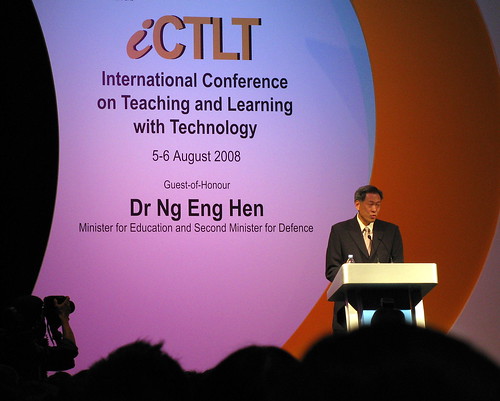
And suddenly I'm asking myself, "doesn't it?" And then I recalled that in the ten years plus I spent in primary and secondary education, I was simply fed material to memorize and got graded according to how closely I reproduced said material at the exams. Not very well, I'm afraid.
That's a fine and efficient way to ensure the kids do well when their annual results come out. After all, how else could my teachers deal with 40 screaming kids in a classroom apart from making us all sit down and shut up while she delivered the next set of predigested facts from the syllabus to a literally captive audience?
It's the same with the most revered TYS with kids faithfully practicing answering past questions as if the same questions will repeat themselves year after year. Success for them means recalling the answer closest to the answers at the back of the book, and they're satisfied that they've done the work expected of them.
Which is true: that is a lot of work, although not necessarily a lot of thinking, so the learning turns out to be somewhat limited. Then the more successful kids step up to college level and wonder why their scores for GP are scraping borderline when in sec school they were the pride and joy, the creme de la creme of their beloved alma mater. The next level for them is quite a large gap to bridge, and it's hard to convince them that their previous secrets to success were actually bad habits, and they need to trade in the old comfortable ways for new ones that are more difficult to master, but work better in the long term.
There was this couple of independently raised examples from two of our panellists: Prof Mo said that he had once observed a 7 year-old repeatedly jumping as high as he could go because he was testing a theory that his teacher had proposed to him: The Earth rotates around the sun. So, the boy reasoned that if he were to jump high enough, the earth would rotate under him and he would land in a different spot from where he had taken off. While there were certain flaws in his assumptions leading him to conclude that because he landed in the same spot every time, his teacher must be wrong, it shows that even little kids have some critical thinking ability and they already can exercise it in their observations of life around them.
Contrast this example with the one Ken raised: his 16-17 year-old students consider critical thinking and philo classes a waste of time 'cos there's no 'O' level paper on the subject. They don't like to think, they say, 'cos it's too hard. Save them time, just give them the answers and they will gladly memorize the material with the time saved.
So, what happened to turn the curious 7 year-old into the jaded, pragmatic 17 year-old? 10 years of education for the masses, perhaps? Fortunately, the fact that we are having discussions such as this one shows that the industry is making inroads into overhauling the old ways. Soon, I hope.
Oh, btw, the venue for the panel discussion brought back some good memories for me. I wandered those old corridors back then as a student. Even though that old institution has since been replaced by this current one, the campus is still mostly the same. But I wasn't there long as a student -- well, long enough to develop my first serious crushes on my girl classmates but not long enough to do anything about them. As Ben said, c'est la vie.
Thursday, May 29, 2008
Finally got my paws on "Mass Effect" for PC. Vista gave problems when I first attempted to start up the game. It simply refused to start. But after a call to EA's helpdesk which advised me to switch off Vista's User Account Control (UAC), I actually got my first taste of this epic space melodrama.
The game space is amazingly huge. I've seen two locations so far, Eden Prime which was a tutorial run for basic game controls, and am currently exploring Citadel, a sprawling complex of districts full of mini quests to accept and fulfill. I still need time to get used to the many keys needed to conduct squad combat properly. Until I figure them out, I'm gonna get killed a lot but that's the learning curve.
Apart from the above two locations, there's a massive galaxy to explore system by system, planet by planet. While I've been only doing grunt fighting so far, there's promise of vehicular combat and space combat as well to look forward to. Death-dealing comes in so many forms!
Despite my excitement, there's still one serious annoyance with the game: It has shut down on me twice already in mid-game, causing the loss of any unsaved content, and forcing replays of certain encounters which I'd already seen, before being unceremoniously dumped back out into the Windows environment so unexpectedly.
Wonder if there'll be a patch soon that will address this problem. Meantime, I'll look around the 'net for a viable solution. Grr...
The game space is amazingly huge. I've seen two locations so far, Eden Prime which was a tutorial run for basic game controls, and am currently exploring Citadel, a sprawling complex of districts full of mini quests to accept and fulfill. I still need time to get used to the many keys needed to conduct squad combat properly. Until I figure them out, I'm gonna get killed a lot but that's the learning curve.
Apart from the above two locations, there's a massive galaxy to explore system by system, planet by planet. While I've been only doing grunt fighting so far, there's promise of vehicular combat and space combat as well to look forward to. Death-dealing comes in so many forms!
Despite my excitement, there's still one serious annoyance with the game: It has shut down on me twice already in mid-game, causing the loss of any unsaved content, and forcing replays of certain encounters which I'd already seen, before being unceremoniously dumped back out into the Windows environment so unexpectedly.
Wonder if there'll be a patch soon that will address this problem. Meantime, I'll look around the 'net for a viable solution. Grr...
Wednesday, May 28, 2008
It's an argument that we in the industry will never win. We're taking flak again, this time for making kids continue classes even though they're supposed to be enjoying their summer break right now. Where is this criticism coming from?
Even in the US, summer school is a legit practice. Kids actually get threatened to be sent to summer school if they are not performing during regular term time. Summer school is also great to attend to gain extra academic credits and makes the study load lighter by a course or two when term resumes. All the more so here then, with parents so anxious about their kids not scoring 'A's, I would think they'd somehow make summer school mandatory without our initiative.
If we didn't hold the kids back, we'd still receive flak anyway for being slack, uncaring, selfish and any other unflattering description because we are not helping the kids to do better at their upcoming exams. After all, we are well-paid civil servants , so we'd better do more to justify our upkeep, some people would say.
Since there's no pleasing anyone on this issue, I'm just going to continue working at whatever needs to be done, whether its admin, lesson planning, materials gathering, assignment marking, course taking, and I'll do it wherever I want, at my own time, without distractions from management or client-base, and I'm going to be happy. I'm on vacation!
Even in the US, summer school is a legit practice. Kids actually get threatened to be sent to summer school if they are not performing during regular term time. Summer school is also great to attend to gain extra academic credits and makes the study load lighter by a course or two when term resumes. All the more so here then, with parents so anxious about their kids not scoring 'A's, I would think they'd somehow make summer school mandatory without our initiative.
If we didn't hold the kids back, we'd still receive flak anyway for being slack, uncaring, selfish and any other unflattering description because we are not helping the kids to do better at their upcoming exams. After all, we are well-paid civil servants , so we'd better do more to justify our upkeep, some people would say.
Since there's no pleasing anyone on this issue, I'm just going to continue working at whatever needs to be done, whether its admin, lesson planning, materials gathering, assignment marking, course taking, and I'll do it wherever I want, at my own time, without distractions from management or client-base, and I'm going to be happy. I'm on vacation!
Stabbing people in the back is a useful skill to master in "Assassin's Creed". As crack assassin, Altair, who seeks redemption for an earlier botched hit, I have a list of nine very bad men to put paid to. Or rather, my ancestor has to and I'm sharing his memories of his greatest hits via a device that allows me to do so.
Assassins carry out a routine before striking. They infiltrate the target's city of residence; seek out as much information as possible about his whereabouts, activities, strengths and weaknesses; sneak past his guards and finally give him a taste of cold steel in his gut.
That's the theory, anyway. A more skilled player than me might just have the patience and timing to make his kills as smooth as butter and keep the body count to a minimum if he wished to sincerely follow the Creed. But where's the fun in that? Clumsy ol' me just blunders into a hornet's nest bristling with angry men holding pointy objects and having to slay them all. If I manage to poke the right target it's because he was stupid enough to stay and fight with his men. Of course, some targets choose the better part of valour, so those guys need to be timed properly or chased down, apologies to whomever stands in the way.
Fighting is easy to pick up. It's just a matter of timing Altair's attack against his opponents'. Time it right and be rewarded with a cinematic of a deft parry or a brutal finisher. There are lots of variations, and I believe that as Altair unlocks more as he progresses through the levels. Altair often gets surrounded with a mass of enemies, but by methodically picking off each enemy the body count racks up until no one is left to challenge the might of the Assassin. Yes.
But sometimes the fighting can get tiresome, so if there's no one important to kill in the mob another option is to break off and run through the crowd of civillians and climb over the rooftops to find a hiding spot -- a pile of hay or a curtained pavillion. Once the pursuers have lost line of sight, they quit their search (slackers!) and return to their posts.
On the way to the big party, though, there are certain buildings to climb to get a better picture of what's happening in the neighbourhood; hidden flags to collect; civillians to rescue from thugs and bullies; people to pickpocket from; others to intimidate for the information they hold, or just eavesdrop on surreptitious conversations between loose lips. Occasionally, a fellow assassin will point out certain secondary targets to eliminate on the quiet, or initiate a race across the rooftops just for fun.
So there's lots to do in between the big kills, although up to a point, even the variety of activities becomes repetitive after a while. Still, these asides are mostly optional. Completing any two or three per city is enough to unlock access to the big cheese himself, and his cryptic final words that make Altair wonder if he is on the right side of the war after all.
Many people have a problem with the ending sequence to the game. Just when you think there's more to come, the game stops on a cliffhanger. The problem is, you don't know the game's ended. You just keep walking around in a closed room where you can access clues about what's to come, then there's nothing else to do except wander around aimlessly wondering what the heck to do next. There's only one thing left to do: see that little box marked with an 'X' on the top right hand of your game window? Click that then get on with your life.
Assassins carry out a routine before striking. They infiltrate the target's city of residence; seek out as much information as possible about his whereabouts, activities, strengths and weaknesses; sneak past his guards and finally give him a taste of cold steel in his gut.
That's the theory, anyway. A more skilled player than me might just have the patience and timing to make his kills as smooth as butter and keep the body count to a minimum if he wished to sincerely follow the Creed. But where's the fun in that? Clumsy ol' me just blunders into a hornet's nest bristling with angry men holding pointy objects and having to slay them all. If I manage to poke the right target it's because he was stupid enough to stay and fight with his men. Of course, some targets choose the better part of valour, so those guys need to be timed properly or chased down, apologies to whomever stands in the way.
Fighting is easy to pick up. It's just a matter of timing Altair's attack against his opponents'. Time it right and be rewarded with a cinematic of a deft parry or a brutal finisher. There are lots of variations, and I believe that as Altair unlocks more as he progresses through the levels. Altair often gets surrounded with a mass of enemies, but by methodically picking off each enemy the body count racks up until no one is left to challenge the might of the Assassin. Yes.
But sometimes the fighting can get tiresome, so if there's no one important to kill in the mob another option is to break off and run through the crowd of civillians and climb over the rooftops to find a hiding spot -- a pile of hay or a curtained pavillion. Once the pursuers have lost line of sight, they quit their search (slackers!) and return to their posts.
On the way to the big party, though, there are certain buildings to climb to get a better picture of what's happening in the neighbourhood; hidden flags to collect; civillians to rescue from thugs and bullies; people to pickpocket from; others to intimidate for the information they hold, or just eavesdrop on surreptitious conversations between loose lips. Occasionally, a fellow assassin will point out certain secondary targets to eliminate on the quiet, or initiate a race across the rooftops just for fun.
So there's lots to do in between the big kills, although up to a point, even the variety of activities becomes repetitive after a while. Still, these asides are mostly optional. Completing any two or three per city is enough to unlock access to the big cheese himself, and his cryptic final words that make Altair wonder if he is on the right side of the war after all.
Many people have a problem with the ending sequence to the game. Just when you think there's more to come, the game stops on a cliffhanger. The problem is, you don't know the game's ended. You just keep walking around in a closed room where you can access clues about what's to come, then there's nothing else to do except wander around aimlessly wondering what the heck to do next. There's only one thing left to do: see that little box marked with an 'X' on the top right hand of your game window? Click that then get on with your life.
Tuesday, May 27, 2008
Currently exploring the Holy Land in the 12th century, during the Crusades. My persona's hands soak in the blood of all who stand in the way of my efforts to restore peace to the region (heh, a side note about the necessity of violence for the sake of peace). I fight for neither Sal-a-hadin nor Richard. My struggle is against those who work in the shadows, who profit by fuelling the fires of the conflict, prolonging the war for the sake of their own private agenda.
Or so I've been told. Lately, I'm not so sure any more...
Saturday, May 24, 2008
People get upset when their kids fail tests and exams. They get especially upset when they find out that their kid is just one casualty among many others in the cohort. They question the school practices, the competence of the teachers, they feel the pressure to get the kid some private tuition, everything except tell the kid to go study, or get his life under control or something.
What are parents really expecting when to the vast majority of them, perfection = 100%? They expect their kids to hit a target that high at primary and secondary level, and raise hell when the kid falls short within a 5% margin or so. At college level, how do we convince the same parents that because an 'A' grade describes the band from 75% and above, the pass mark actually works out to 45% and even then that's erring on the conservative.
Speaking from the experience of a foreign education, it certainly encouraged me that my profs never did pressure me for an 'A' performance. We all had the understanding that a 'C' grade was entirely satisfactory. 'C' stood for 'competent', a decent level of proficiency in the subject so that I didn't have to be shackled to my desk and textbooks all day and instead did other things with my life that weren't necessarily academic or even intellectual. I still turned in a "B+" average in the end, which meant I did spend some time studying, but my studies were never my life.
Having said that, things are quite different back here. Here people study to live, and our education experience tells us 'A' or die. We have a very penalizing attitude to our tests and exams, which filters down all the way to our setting of papers and our marking. Our papers are necessarily difficult because we hold our kids to very high performance standards. We often teach beyond their syllabus requirements, making them stretch to grasp our material. And when we mark, we usually have very high expectations of them. When they don't quite live up to our expectations, our marking reflects our disappointment. But we are loath to 'dumb it down' because no one is prepared to accept lower standards, and so the hamster wheel just keeps going faster with every subsequent batch of kids.
Wonder how many (if any) of the kids who, on entering university, suddenly realized that we were already trying to teach them the same stuff a couple of years earlier? Just asking.
What are parents really expecting when to the vast majority of them, perfection = 100%? They expect their kids to hit a target that high at primary and secondary level, and raise hell when the kid falls short within a 5% margin or so. At college level, how do we convince the same parents that because an 'A' grade describes the band from 75% and above, the pass mark actually works out to 45% and even then that's erring on the conservative.
Speaking from the experience of a foreign education, it certainly encouraged me that my profs never did pressure me for an 'A' performance. We all had the understanding that a 'C' grade was entirely satisfactory. 'C' stood for 'competent', a decent level of proficiency in the subject so that I didn't have to be shackled to my desk and textbooks all day and instead did other things with my life that weren't necessarily academic or even intellectual. I still turned in a "B+" average in the end, which meant I did spend some time studying, but my studies were never my life.
Having said that, things are quite different back here. Here people study to live, and our education experience tells us 'A' or die. We have a very penalizing attitude to our tests and exams, which filters down all the way to our setting of papers and our marking. Our papers are necessarily difficult because we hold our kids to very high performance standards. We often teach beyond their syllabus requirements, making them stretch to grasp our material. And when we mark, we usually have very high expectations of them. When they don't quite live up to our expectations, our marking reflects our disappointment. But we are loath to 'dumb it down' because no one is prepared to accept lower standards, and so the hamster wheel just keeps going faster with every subsequent batch of kids.
Wonder how many (if any) of the kids who, on entering university, suddenly realized that we were already trying to teach them the same stuff a couple of years earlier? Just asking.
Friday, May 23, 2008
Indy's back and it's another fun run. There are thrills galore in "Crystal Skull", though some of the stunts are worth the scrutiny of the Mythbusters guys. How Indy escapes a nuclear blast test is unbelievable -- i.e., cannot be believed even with copious amounts of disbelief suspended; rather than whoa, awesome, dude!
In this fourth installment the action takes place in Indy's backyard: in the US and in South America. It's the 50s at the height of McCarthyism. Paranoia runs rampant against the Communist threat, and apparently with good reason as a whole platoon of KGB goons in US Army uniforms drive freely around the country seeking paranormal artifacts kept in cold storage in Area 51. Indy himself becomes a victim of the witchhunt due to his unwilling involvement with the Area 51 incident, and having previously lost Marcus Brody and Dr Jones Sr., and recently his tenure at the University, decides to start a new life across the Atlantic.
His journey east gets interrupted by Mutt, a young, leather-clad biker and school-dropout, who brings news that an old colleague and friend is in danger, so off they go to a family reunion of sorts in the jungles of South America.
Spielberg ties both modern and ancient mythology in this episode as Indy discovers a link between the ancient culture of the Meso-Americas and the Roswell incident of 1947. Apart from his escapades in fast moving vehicles on the edge of a precipiece, quicksand, army ants and the usual company of heavily-accented gun-totting goons, Indy movies are fun to watch because they invent answers to some of the mysteries left behind by our long-lost and forgotten ancestors whose technological prowess we tend to underestimate.
In Crystal Skull, we glimpse deiety in yet another form, though this time one that is less than traditionally conventional. From this perspective, the story gets quite a bit hokey with lots of plot loopholes. Like for example, what were the crystal skulls doing together for a thousand years before one got stolen; then when the one is finally returned, what's the reason for all the sudden fireworks? Action and adventure get a heavier weightage than a coherent storyline, but that's Indy.
Ultimately, Crystal Skull is commercial fluff. It's addictive, like a bucket of warm popcorn, and offers as much nutritional value.
In this fourth installment the action takes place in Indy's backyard: in the US and in South America. It's the 50s at the height of McCarthyism. Paranoia runs rampant against the Communist threat, and apparently with good reason as a whole platoon of KGB goons in US Army uniforms drive freely around the country seeking paranormal artifacts kept in cold storage in Area 51. Indy himself becomes a victim of the witchhunt due to his unwilling involvement with the Area 51 incident, and having previously lost Marcus Brody and Dr Jones Sr., and recently his tenure at the University, decides to start a new life across the Atlantic.
His journey east gets interrupted by Mutt, a young, leather-clad biker and school-dropout, who brings news that an old colleague and friend is in danger, so off they go to a family reunion of sorts in the jungles of South America.
Spielberg ties both modern and ancient mythology in this episode as Indy discovers a link between the ancient culture of the Meso-Americas and the Roswell incident of 1947. Apart from his escapades in fast moving vehicles on the edge of a precipiece, quicksand, army ants and the usual company of heavily-accented gun-totting goons, Indy movies are fun to watch because they invent answers to some of the mysteries left behind by our long-lost and forgotten ancestors whose technological prowess we tend to underestimate.
In Crystal Skull, we glimpse deiety in yet another form, though this time one that is less than traditionally conventional. From this perspective, the story gets quite a bit hokey with lots of plot loopholes. Like for example, what were the crystal skulls doing together for a thousand years before one got stolen; then when the one is finally returned, what's the reason for all the sudden fireworks? Action and adventure get a heavier weightage than a coherent storyline, but that's Indy.
Ultimately, Crystal Skull is commercial fluff. It's addictive, like a bucket of warm popcorn, and offers as much nutritional value.
Thursday, May 22, 2008
Spent another day improvising GP essays in front of students. One of the requests they made was for the question, "Is competition healthy for man?" Thought I'd put my take here in a more formal presentation. Click.
Wednesday, May 21, 2008
In our industry-sponsored dialogue with professionals from outside our industry, we had a couple of government-types and one NGO rep discuss with us the energy issue facing our country today.
While much of the presentations were rather technical to follow, we got the general idea that we are way too dependent on our neighbours for our sources of gas that powers our electrical generators that keep this wired nation humming. Like our water issue, our R&D experts are exploring other forms of power generation leaving no stone unturned in our quest for energy self-sufficiency. Interesting possibilities for our future, yes.
Meantime, we have to save what we can because we are running on finite resources. The second industry expert spoke to us at length about how his organization works to make buildings more energy-efficient. While we got lost in his diagrams, chart and tables, we met in him a guy who really takes pride in his work. With good old engineering know-how, a building's heating and cooling systems can be redesigned to reduce power consumption amounting to quite significant savings every year.
But it was the NGO rep that got our attention because he was talking about things within the household consumer's control -- that's us. He spoke about our behaviour as power consumers and laid out lots of eco-friendly options which we can make to live more responsibly. He spoke about the now compulsory labelling of appliances by his organization which appraises how energy-efficient they are (the more ticks the better); their efforts to educate the public with clean, green living; awards programmes and incentive schemes for organizations going eco-friendly (no school has won such an award yet, he said); and various opportunities for volunteer work.
In the wrap-up, we got the idea that both green initiatives and economic growth must balance each other. Pragmatic, as always, our colleagues in public service.
While much of the presentations were rather technical to follow, we got the general idea that we are way too dependent on our neighbours for our sources of gas that powers our electrical generators that keep this wired nation humming. Like our water issue, our R&D experts are exploring other forms of power generation leaving no stone unturned in our quest for energy self-sufficiency. Interesting possibilities for our future, yes.
Meantime, we have to save what we can because we are running on finite resources. The second industry expert spoke to us at length about how his organization works to make buildings more energy-efficient. While we got lost in his diagrams, chart and tables, we met in him a guy who really takes pride in his work. With good old engineering know-how, a building's heating and cooling systems can be redesigned to reduce power consumption amounting to quite significant savings every year.
But it was the NGO rep that got our attention because he was talking about things within the household consumer's control -- that's us. He spoke about our behaviour as power consumers and laid out lots of eco-friendly options which we can make to live more responsibly. He spoke about the now compulsory labelling of appliances by his organization which appraises how energy-efficient they are (the more ticks the better); their efforts to educate the public with clean, green living; awards programmes and incentive schemes for organizations going eco-friendly (no school has won such an award yet, he said); and various opportunities for volunteer work.
In the wrap-up, we got the idea that both green initiatives and economic growth must balance each other. Pragmatic, as always, our colleagues in public service.
Tuesday, May 20, 2008
When will I learn that the only one I can count on is me; the only one who shares common goals with me is me; the only one committed to my cause is me? I should have expected this; after all, my charisma level is roughly equivalent to that of a corpse lying in an open field, and even then I couldn't attract the flies.
How did the game go today? We can safely say that we've firmly cemented our place at rock bottom despite facing a team we could have beaten. The Boyz were a complete no-show, and it was only thanks to the goodwill of ol' Des as a last minute subby that we were allowed to bowl at all -- one bowler short.
This is the last time I'm going to be organizing something that is so low on everybody's priorities. It'll be the last time I'll be organizing anything at all. I'm tired of being constantly brushed off like some kind of inconvenience. From now on, this act is going solo.
How's that for self-indulgent?
How did the game go today? We can safely say that we've firmly cemented our place at rock bottom despite facing a team we could have beaten. The Boyz were a complete no-show, and it was only thanks to the goodwill of ol' Des as a last minute subby that we were allowed to bowl at all -- one bowler short.
This is the last time I'm going to be organizing something that is so low on everybody's priorities. It'll be the last time I'll be organizing anything at all. I'm tired of being constantly brushed off like some kind of inconvenience. From now on, this act is going solo.
How's that for self-indulgent?
Monday, May 19, 2008
Installing Windows SP3 killed Mr L33t! Partway through installation, the update hung and Mr L33t went straight into a coma. The poor guy is now in intensive care. The best I can hope for is to salvage whatever files I can from my archives, then it's probably "good night, sweet prince." A full Windows re-install will be needed to revive him, but I don't have the time for that now.
Usually, I'd be climbing the walls in anxiety right now -- such is the extent of my addiction -- but I'm quite philosophical about this latest untimely demise. As it is, Mr L33t was starting to show his age already. He didn't even live up to the minimum specs of "Assassin's Creed" which I bought to keep me company over the coming hols. I'm also looking forward to picking up "Mass Effect" for PC which should be launching in a couple of weeks, just in time for when I'll be slightly freer to game on again.
So as soon as I'm able to get some time off, I'm donning my geek glasses and pocket protector and heading off to the market for some serious hardware upgrades. At this time, I wonder if Vista is worth investing in? Full DX-10 functionality... tempting.
Usually, I'd be climbing the walls in anxiety right now -- such is the extent of my addiction -- but I'm quite philosophical about this latest untimely demise. As it is, Mr L33t was starting to show his age already. He didn't even live up to the minimum specs of "Assassin's Creed" which I bought to keep me company over the coming hols. I'm also looking forward to picking up "Mass Effect" for PC which should be launching in a couple of weeks, just in time for when I'll be slightly freer to game on again.
So as soon as I'm able to get some time off, I'm donning my geek glasses and pocket protector and heading off to the market for some serious hardware upgrades. At this time, I wonder if Vista is worth investing in? Full DX-10 functionality... tempting.
Yay! Long weekend! Took my first Saturday off this entire term. Really been looking forward to it since quite a while ago. Had a most fruitful time cuddling up with essays to mark, with more essays to look forward to today and tomorrow's public holiday as well. If I'm good, I'll be done with this entire batch of essay marking by late afternoon tomorrow. Then I can sort of rest until the mid-year exam essays arrive at the end of the week. Have to earn my June hols, don't you know?
Saturday, May 17, 2008
Looking at the PW results some colleges have been able to achieve in the previous project work cycle, it's easy to get the impression that an 'A' grade in the subject is a dime-a-dozen, and that there's some kind of magic formula that when followed makes scoring top marks possible. Perhaps there is, perhaps there is a way to template the perfect project, and it's tempting to do so for the sake of the grade. But I don't see the point of following a formula as if there was only one single solution to every problem we're going to encounter in life.
A template is like a join-the-dots puzzle, success involves just pencilling a line from digit to digit. So the 'A' grade via template is just an acknowledgement of how well the kids followed their instructions. How difficult can that be, tracing a pre-determined path tocreate derive a pre-determined picture? What a surprise! When a toddler is able to do this we remark how clever it is. These are college students we are dealing with. What's an 'A' worth these days?
Which is why I get disturbed when I hear tell of students' proposals getting rejected outright and sent back to the drawing board because the proposal didn't live up to the super's pre-conceived expectations. We're supposed to be working with the students on this, not against them. So I'm not surprised when some kids eventually see the whole thing as a waste of time, because literally what amounts to hours of work gets summarily dismissed and there's no progress to show for it. They get bored, resentful, and lose confidence in their project. When it's time to make their presentations that's what gets reflected. Ironically, aming for an 'A' grade like this becomes counter-productive to both the grade and the learning behind it.
Fortunately, the groups I have seem motivated and have delivered creative and meticulously crafted proposals, so I don't have to worry too much over WHAT they are planning. I'll keep an eye on them to see HOW they are carrying out their plans, but at least they're off and running already. I can do my real job of supervision by managing group dynamics and being basically a cheerleader and resource for them, but I have firmly taken my hands off the micromanagement controls and am letting them run the nitty-gritty on their own.
I already have a group dysfunction to manage -- mainly a self-interest vs group-interest conflict -- but this is where the super's real work begins. Of course there will be conflicts; that's what we were hoping for when we threw separate individuals together to work as a group. How the different personality types learn to speak up and settle their differences, come to agreement and focus on a common goal, then work in cooperation with each other and build bonds based on the trust that accumulates as they pass milestone after milestone together. That's the most important lesson to learn from PW. If the kids learn this early enough, there'll be enough time to put together an impressive, professional presentation that deserves an 'A' from start to finish. That will be an 'A' to be proud of.
A template is like a join-the-dots puzzle, success involves just pencilling a line from digit to digit. So the 'A' grade via template is just an acknowledgement of how well the kids followed their instructions. How difficult can that be, tracing a pre-determined path to
Which is why I get disturbed when I hear tell of students' proposals getting rejected outright and sent back to the drawing board because the proposal didn't live up to the super's pre-conceived expectations. We're supposed to be working with the students on this, not against them. So I'm not surprised when some kids eventually see the whole thing as a waste of time, because literally what amounts to hours of work gets summarily dismissed and there's no progress to show for it. They get bored, resentful, and lose confidence in their project. When it's time to make their presentations that's what gets reflected. Ironically, aming for an 'A' grade like this becomes counter-productive to both the grade and the learning behind it.
Fortunately, the groups I have seem motivated and have delivered creative and meticulously crafted proposals, so I don't have to worry too much over WHAT they are planning. I'll keep an eye on them to see HOW they are carrying out their plans, but at least they're off and running already. I can do my real job of supervision by managing group dynamics and being basically a cheerleader and resource for them, but I have firmly taken my hands off the micromanagement controls and am letting them run the nitty-gritty on their own.
I already have a group dysfunction to manage -- mainly a self-interest vs group-interest conflict -- but this is where the super's real work begins. Of course there will be conflicts; that's what we were hoping for when we threw separate individuals together to work as a group. How the different personality types learn to speak up and settle their differences, come to agreement and focus on a common goal, then work in cooperation with each other and build bonds based on the trust that accumulates as they pass milestone after milestone together. That's the most important lesson to learn from PW. If the kids learn this early enough, there'll be enough time to put together an impressive, professional presentation that deserves an 'A' from start to finish. That will be an 'A' to be proud of.
As riotous a time as we could have sans alcohol, we lived it up and bade farewell to the J2s in an evening of finger-foods, fun and games.
The incoming J1s who organised the party did well with their logistics and timekeeping precision. Their games were hilarious to play, except the one where I got my instructions confused and instantly self-immolated on my first utterance. Well-rigged, ppl!
Nice to see how this bunch of Drama kids took to improv. They haven't entirely got the theory right, but they were enthusiastically launching themselves into their assigned characters with minimal think time. Five different improv groups playing out five different scenarios, each group presenting a different playing style as best suits their collective personalities. Could be the basis of a set of rules for a new improv game! Hmm...
Kids finally got to see themselves on Drama Night. We sped through video highlights of both "Admiral" and "Walls", and it was funny to hear them groan at their own performance. As Wayne said later, "good actors don't like to watch themselves act," and the kids must be living up to that latest Waynism.
Gonna miss the zany but committed J2s, looking forward to working with the meticulous J1s. Not sure if there are any crazies among them, but I guess I'll find out soon.
Thursday, May 15, 2008
Many thanks to everyone from x32 for the off-beat, unexpected and totally sweet thing y'all did for me today. It took a lot of effort and much thoughtfulness, and I really appreciate it very much. Even we staff need positive feedback at times -- yours came unsolicited, and right out of the blue. And, yes, in case you've been wondering, I've been off medication for almost a week already, and I hope that means the worst is over.
Wednesday, May 14, 2008
An end to two items on my weekly schedule. The first is the Drama competition which ended early this afternoon; the second, my 6-week self-leadership course which I have been faithfully attempting to follow as a personal commitment.
Our drama entry played exactly as I've seen it rehearsed many times over. It was as competent and as polished as it's ever going to get, though perhaps I'm seeing it through the eyes of someone who's seen the repeats once too many times.
I hope I'm wrong, 'cos the kids put in so much time, effort, and much of their lives into this production, but I'm going to be conservative about our chances at a top award this year. For me, the play looked so polished that it lost it's sense of 'reality' which was what was so strong about it to begin with. Well, better over-prepared and over-rehearsed than under, I suppose.
The other thing is the course I'm taking with a number of staff from across the departments. Apart from the key concepts of mentorship and rapport-building through both theory discussions and practical application, my best takeaway is in having made new friends from fellow staff I would generally not have had a need to talk to as part of my daily routine. Because everyone was keen to learn and participate, it was actually fun to play the games and open up about our current challenges and future goals to get affirmation and support from each other.
And now it almost feels like half the year is over already. Wow.
Our drama entry played exactly as I've seen it rehearsed many times over. It was as competent and as polished as it's ever going to get, though perhaps I'm seeing it through the eyes of someone who's seen the repeats once too many times.
I hope I'm wrong, 'cos the kids put in so much time, effort, and much of their lives into this production, but I'm going to be conservative about our chances at a top award this year. For me, the play looked so polished that it lost it's sense of 'reality' which was what was so strong about it to begin with. Well, better over-prepared and over-rehearsed than under, I suppose.
The other thing is the course I'm taking with a number of staff from across the departments. Apart from the key concepts of mentorship and rapport-building through both theory discussions and practical application, my best takeaway is in having made new friends from fellow staff I would generally not have had a need to talk to as part of my daily routine. Because everyone was keen to learn and participate, it was actually fun to play the games and open up about our current challenges and future goals to get affirmation and support from each other.
And now it almost feels like half the year is over already. Wow.
Subscribe to:
Posts (Atom)