Alvin confirmed his place at our breakfast table with his amazing Excel spreadsheet. It was a work of pure genius, allowing us to key in our orders for McD's breakfast meals and immediately tally our outstanding payment from our own terminals in the staffroom. With a comprehensive list of our demands, it was easy for him to place a mass order for us; a lifesaving gesture on his part, as the canteen was closed today.
Meantime, I've had my prelim marking temporarily interrupted to give my attention to shooting D NY EL's farewell messages to our JC2s. The bulk of our shoot caused quite a bit of inconvenience to the staff not involved 'cos I didn't want any incidentals popping up unexpectedly on camera and forcing an unnecessary retake. The shoot took about an hour split over two sessions today, no more, so I hope to be forgiven for the disruption to the [serious] work schedule... someday.
Still, some shots simply could not be used. I had problems with continuity, poor composition and pacing, and they basically looked weird, not quite complementary with the main storyline, if we may call it that. Have to do some quick improvisation on Mon if I'm gonna meet the Wed deadline
Dinner was at Sunset, finally, after planning to drop by for several weeks now. Amazingly, quite a number of us (and our dates) found this evening to be free. Even more amazingly, Josh and Jo couldn't, even though they were the ones most hoping to go this time around. But Sunset is beautiful, the prices are quite reasonable, and there is every reason for us to make another trip up. Better luck next time!
Friday, September 21, 2007


Wednesday, September 19, 2007
Have to give IJ credit for trying out a more argumentative, critical-thinking approach to GP, even if it was only for an academic study.
"The aim was to enable students to engage more effectively in critical thinking as they explored different perspectives, concretised their arguments, and analysed the strengths and weaknesses of each other's arguments and underlying assumptions - skills required in both the essay and the Application Question components of GP."
The theory appears sound enough. GP's stock-in-trade is argumentation. We look at ideas, events and phenomena from multiple perspectives, recognizing that not all these diverse views are entirely reasonable. For reasons such as experiential or cultural prejudice, lack of knowledge, or perhaps even because of a personal agenda, people perceive and interpret the things that go on around them differently from one another. It is the stronger folk that try to persuade others to see things their way in order to initiate some action in order to salvage or exploit the situation as they see fit.
These are the arguments we all get blasted with daily. Politicians, scientists, clergy, enterprise, yes, even educators and parents all communicate with us through presenting arguments -- some more formally and more skillfully than others -- but they all tell us to go do something, eat something, wear something, buy something, and so on. For a teenager, all these arguments can appear conflicting, and worse, because they are usually voiced by an authority figure, they sound more like orders and instructions rather than simply appeals for positive support.
If teens feel they have no freedom, and no choices to make, it's usually because they are unable to prioritize all these diverse arguments but instead see them all as equally important, and hence, get stretched apart running, jumping through hoops, fetching and carrying for whoever assaults them with the loudest voice first.
By teaching argumentation and critical thinking in GP, that should be the first step to our teens learning to empower themselves to sieve through their various stimuli, analyze their situation and take action based on their own decision-making processes. This, ultimately, is teaching our teens to fish for themselves, rather than us staff catching, preparing, de-boning, and offering our ungrateful children our best fish dishes all the time. We continue doing this for our kids and we shouldn't be surprised that all they do is pick at their food and all they return to us is excrement in the form of poorly thought out essays and compre papers. Garbage in, garbage out.
Ok. Easy to say. Why aren't my kids performing any better, since I seem to have all the answers? Simple. I don't have the loudest voice.
"The aim was to enable students to engage more effectively in critical thinking as they explored different perspectives, concretised their arguments, and analysed the strengths and weaknesses of each other's arguments and underlying assumptions - skills required in both the essay and the Application Question components of GP."
The theory appears sound enough. GP's stock-in-trade is argumentation. We look at ideas, events and phenomena from multiple perspectives, recognizing that not all these diverse views are entirely reasonable. For reasons such as experiential or cultural prejudice, lack of knowledge, or perhaps even because of a personal agenda, people perceive and interpret the things that go on around them differently from one another. It is the stronger folk that try to persuade others to see things their way in order to initiate some action in order to salvage or exploit the situation as they see fit.
These are the arguments we all get blasted with daily. Politicians, scientists, clergy, enterprise, yes, even educators and parents all communicate with us through presenting arguments -- some more formally and more skillfully than others -- but they all tell us to go do something, eat something, wear something, buy something, and so on. For a teenager, all these arguments can appear conflicting, and worse, because they are usually voiced by an authority figure, they sound more like orders and instructions rather than simply appeals for positive support.
If teens feel they have no freedom, and no choices to make, it's usually because they are unable to prioritize all these diverse arguments but instead see them all as equally important, and hence, get stretched apart running, jumping through hoops, fetching and carrying for whoever assaults them with the loudest voice first.
By teaching argumentation and critical thinking in GP, that should be the first step to our teens learning to empower themselves to sieve through their various stimuli, analyze their situation and take action based on their own decision-making processes. This, ultimately, is teaching our teens to fish for themselves, rather than us staff catching, preparing, de-boning, and offering our ungrateful children our best fish dishes all the time. We continue doing this for our kids and we shouldn't be surprised that all they do is pick at their food and all they return to us is excrement in the form of poorly thought out essays and compre papers. Garbage in, garbage out.
Ok. Easy to say. Why aren't my kids performing any better, since I seem to have all the answers? Simple. I don't have the loudest voice.
Tuesday, September 18, 2007
The pioneer batch of KIds have submitted their Independent Study (IS) research papers. I think there is definitely a difference in the quality of the 2500-3000 word K&I essays I've received, and the 500-800 word GP essays I'm currently marking. Odd thing is, neither I nor NBS have really hand-held the KIds through their IS -- it is an Independent Study, after all -- and they've shown quite a level of motivation, even enthusiasm in getting their task done, whereas we've been teaching our brains out at GP, but I doubt many of the GP kids could produce anything like the K&I IS even at this stage.
How our IS papers compare with other JCs', I wouldn't know. But K&I's emphasis on purposeful research and personal responsibility for knowledge acquisition seems to have pushed the KIds' writing capabilities up a notch from the usual GP standard.
Is it innate in the KIds themselves, that they are already predisposed to cope with such pressure, stress and rigour? Or could it be the nature of the subject, that by setting higher expectations the students stretch themselves further to meet those expectations?
Or could K&I really demonstrate that the industry's "teach less, learn more" guideline actually has some merit? Guess it's up to Cambridge now to put some numbers to what is right now merely speculative thinking.
Good luck with your submissions, KIds!
How our IS papers compare with other JCs', I wouldn't know. But K&I's emphasis on purposeful research and personal responsibility for knowledge acquisition seems to have pushed the KIds' writing capabilities up a notch from the usual GP standard.
Is it innate in the KIds themselves, that they are already predisposed to cope with such pressure, stress and rigour? Or could it be the nature of the subject, that by setting higher expectations the students stretch themselves further to meet those expectations?
Or could K&I really demonstrate that the industry's "teach less, learn more" guideline actually has some merit? Guess it's up to Cambridge now to put some numbers to what is right now merely speculative thinking.
Good luck with your submissions, KIds!
Sunday, September 16, 2007
Today was Lorenzo's one-day-only sale. We were in the market for a new bed frame. Our current one is getting awfully rickety. For some reason, the headboard joints have been getting increasingly loose, and it feels like it'll collapse pretty soon with one more false move.
It's not our safety we're concerned about, but rather Q-tip's. She loves to sleep under the bed, and if there should be a sudden nocturnal falling apart, we're going to end up with one slightly flattened mini-maltese.
Lorenzo has very chic looking beds, all angular with clean lines, and probably great for creating a Zen ambiance. But that is also the problem. Such hard angles are a potential health hazard for people who have to walk between the light switch and their "side" of the bed. I've already stubbed my toe several times on the current bed, but the higher corners on the Lorenzo beds offer bruised shins and knees apart from the usual digit damage. And, as June pointed out, because the bed frame is covered in a leather layer, it'll become a tempting new scratching post for our cats.
So despite the sale, we gave Lorenzo a miss.
We did, however, blow a wad on a Scanteak bed frame, the design of which is surprisingly not that dissimilar to our current one. All teak, nothing to claw at, and seems stable enough so Q-tip can sleep with a little more security at night. For what we paid for it, we hope it'll last 10 years or more.
It's not our safety we're concerned about, but rather Q-tip's. She loves to sleep under the bed, and if there should be a sudden nocturnal falling apart, we're going to end up with one slightly flattened mini-maltese.
Lorenzo has very chic looking beds, all angular with clean lines, and probably great for creating a Zen ambiance. But that is also the problem. Such hard angles are a potential health hazard for people who have to walk between the light switch and their "side" of the bed. I've already stubbed my toe several times on the current bed, but the higher corners on the Lorenzo beds offer bruised shins and knees apart from the usual digit damage. And, as June pointed out, because the bed frame is covered in a leather layer, it'll become a tempting new scratching post for our cats.
So despite the sale, we gave Lorenzo a miss.
We did, however, blow a wad on a Scanteak bed frame, the design of which is surprisingly not that dissimilar to our current one. All teak, nothing to claw at, and seems stable enough so Q-tip can sleep with a little more security at night. For what we paid for it, we hope it'll last 10 years or more.
While the prelims are on, we have just been focused on marking our papers and using the time to write our comments in more detail on each script that passes through our hands.
The kids of this year have been more diligent and studious than I've ever encountered before. Most of my scripts show that the kids have been reading their notes and have been paying attention during their lectures, and quite a number have been keeping up with the news as well. At least content-wise they're showing promise.
So, they have amassed a nice pile of Lego bricks to build answers with. The difficulty for them now is fitting the pieces together as the question requires. Some concepts they have a better grasp of than others. Environmental issues they seem ok with 'cos they're mostly straightforward cause-effect principles. But the kids writing on the censorship issue have been turning in essays comprising ill-fitting bits, looking quite skeletal and grotesque in nature. I shouldn't be surprised; censorship is a pretty abstract concept, especially if the question requires them to discuss its effectiveness against unwholesome values. Let's not even talk about the question on scepticism, an even more abstract concept.
While the kids have been kuai with their input, their unquestioning acceptance of everything we've shoveled at them suggests that in the next few weeks before the 'A's, we have to work on their processing, helping them to understand their content better, and in some cases, update their content as well. Quoting case studies from the '60s and '70s just seems a little dated. But at least they know their case studies.
The kids of this year have been more diligent and studious than I've ever encountered before. Most of my scripts show that the kids have been reading their notes and have been paying attention during their lectures, and quite a number have been keeping up with the news as well. At least content-wise they're showing promise.
So, they have amassed a nice pile of Lego bricks to build answers with. The difficulty for them now is fitting the pieces together as the question requires. Some concepts they have a better grasp of than others. Environmental issues they seem ok with 'cos they're mostly straightforward cause-effect principles. But the kids writing on the censorship issue have been turning in essays comprising ill-fitting bits, looking quite skeletal and grotesque in nature. I shouldn't be surprised; censorship is a pretty abstract concept, especially if the question requires them to discuss its effectiveness against unwholesome values. Let's not even talk about the question on scepticism, an even more abstract concept.
While the kids have been kuai with their input, their unquestioning acceptance of everything we've shoveled at them suggests that in the next few weeks before the 'A's, we have to work on their processing, helping them to understand their content better, and in some cases, update their content as well. Quoting case studies from the '60s and '70s just seems a little dated. But at least they know their case studies.
Thursday, September 13, 2007
While getai was getting an '881' makeover in the '60s in S'pore, over on the other side of the world America was waking up to a rebellion of music and dance against the white-dominated conservative values of a decade before. Welcome to Baltimore, Maryland, a nondescript town in one of the tiniest of the US States, and the setting for 'Hairspray'.
'881' was a nostalgic reflection on Hokkien music which has not really grown out of its niche and is currently being kept alive primarily as entertainment for the Dead (no, I don't mean Deadheads, duh. I do literally mean our dearly departed during the annual 7th month summer break from the afterlife). The story focuses on the divisiveness of the music, and how rival getai singers compete with one another through music, dance and costume as they backstab, badmouth and brawl their way to the top of their circuit.
'Hairspray' looks at rock & roll, the springboard for the kind of music heard around the world today, and the common ancestor of black music and white music as we know them today. In the US, rock & roll underscores some major changes in the lives of the American people. Some changes were frivolous and transient (fashion, hairstyle, dance moves), but others impacted on the values of society as a part of a fundamental shift in the way people lived (e.g., racial integration, the idea that "being different" is no longer an obstacle to achieving one's dreams).
Both movies say a lot about our two very different cultures. Over here, we see threats and competition all over the place. For us, the only way to the top is through tooth and claw and the sweat of our brows. Over in 'Hairspray', change centres around plus-sized Tracy Turnblad, whose irrepressible optimism and talent for turning adversity into opportunity makes her a natural stereotype breaker in modest-town Baltimore.
As in '881', Tracy aims to win a contest -- a real one with crown and contract, compared to '881's totally imaginary self-imposed one -- but the contest becomes secondary for her as she embraces a cause even larger than herself. Determined as she is to break into TV as a dancer despite her non-TV friendly proportions ("this show isn't broadcast in Cinemascope," is one of the nastier comments she receives from fellow dancer, Amber Von Tussle, her biggest critic on the show), she jeopardises her dreams to march in a demonstration advocating racial integration because "it's the right thing to do."
Both musicals are highly entertaining, employing captivating vocals, choreography, and particularly in 'Hairspray', colour scheme. Both are very down-to-earth in their character portrayals and concerns, from the point of view of very ordinary people and their dreams to transcend their ordinariness. But '881' has a particular sense of urgency, to make change now because an individual's life is short. 'Hairspray' is more patient, recognizing the quiet strength of a united people (as in Motormouth Maybelle's anthem, 'I know where I've been'), whose resoluteness brings about a slower but more inevitable change for everyone.
Compared to 'Hairspray', '881' is a kancheong spider. If you want to get to know a culture, listen to their stories, or watch their movies, and learn how the people think. I dunno. With '881', I'm like, yeah, that's how it was... interesting. But with 'Hairspray', I feel more like singing along with Tracy, "Good morning, Siiiiingapore...!"*
*Hear this song for free at the 'Hairspray' Broadway musical site -- just activate the 1st song on the jukebox.
'881' was a nostalgic reflection on Hokkien music which has not really grown out of its niche and is currently being kept alive primarily as entertainment for the Dead (no, I don't mean Deadheads, duh. I do literally mean our dearly departed during the annual 7th month summer break from the afterlife). The story focuses on the divisiveness of the music, and how rival getai singers compete with one another through music, dance and costume as they backstab, badmouth and brawl their way to the top of their circuit.
'Hairspray' looks at rock & roll, the springboard for the kind of music heard around the world today, and the common ancestor of black music and white music as we know them today. In the US, rock & roll underscores some major changes in the lives of the American people. Some changes were frivolous and transient (fashion, hairstyle, dance moves), but others impacted on the values of society as a part of a fundamental shift in the way people lived (e.g., racial integration, the idea that "being different" is no longer an obstacle to achieving one's dreams).
Both movies say a lot about our two very different cultures. Over here, we see threats and competition all over the place. For us, the only way to the top is through tooth and claw and the sweat of our brows. Over in 'Hairspray', change centres around plus-sized Tracy Turnblad, whose irrepressible optimism and talent for turning adversity into opportunity makes her a natural stereotype breaker in modest-town Baltimore.
As in '881', Tracy aims to win a contest -- a real one with crown and contract, compared to '881's totally imaginary self-imposed one -- but the contest becomes secondary for her as she embraces a cause even larger than herself. Determined as she is to break into TV as a dancer despite her non-TV friendly proportions ("this show isn't broadcast in Cinemascope," is one of the nastier comments she receives from fellow dancer, Amber Von Tussle, her biggest critic on the show), she jeopardises her dreams to march in a demonstration advocating racial integration because "it's the right thing to do."
Both musicals are highly entertaining, employing captivating vocals, choreography, and particularly in 'Hairspray', colour scheme. Both are very down-to-earth in their character portrayals and concerns, from the point of view of very ordinary people and their dreams to transcend their ordinariness. But '881' has a particular sense of urgency, to make change now because an individual's life is short. 'Hairspray' is more patient, recognizing the quiet strength of a united people (as in Motormouth Maybelle's anthem, 'I know where I've been'), whose resoluteness brings about a slower but more inevitable change for everyone.
Compared to 'Hairspray', '881' is a kancheong spider. If you want to get to know a culture, listen to their stories, or watch their movies, and learn how the people think. I dunno. With '881', I'm like, yeah, that's how it was... interesting. But with 'Hairspray', I feel more like singing along with Tracy, "Good morning, Siiiiingapore...!"*
*Hear this song for free at the 'Hairspray' Broadway musical site -- just activate the 1st song on the jukebox.
Saturday, September 08, 2007
Installing one additional gig of RAM has worked wonders for my exploration of Rapture. No more juddering, shuddering, abrupt system freezes, no more crashes. Now I'm ready to immerse myself in Bioshock. Thanks to YKM for the tip, though that was what I actually intended to do in the first place.
But gamer or not, I do too have a social life. Caught the All Blacks demolish a brave Italy at the Rugby World Cup with Anne, Mel, Wayne, JY and Thad. June and I joined them at Blooie's for dinner and dessert.
Yay, Blacks! Though the final scoreline (76-14) was a testament to how one-sided the match was. Oh well, Italy already got the soccer World Cup. What would they want a Rugby one for?
But gamer or not, I do too have a social life. Caught the All Blacks demolish a brave Italy at the Rugby World Cup with Anne, Mel, Wayne, JY and Thad. June and I joined them at Blooie's for dinner and dessert.
Yay, Blacks! Though the final scoreline (76-14) was a testament to how one-sided the match was. Oh well, Italy already got the soccer World Cup. What would they want a Rugby one for?
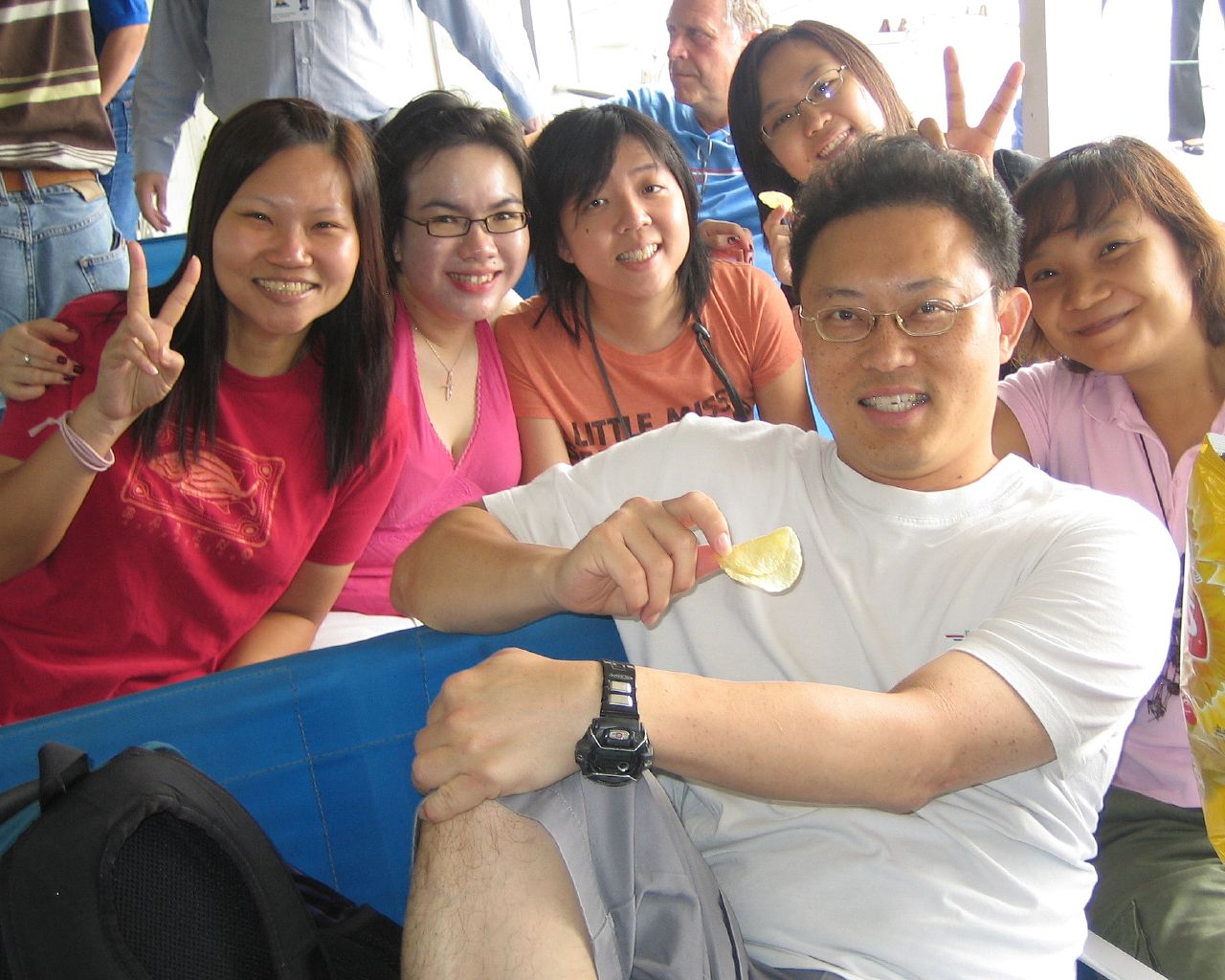 Casting off and casting care and concern aside, D. NY EL went on retreat to the Pulai Resort, Desaru. Josh, Baggy and I brought accompanying spouses, Boss Lady brought her 2 not-so-little gremlins.
 Welcome to Desaru! This is about as exciting as it gets here. No modern conveniences of a shopping mall anywhere, but enough beach, swimming pool, and plenty of food for a relaxing get-away-from-it-all. It's a place to come to when looking for a slower pace of life, and to luxuriate in the otherwise guilty pleasures of torpor and indolence. The food quality isn't great, in fact it seemed to deteriorate gradually while we were there, but there's enough palatable selections on the buffet table at every meal to keep us going.
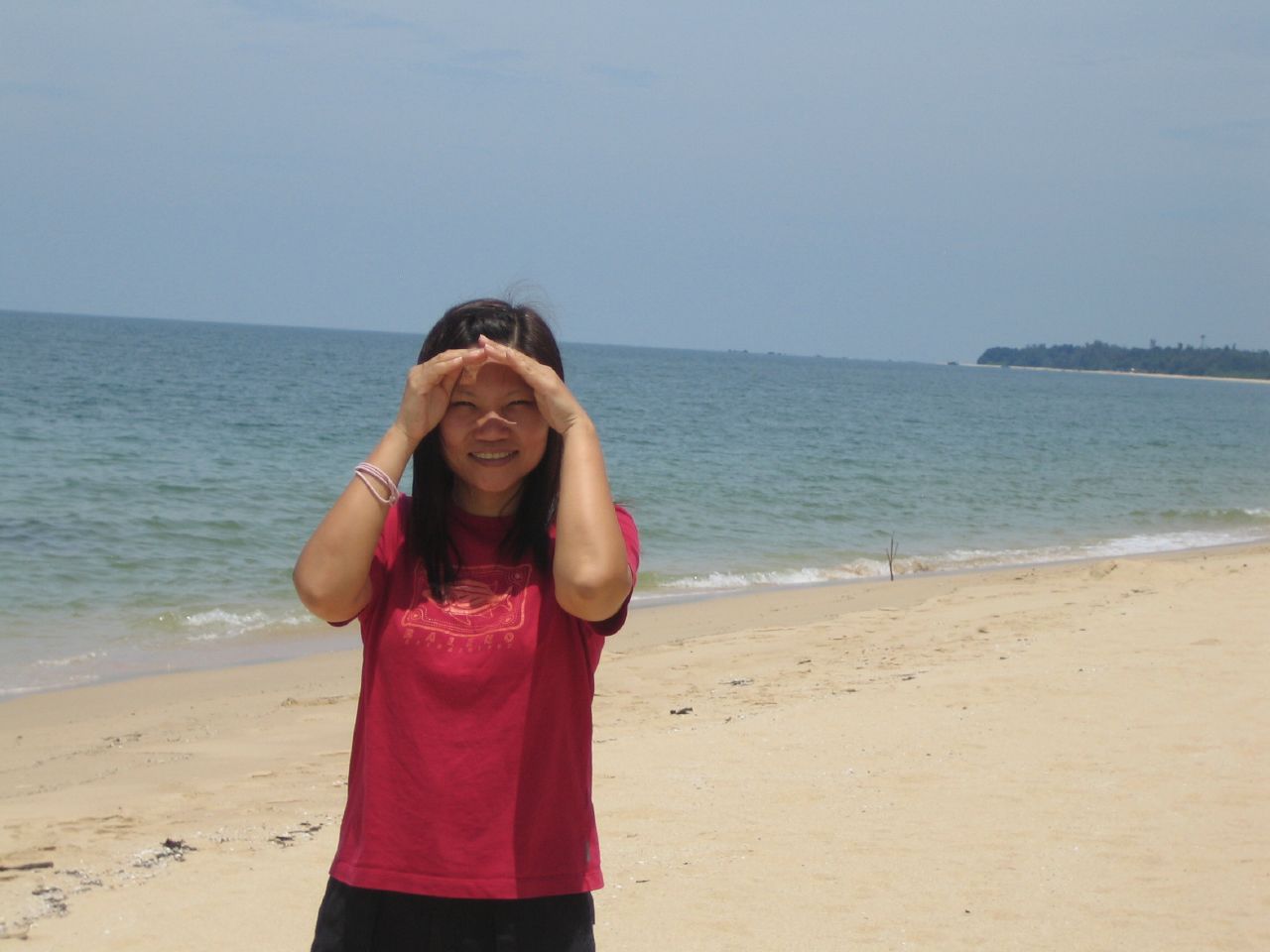 This here's the beach. We had dry, sunny weather throughout our stay. The beach is white and sandy, with lots of washed up seashells and shell fragments. June gathered a small collection of the best looking ones. The beach is mostly free of human debris, and while we were there, quite free of human beings as well. Nice.
 This is a local individual who is suffering from a severe identity crisis. It and its friends were responsible for what I initially took to be bicycle tyre tracks all over the beach. We only saw this one though. How it got hold of a land snail shell to inhabit is probably an epic story worthy of a Peter Jackson retelling. I simply don't have that kind of imagination.
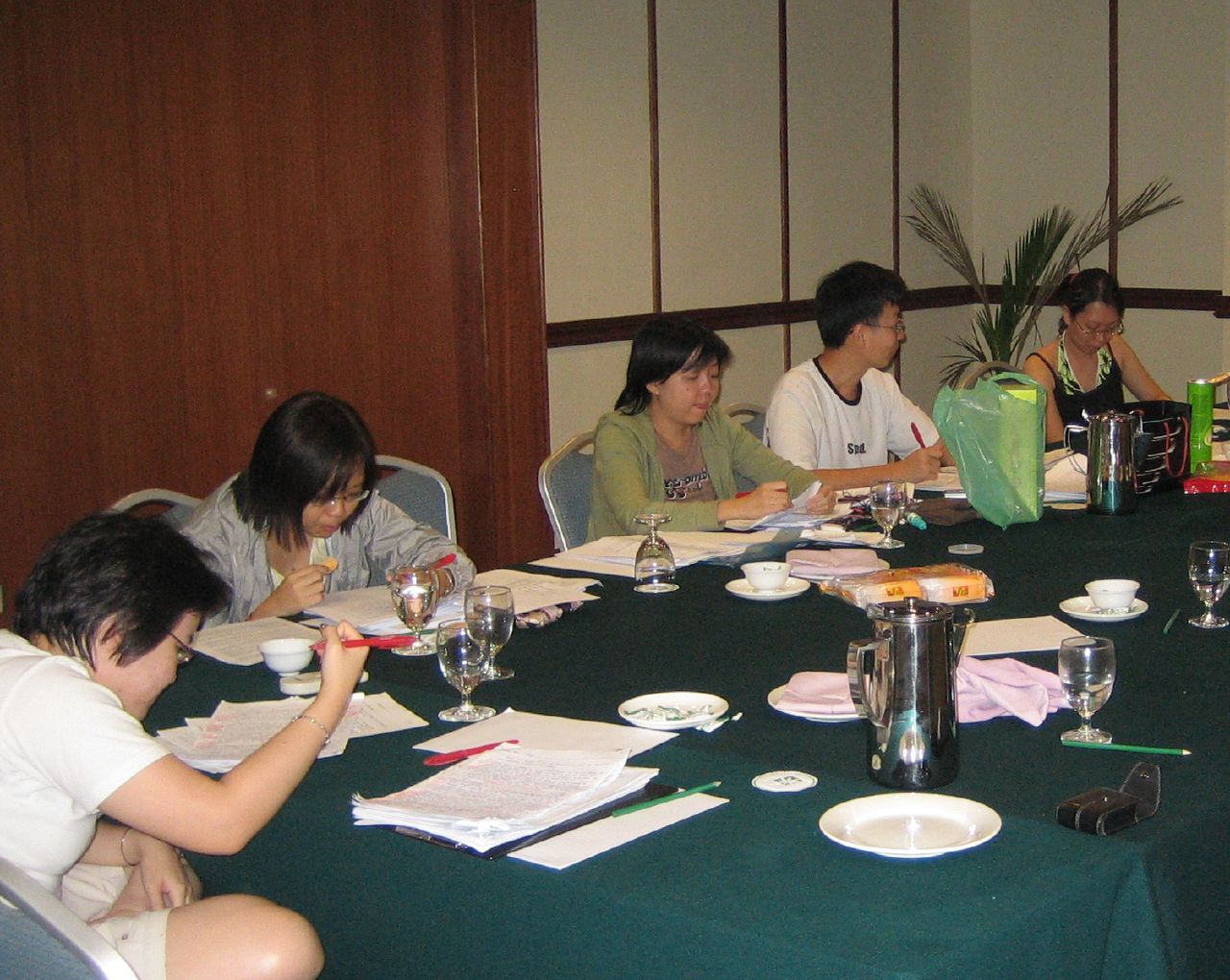 It wasn't all play and no work, though. Here we take a little break from our daily inactivity to get something useful done. Yes, the never-ending marking of the academic profession goes on vacation with us.
 Probably the highlight of our retreat was our night cruise down the river on a vessel that reminded me somewhat of the African Queen in search of
 Fireflies we found, but, as Mel said, what was even more fascinating were the stars overhead. They stood out for us city folk like never before, here so far from the glare of urban civilization. The stars have never been so bright, nor as numerous, and I saw a couple of constellations I roughly know the shape of, but could never before see in our own night sky.
1 weekend left to chill, then it's back to reality again...
Tuesday, September 04, 2007
"Why doesn't anarchy work?", I asked Wayne and Linc just yesterday. Apparently, it's because we are ultimately beings that function best when organized around one or more common goals, or something like that. Today, I am getting an object lesson on anarchy, as defined by rampant industrialized capitalism fueling unfettered scientific research and development devoid of any moral considerations whatsoever in an environment of complete freedom of expression and no censorship. Welcome to the undersea utopia of Rapture, the setting for Bioshock, the latest FPS to hit the console and PC market.
In Rapture, anarchy, which begins as a visionary Industrialist's dream, quickly degenerates into violence and hell-under-the-ocean-depths. Scientific research here finds a way to genetically enhance the good citizens of Rapture, and soon everyone wants to biologically command electric bolts from their fingertips to fry their irritating neighbours with. Before long, the genetic enhancement process drives everyone nuts, then it becomes open warfare, survive or die. There, another example of how our human nature simply cannot be left alone to manage things on our own.
Fortunately for the player's character, R&D also results in some awesome weapons and ammo the player can find lying around or pry from cold, dead fingers. The player also may seek genetic enhancements, boosting fight or puzzle-solving prowess to superhuman levels, a great asset to have in this game.
How far have I progressed into Rapture? I'm just a couple of scenes past the intro, admiring the detail in the underwater environment, the play between light and dark areas, and the ferocity of the AI enemies.
But sadly, I haven't progressed much further. The game crashes often on Mr L33t whose components are just past a year old as of today. Looks like I'll be in the market for another gig's worth of memory, a faster video card (my current 7600 just can't make it anymore), and perhaps a good sound card to complete the ensemble.
But again, no hurry. The D. NY EL retreat begins tomorrow morning. We're going to be leaving civilization for a few days to enjoy some Resort living. No technology... ttfn!
In Rapture, anarchy, which begins as a visionary Industrialist's dream, quickly degenerates into violence and hell-under-the-ocean-depths. Scientific research here finds a way to genetically enhance the good citizens of Rapture, and soon everyone wants to biologically command electric bolts from their fingertips to fry their irritating neighbours with. Before long, the genetic enhancement process drives everyone nuts, then it becomes open warfare, survive or die. There, another example of how our human nature simply cannot be left alone to manage things on our own.
Fortunately for the player's character, R&D also results in some awesome weapons and ammo the player can find lying around or pry from cold, dead fingers. The player also may seek genetic enhancements, boosting fight or puzzle-solving prowess to superhuman levels, a great asset to have in this game.
How far have I progressed into Rapture? I'm just a couple of scenes past the intro, admiring the detail in the underwater environment, the play between light and dark areas, and the ferocity of the AI enemies.
But sadly, I haven't progressed much further. The game crashes often on Mr L33t whose components are just past a year old as of today. Looks like I'll be in the market for another gig's worth of memory, a faster video card (my current 7600 just can't make it anymore), and perhaps a good sound card to complete the ensemble.
But again, no hurry. The D. NY EL retreat begins tomorrow morning. We're going to be leaving civilization for a few days to enjoy some Resort living. No technology... ttfn!
Monday, September 03, 2007
Officially, we're having a week off, but most of us staff still found our way back to campus for one reason or another. Consultations, backlog admin, the consolation is that we're assured of lunch company.
Anyway, it's a bit late but I've finally got our new NYconneX print edition #6 uploaded. Glad to say that the editorial team did most of the layouts themselves, though they're still rough around the edges.
Thanks to the sponsorship of Jane's committee, we could afford a little better quality paper for this run. We opted for 80 gsm photocopy paper which made the colour pix stand out beautifully compared to our usual newsprint. Now Wan's asking for a reprint of another 1k copies for use as publicity material at our upcoming Open House.
Good job, my Editorial Crew!
Anyway, it's a bit late but I've finally got our new NYconneX print edition #6 uploaded. Glad to say that the editorial team did most of the layouts themselves, though they're still rough around the edges.
Thanks to the sponsorship of Jane's committee, we could afford a little better quality paper for this run. We opted for 80 gsm photocopy paper which made the colour pix stand out beautifully compared to our usual newsprint. Now Wan's asking for a reprint of another 1k copies for use as publicity material at our upcoming Open House.
Good job, my Editorial Crew!
Sunday, September 02, 2007
Here's a great study tip: eating makes mugging more effective. Ain't that great to know? Click here.
Saturday, September 01, 2007
Pixar's "Ratatouille" is such a charming tale. Set in la belle Paris, how could it go wrong? It's about good food and messing about in the kitchen, a la the plethora of audience-friendly cable cooking shows, the likes of Oliver, Bourdain, and the travelogues of Samantha Brown. If that isn't a license to print money, I don't know what is.
Oh, and Chef Remy is a rat. Not the Cagney "you dirty... rat" type, but the actual makes [Victorian] women jump on chairs and scream rattus rattus variety. While his genius becomes so well-loved by the top food critics in Paris, his genus is widely despised, reviled and persecuted by nearly every human being who catches sight of him.
So, basically he's a mutant rat with some very special abilities. His uncomfortable friendship and partnership with the new garbage boy, Linguini, revives the name of the once-famous 5-star rated "Gusteau's" -- and brings it back into the attention of the much-feared food critic, Anton Ego, whose scathing review of many years ago had brought the restaurant's name down in the first place.
In the complicated relationship between rat and garbage boy, success lies somewhere between their strength of self-belief and identifying their personal talents which work well together in times of crisis. Like foreign talent, both are viewed with disdain, suspicion, jealousy and hate. Head Chef Skinner -- who has his own plans for Gusteau's -- particularly fears the new staff member, concerned that he will eventually be eclipsed and replaced (sound familiar?), and is unable to switch from his tried-and-tested ways to accept the newcomers' unorthodox but effective new practices.
Both facing the prejudice of their colleagues, and creating a dish to satisfy their culinary nemesis, Monseur Ego, require their ingenuity, creativity, talent and a touch of audacity, and is indeed a sight to behold, particularly as Gusteau's kitchen has to resolve a dramatic personnel meltdown in order to do so. Too bad for the locals, then, who cannot see the reality that in these days of unprecedented talent mobility, "Anyone Can Cook", and the next great thing may not necessarily be home-grown. It's going to take an attitude shift like chef Collette's, who adapts quickly to the unfolding circumstances and adds her local talent to create the new gastronomic haven that emerges.
Is the movie funny? 'Funny' has to do with the juxtaposition of opposites, in unlikely situations, causing unexpected results. Rat. Boy. Gourmet kitchen. Pressure-cooker kitchen environment. Paris. Lots of dichotomies too, as Remy and Linguini have to wear more than one hat each as they learn to adapt to their new home. Yup, the mix looks to be just right. Let it simmer to boil, serve warm. Good stuff.
Whatever. Linguini may live in a rathole, but at least it's a rathole in Paris.
Oh, and Chef Remy is a rat. Not the Cagney "you dirty... rat" type, but the actual makes [Victorian] women jump on chairs and scream rattus rattus variety. While his genius becomes so well-loved by the top food critics in Paris, his genus is widely despised, reviled and persecuted by nearly every human being who catches sight of him.
So, basically he's a mutant rat with some very special abilities. His uncomfortable friendship and partnership with the new garbage boy, Linguini, revives the name of the once-famous 5-star rated "Gusteau's" -- and brings it back into the attention of the much-feared food critic, Anton Ego, whose scathing review of many years ago had brought the restaurant's name down in the first place.
In the complicated relationship between rat and garbage boy, success lies somewhere between their strength of self-belief and identifying their personal talents which work well together in times of crisis. Like foreign talent, both are viewed with disdain, suspicion, jealousy and hate. Head Chef Skinner -- who has his own plans for Gusteau's -- particularly fears the new staff member, concerned that he will eventually be eclipsed and replaced (sound familiar?), and is unable to switch from his tried-and-tested ways to accept the newcomers' unorthodox but effective new practices.
Both facing the prejudice of their colleagues, and creating a dish to satisfy their culinary nemesis, Monseur Ego, require their ingenuity, creativity, talent and a touch of audacity, and is indeed a sight to behold, particularly as Gusteau's kitchen has to resolve a dramatic personnel meltdown in order to do so. Too bad for the locals, then, who cannot see the reality that in these days of unprecedented talent mobility, "Anyone Can Cook", and the next great thing may not necessarily be home-grown. It's going to take an attitude shift like chef Collette's, who adapts quickly to the unfolding circumstances and adds her local talent to create the new gastronomic haven that emerges.
Is the movie funny? 'Funny' has to do with the juxtaposition of opposites, in unlikely situations, causing unexpected results. Rat. Boy. Gourmet kitchen. Pressure-cooker kitchen environment. Paris. Lots of dichotomies too, as Remy and Linguini have to wear more than one hat each as they learn to adapt to their new home. Yup, the mix looks to be just right. Let it simmer to boil, serve warm. Good stuff.
Whatever. Linguini may live in a rathole, but at least it's a rathole in Paris.
Friday, August 31, 2007
 My true talents have finally been recognized, if only by Taily and Que! Now I have another shiny thing to add to my collection that's sitting on the top of my cubicle's partition, thanks you two!
Thanks also for the other Teachers' Day gifts and notes of appreciation and encouragement from everyone else.
There was a novel party on campus to celebrate the occasion. There was food and open-air entertainment. P personally handed out ice-cream to the staff, Dee had a counter selling pretty little cupcakes for a good cause, and Lena brought her maltese, Hercules, whose well-groomed coat bravely bore the brunt of many hands seeking pet therapy.
Don't know how Council managed it but during the penultimate act at the open-air concert, the beautiful blue sky grew ominously dark and a light drizzle started, prompting a mad scramble for shelter and an abrupt close to the festivities. Perhaps we could hire out that last act to drought-stricken countries?
Great lunch at the White Dog with a larger group of company than usual. Vays, Linc & I were GoH to mark the completion of yet another solar orbit. Thanks everyone!
Wednesday, August 29, 2007
We had 2 speakers discuss talent and population challenges for S'pore at this afternoon's industry-organized seminar. 1st guy was from a private sector consultancy, a Permanent Resident himself, focusing on the competition for talent around the world and looking at some of the factors that attract talented people to make a decision as to where they want to stay.
From his company's studies, financial reward comes last out of 4 criteria. The most important factor is something so subjective that it's difficult to quantify: talented people want, above all, a challenging experience, and a "buzz" in their work culture and environment.
Call me parochial, but I couldn't help thinking about my own employment situation, wondering if the "buzz" I'm getting now on the job will be enough to keep me going, and for how much longer. In the workplace right now, there are staff who've been here since like forever, so there's no doubt there is some kind of "buzz" going on. In a recent email, a friend of mine from waaaay back, listed a number of our old teachers from our sec school days who are still teaching there, and I'm like, wow... If I can already consider myself a wizened, shriveled, prune of a sage, these old mentors and tormentors of mine must have become hardened into diamond by now after so many years on the job. Would I ever last that long? Do I even want to?
What's the "buzz", anyway? It obviously has something to do with the challenging nature of the work, which should be stimulating in process and somehow results in benefits for others -- which makes the job worthwhile. Solving problems for people can be quite an ego boost, sometimes worth even more than the financial compensation for the work done.
But the "buzz" is also a social thing, in that there must be other co-workers who inspire, support and socialize informally with each other; sharing time, food, caffeine (or similar biochemical stimulants), gossip and jokes apart from the work-load. The "buzz" is excitement in the things we do together, whether it's duty-hours serious business, or off-duty fun and play. People respond positively to busy-ness within an atmosphere of "buzzy"-ness.
This year, I've had to get used to things being a little less buzzy, and I kinda' miss the Boyz still. CCA-wise I feel isolated and cast adrift since I've got no partner to bounce ideas off, or to spur me to do more than just tread water, or even help me get my admin straight. But I am appreciative of my current company, and the effort we make to still have meals together, at least. Today's pasta lunch before the seminar, the few movies we've sat through, and the upcoming D. NY EL Retreat, for example, show we still know how to create a buzz for ourselves. Even without the Boyz who, I'm beginning to be convinced these days, were a bit of an anomaly.
Guess I'll be sticking around a while more...
From his company's studies, financial reward comes last out of 4 criteria. The most important factor is something so subjective that it's difficult to quantify: talented people want, above all, a challenging experience, and a "buzz" in their work culture and environment.
Call me parochial, but I couldn't help thinking about my own employment situation, wondering if the "buzz" I'm getting now on the job will be enough to keep me going, and for how much longer. In the workplace right now, there are staff who've been here since like forever, so there's no doubt there is some kind of "buzz" going on. In a recent email, a friend of mine from waaaay back, listed a number of our old teachers from our sec school days who are still teaching there, and I'm like, wow... If I can already consider myself a wizened, shriveled, prune of a sage, these old mentors and tormentors of mine must have become hardened into diamond by now after so many years on the job. Would I ever last that long? Do I even want to?
What's the "buzz", anyway? It obviously has something to do with the challenging nature of the work, which should be stimulating in process and somehow results in benefits for others -- which makes the job worthwhile. Solving problems for people can be quite an ego boost, sometimes worth even more than the financial compensation for the work done.
But the "buzz" is also a social thing, in that there must be other co-workers who inspire, support and socialize informally with each other; sharing time, food, caffeine (or similar biochemical stimulants), gossip and jokes apart from the work-load. The "buzz" is excitement in the things we do together, whether it's duty-hours serious business, or off-duty fun and play. People respond positively to busy-ness within an atmosphere of "buzzy"-ness.
This year, I've had to get used to things being a little less buzzy, and I kinda' miss the Boyz still. CCA-wise I feel isolated and cast adrift since I've got no partner to bounce ideas off, or to spur me to do more than just tread water, or even help me get my admin straight. But I am appreciative of my current company, and the effort we make to still have meals together, at least. Today's pasta lunch before the seminar, the few movies we've sat through, and the upcoming D. NY EL Retreat, for example, show we still know how to create a buzz for ourselves. Even without the Boyz who, I'm beginning to be convinced these days, were a bit of an anomaly.
Guess I'll be sticking around a while more...
After an intense weekend of news editing and laying out, compre marking and the last couple of days of non-stop seeing of individual and small groups of students every hour on the hour with only a short lunch break in between, by this evening I was feeling like I'd been taking meds without actually having taken any.
The year 2 students are on study break, meaning no more formal timetable, but they arrange personal consultations with their subject tutors on a loose per-hour basis, first come, first served. Around this period in previous years, I don't remember ever being so popular. It's probably the nature of this batch, more of whom seem genuinely concerned about doing better about their grades than the earlier batches.
A couple of things I've been repeating today: Despite essay and compre papers looking like pen-and-paper exercises, if we treat them simply as intellectual exercises, we tend to be more interested in what we want to say about the issue rather than address the specific concerns of the person asking the question. We seek our own agenda among the questions offered and pick the one with the closest match, but fail to pay attention to what we are actually being asked. Hence we often miss out on the specific nuances that our chosen question requires us to address. That, in human terms, is just rude.
Instead, a good essayist listens to the questions like there was a real person asking them. Respect the inquirer, seek to understand the situation from the inquirer's perspective, address the inquirer's concerns, and reassure the inquirer that things are not so bad. Even if the essayist has no solutions to the problem, the essayist should at least know of which agencies are taking steps to solve the problem, and make referrals accordingly.
For GP students concerned about formalities like keyword definition, thesis statement construction, and the biggest bugbear, argument "balancing", perhaps the famous Prayer of St Francis might offer some insight and wisdom.
The year 2 students are on study break, meaning no more formal timetable, but they arrange personal consultations with their subject tutors on a loose per-hour basis, first come, first served. Around this period in previous years, I don't remember ever being so popular. It's probably the nature of this batch, more of whom seem genuinely concerned about doing better about their grades than the earlier batches.
A couple of things I've been repeating today: Despite essay and compre papers looking like pen-and-paper exercises, if we treat them simply as intellectual exercises, we tend to be more interested in what we want to say about the issue rather than address the specific concerns of the person asking the question. We seek our own agenda among the questions offered and pick the one with the closest match, but fail to pay attention to what we are actually being asked. Hence we often miss out on the specific nuances that our chosen question requires us to address. That, in human terms, is just rude.
Instead, a good essayist listens to the questions like there was a real person asking them. Respect the inquirer, seek to understand the situation from the inquirer's perspective, address the inquirer's concerns, and reassure the inquirer that things are not so bad. Even if the essayist has no solutions to the problem, the essayist should at least know of which agencies are taking steps to solve the problem, and make referrals accordingly.
For GP students concerned about formalities like keyword definition, thesis statement construction, and the biggest bugbear, argument "balancing", perhaps the famous Prayer of St Francis might offer some insight and wisdom.
Sunday, August 26, 2007
With all our concerns about climate change and pollution and hyper-consumerism all being linked to our mania for urbanization, maybe it IS time to let the Taleban and Al-Qaeda take over the reigns of the world. They pursue the perfect save-the-earth policy, after all. It's called "Turbanization".
Well, what did you expect? I've just finished laying out our latest print NYconneX, and am now facing about 30 essays to mark by tonight. I'm really not supposed to be blogging now...
Well, what did you expect? I've just finished laying out our latest print NYconneX, and am now facing about 30 essays to mark by tonight. I'm really not supposed to be blogging now...
Friday, August 24, 2007
I am upset with taily for being clairvoyant. Not a couple of months after suggesting I might smash my new Samsung cellphone, I have indeed accomplished the (then) unthinkable. There's now a thumb-shaped depression over a nasty crack on my poor phone's faceplate and the screen has gone blank apart from a few pretty coloured streaks of LDC material radiating from the epicenter of Ground Zero.
There are a couple of possibilities as to how the damage could have occurred. One: I'm a ham-fisted oaf who doesn't know his own strength, and pressed my thumb too hard on the faceplate as I was sliding the phone open (likely). Two: This damage is to be expected when a 40+ year-old crams his phone with his hard-plastic protected staff-pass in the pocket of his too-tight jeans, and the immense pressures that build up upon sitting his fat ass down proved too much for the delicate Korean-made product to withstand (I don't even want to consider this one).
Anyone know where I can take the casualty to get some A&E treatment?
There are a couple of possibilities as to how the damage could have occurred. One: I'm a ham-fisted oaf who doesn't know his own strength, and pressed my thumb too hard on the faceplate as I was sliding the phone open (likely). Two: This damage is to be expected when a 40+ year-old crams his phone with his hard-plastic protected staff-pass in the pocket of his too-tight jeans, and the immense pressures that build up upon sitting his fat ass down proved too much for the delicate Korean-made product to withstand (I don't even want to consider this one).
Anyone know where I can take the casualty to get some A&E treatment?
Tuesday, August 21, 2007
Elite instiutions take pride in the high rate of candidates "washing out" of their courses such that only a small handful of deserving students can claim the honour and bragging rights of having survived a most gruelling, challenging experience. Those that graduate from the course know they are the best in their field, that they passed the highly stringent quality control measures, and their qualification actually means something to society.
Somewhere along the line, the Junior College has lost this prestige as an elite institution. A JC is, after all, not an institution of basic education, and being educated in a JC is therefore not an entitlement, as much as our students seem to think it is (and news of there being yet a 4th Uni could well increase the sense of entitilement our future students will have).
Under Article 26 of the UN Declaration of Human Rights, while "Elementary education shall be compulsory.... higher education shall be equally accessible to all on the basis of merit" (emphasis mine). Kids, you either work to prove your worthiness to be educated at H1/H2 level, or the education you have already received already ensures that you won't starve if you decide that you are wasting your time with us.
These days, though, we are so afraid to allow our students to fail. We pride ourselves in the number of our students who pass, and we bend over backwards just to get even the least deserving to make the grade. Not that we do anything illegal or underhand to give our students a passing grade, but we take it personally, when the kids underperform, and feel that we haven't been doing our jobs properly.
But our job is also to maintain standards and quality as gatekeepers of qualified personnel who will seek responsible positions in society in the near future. We canot afford to let loose into society sub-standard, yet paper-qualified graduates, or that really would be a violation of our civil trust. Yet we feel guilty for letting down our students if they eventually fail.
Perhaps it's us that are perpetuating the fear of failure that's a symptom of our unwillingness to try new paths, take risks and experiment to make new discoveries. It's us that perpetuate the myth that there is only one way in life and that failure at this stage is the end of the world for our kids.
The kids don't realize how much in the minority they are out of their cohort that took the 'O's with them. Our kids are elite seeking elite education. We need to constantly remind them of the reaity that not all of them are going to make it. Only the brightest and the best will, while the rest, well, they can always go back to living ordinary lives with the rest of their compatriots.
This is a proving ground, not a playground. Sure, everyone who enters has the potential to make it given their prior qualification, but it takes further effort, further endurance, further determination to overcome setback after setback, and if that is too much for them, then I'm sorry, they don't have what it takes. As their instructors, we have a responsibility to help the deserving, but we also need the courage -- and these days, reassure ourselves that we have the authority -- to allow those who deserve to fail fail.
Welcome to the Junior College. Appreciate the privilege of being here. We hope you survive the experience.
Somewhere along the line, the Junior College has lost this prestige as an elite institution. A JC is, after all, not an institution of basic education, and being educated in a JC is therefore not an entitlement, as much as our students seem to think it is (and news of there being yet a 4th Uni could well increase the sense of entitilement our future students will have).
Under Article 26 of the UN Declaration of Human Rights, while "Elementary education shall be compulsory.... higher education shall be equally accessible to all on the basis of merit" (emphasis mine). Kids, you either work to prove your worthiness to be educated at H1/H2 level, or the education you have already received already ensures that you won't starve if you decide that you are wasting your time with us.
These days, though, we are so afraid to allow our students to fail. We pride ourselves in the number of our students who pass, and we bend over backwards just to get even the least deserving to make the grade. Not that we do anything illegal or underhand to give our students a passing grade, but we take it personally, when the kids underperform, and feel that we haven't been doing our jobs properly.
But our job is also to maintain standards and quality as gatekeepers of qualified personnel who will seek responsible positions in society in the near future. We canot afford to let loose into society sub-standard, yet paper-qualified graduates, or that really would be a violation of our civil trust. Yet we feel guilty for letting down our students if they eventually fail.
Perhaps it's us that are perpetuating the fear of failure that's a symptom of our unwillingness to try new paths, take risks and experiment to make new discoveries. It's us that perpetuate the myth that there is only one way in life and that failure at this stage is the end of the world for our kids.
The kids don't realize how much in the minority they are out of their cohort that took the 'O's with them. Our kids are elite seeking elite education. We need to constantly remind them of the reaity that not all of them are going to make it. Only the brightest and the best will, while the rest, well, they can always go back to living ordinary lives with the rest of their compatriots.
This is a proving ground, not a playground. Sure, everyone who enters has the potential to make it given their prior qualification, but it takes further effort, further endurance, further determination to overcome setback after setback, and if that is too much for them, then I'm sorry, they don't have what it takes. As their instructors, we have a responsibility to help the deserving, but we also need the courage -- and these days, reassure ourselves that we have the authority -- to allow those who deserve to fail fail.
Welcome to the Junior College. Appreciate the privilege of being here. We hope you survive the experience.
Monday, August 20, 2007
US kids cite very simple things that make them happy, according to an AP-MTV survey on youth happiness. Having strong relationships with others: family, friends and significant others -- in that order -- give them the security they need to be happy. Other indicators of youth happiness have to do with having a sense of belonging with some form of religious organization, and close parental bonding. Surprisingly, kids are also happier attending school (I suppose than not). Concerns for material well-being seem to have more to do with concerns over income disparity across the ethnic divide rather than with personal concerns.
Could it be that our kids aren't the selfish, angst-ridden, ungrateful little brats that we take them to be after all? Could it be also that despite the world having changed so much in the last couple of generations in terms of personal access to wealth and technology, our fundamental happy-factors haven't changed at all? What makes these kids happy are pretty much what would have made our ancestors happy, according to the results of this survey.
If these survey results are to be believed, then I wonder if the developments the PM promised us in his Nat Day Rally speech are going to be enough to make S'poreans a happier lot in the long-run. We can look forward to a whole slew of initiatives that will take care of our material concerns, some necessarily pragmatic (like tweaking our CPF in consideration of our longer life-expectancies) to the extravagant (beach resort HDB dwelling, anyone?), but if we don't do something about building better relations with our fellow S'poreans and FTs, our beautiful house will still not yet be a home.
But that, of course, is only what the govt can realistically promise -- better infrastructure, better living conditions. There's nothing wrong with having a nicer house, I guess, but it depends on ourselves as residents to make life pleasant for everyone, family members, guests and even our neighbours as well. Whatever the govt is promising, being happy is ultimately a do-it-yourself endeavour. Shall we roll up our sleeves and start work on it?
Could it be that our kids aren't the selfish, angst-ridden, ungrateful little brats that we take them to be after all? Could it be also that despite the world having changed so much in the last couple of generations in terms of personal access to wealth and technology, our fundamental happy-factors haven't changed at all? What makes these kids happy are pretty much what would have made our ancestors happy, according to the results of this survey.
If these survey results are to be believed, then I wonder if the developments the PM promised us in his Nat Day Rally speech are going to be enough to make S'poreans a happier lot in the long-run. We can look forward to a whole slew of initiatives that will take care of our material concerns, some necessarily pragmatic (like tweaking our CPF in consideration of our longer life-expectancies) to the extravagant (beach resort HDB dwelling, anyone?), but if we don't do something about building better relations with our fellow S'poreans and FTs, our beautiful house will still not yet be a home.
But that, of course, is only what the govt can realistically promise -- better infrastructure, better living conditions. There's nothing wrong with having a nicer house, I guess, but it depends on ourselves as residents to make life pleasant for everyone, family members, guests and even our neighbours as well. Whatever the govt is promising, being happy is ultimately a do-it-yourself endeavour. Shall we roll up our sleeves and start work on it?
Subscribe to:
Posts (Atom)